
Trusted and leading provider of sustainable waste management solutions from 20 years. (786) 655-7070
Delray Beach restaurants need a licensed grease hauler that provides Palm Beach County FOG-compliant collection, volume-responsive scheduling for Atlantic Avenue’s seasonal tourism surges, and signed manifests that satisfy both county utility inspections and Florida DOH food safety requirements.
GreasePros Recycling LLC, a licensed Florida used cooking oil hauler with over 20 years of operation, provides free, lockable, hurricane-rated containers, scheduled pickups, and 24/7 emergency service for restaurants, hotels, and institutional kitchens across Delray Beach and Palm Beach County.
Your Delray Beach kitchen is one missed pickup away from an overflow, a fine, or a failed inspection — schedule a free container delivery with GreasePros Recycling today.
GreasePros Recycling provides complete used cooking oil collection, grease trap support, professional hood cleaning, and 24/7 emergency retrieval for restaurants, hotels, schools, hospitals, and food trucks across Delray Beach and Palm Beach County.
The company delivers free lockable containers in 55-gallon, 140-gallon, and 240-gallon sizes and schedules weekly, bi-weekly, or monthly pickups matched to each kitchen’s oil output.
Delray Beach’s food service landscape spans upscale dining on Atlantic Avenue, casual cafés in the Pineapple Grove Arts District, beachfront hotel kitchens, corporate dining facilities, and school and hospital cafeterias across the western communities.
GreasePros Recycling tailors container sizing and pickup frequency to each operation type, and the company’s South Florida headquarters at 2321 SW 57th Terr., West Park, FL 33023 provides local dispatch that reaches any Delray Beach address with 2-to-4-hour emergency response times.
GreasePros Recycling now serves all Florida cities — providing statewide compliance documentation, centralized billing for multi-location operators, and consistent service standards from Delray Beach through Boca Raton, West Palm Beach, Fort Lauderdale, and Orlando.
The company’s full licensing and credentials are maintained across every service territory.
If you’re ready to get started, call us now!
The Palm Beach County Water Utilities Department (PBCWUD) manages the Pretreatment Program that governs FOG discharge from commercial food service establishments in Delray Beach.
Every restaurant, hotel kitchen, cafeteria, and food truck operating on the county sewer system must install an approved grease interceptor sized according to the Florida Building Code Plumbing volume and maintain that interceptor under the 25% capacity rule — pumping before combined grease and solids reach 25% of the trap’s liquid depth.
PBCWUD conducts inspections on a six-month cycle for food service establishments in its service territory. Inspectors verify the interceptor’s condition, review pump-out frequency records, and confirm that the establishment uses a licensed hauler that produces signed service manifests.
Palm Beach County requires triplicate manifests for each pump-out documenting the generator name, hauler identification, disposal destination, and gallons removed. Establishments must keep manifests on-site for at least 1 year and produce them during inspections.
Florida Statute § 403.0741 governs statewide hauler licensing and requires signed service manifests for every grease waste collection and transport event.
The Florida Department of Health inspects Delray Beach food establishments under Section 381.0072 of the Florida Statutes, and county health inspectors may review grease trap maintenance records as part of routine food safety inspections.
GreasePros Recycling generates triplicate manifests that satisfy both the PBCWUD inspection framework and the DOH food safety standard, so Delray Beach operators maintain a single compliance file covering both regulatory layers.
Stop worrying about your next Palm Beach County inspection — call GreasePros Recycling at (786) 655-7070 for manifests and documentation that keep your Delray Beach kitchen inspection-ready.
Pickup frequency in Delray Beach depends on kitchen type, daily cover count, and the seasonal volume shifts driven by the city’s nationally recognized dining scene, beach tourism, and special events along Atlantic Avenue.
| Delray Beach Operation Type | Estimated Weekly UCO Volume | Recommended Container | Pickup Frequency |
| Boutique café or bakery (Pineapple Grove, NE 2nd Ave.) | 15–35 gallons | 55-gallon drum | Monthly |
| Mid-volume restaurant (Atlantic Avenue, downtown) | 40–80 gallons | 140-gallon container | Bi-weekly |
| High-volume waterfront or upscale dining | 60–120 gallons | 240-gallon container | Weekly |
| Hotel or resort kitchen (A1A corridor, beach properties) | 80–200 gallons | 240-gallon container | Weekly or surge-responsive |
| School or hospital cafeteria (western Delray, Palm Beach County) | 40–80 gallons | 140-gallon container | Bi-weekly |
| Food truck or mobile vendor (events, farmers markets) | 10–25 gallons | 55-gallon drum | Monthly or event-based |
GreasePros Recycling adjusts Delray Beach pickup schedules to match the city’s seasonal demand cycle. Atlantic Avenue restaurants and A1A beachfront hotel kitchens experience occupancy surges between November and April that can double baseline production of used cooking oil.
A downtown restaurant averaging 60 gallons per week during September may produce 120 gallons during a February weekend when Delray Beach’s winter tourism peaks.
The company provides on-call surge pickup — one call to (786) 655-7070 adds an extra collection during a high-volume period with no contract adjustment required.
If you’re ready to get started, call us now!
Delray Beach’s downtown dining district along Atlantic Avenue draws visitors year-round but concentrates its heaviest kitchen output during the November-through-April winter tourism season and during special events like the Delray Beach Wine and Seafood Festival, the Delray Affair, and the Pineapple Grove Art Walk.
That seasonal concentration creates a grease management profile that fixed monthly schedules cannot absorb.
Atlantic Avenue restaurants operate at 40–60% capacity during summer months and 90–100% capacity during peak winter season. A restaurant running four fryers at full output in February produces roughly twice as much used cooking oil as in August.
Hotels along the A1A corridor experience the same pattern — occupancy drives room service, poolside dining, and banquet kitchen output simultaneously, compounding the volume spike across multiple outlets under a single roof.
Delray Beach’s downtown dining district operates late into the evening, with many Atlantic Avenue restaurants serving until 11 PM or midnight during peak season.
GreasePros Recycling provides discreet off-hours collection after the last service — typically between 2 AM and 6 AM — so grease trucks never share the sidewalk with diners or compete with food delivery vehicles during service hours.
The company coordinates container placement behind dumpster enclosures and inside screened service areas to keep grease infrastructure invisible in Delray Beach’s pedestrian-friendly downtown corridor.
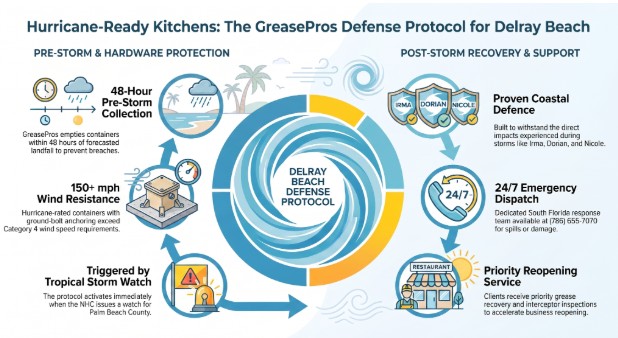
Florida’s hurricane season runs from June 1 through November 30, and Delray Beach’s coastal location on the Palm Beach County barrier island places the city in the direct path of Atlantic storms.
NOAA’s May 2026 outlook projects a 55% chance of a below-normal season, but Palm Beach County has experienced direct hurricane impacts from storms including Irma (2017), Dorian (2019), and Nicole (2022).
GreasePros Recycling activates a 48-hour pre-storm collection protocol for Delray Beach clients when the National Hurricane Center issues a tropical storm watch for Palm Beach County. The protocol includes the following protections:
Protect your Delray Beach kitchen from the next storm and the next inspection — call GreasePros Recycling at (786) 655-7070 to schedule your free container delivery and lock in hurricane-ready service.
What grease collection services does GreasePros Recycling provide in Delray Beach?
GreasePros Recycling provides free locked containers, scheduled used cooking oil pickup, emergency retrieval, hood cleaning, and commercial drain maintenance for restaurants, hotels, schools, hospitals, and food trucks across Delray Beach and Palm Beach County.
What FOG regulations apply to Delray Beach restaurants under Palm Beach County code?
Palm Beach County Water Utilities Department manages the Pretreatment Program, requiring every food service establishment to install and maintain an approved grease interceptor under the 25% capacity rule. PBCWUD conducts inspections on a six-month cycle and requires triplicate manifests on-site.
How often should a Delray Beach restaurant schedule grease pickup?
Pickup frequency depends on kitchen type and seasonal volume. Boutique cafés typically need monthly collections, mid-volume Atlantic Avenue restaurants need biweekly service, and high-volume or hotel kitchens need weekly pickups with on-call surge capacity during the winter tourist season.
Does GreasePros Recycling provide discreet off-hours pickup for Atlantic Avenue restaurants?
GreasePros Recycling provides off-hours collection between 2 AM and 6 AM for Delray Beach restaurants operating in pedestrian-heavy dining districts. Container placement behind screened service areas keeps grease infrastructure invisible to guests and diners along Atlantic Avenue.
Does GreasePros Recycling provide hurricane-season service for Delray Beach restaurants?
GreasePros Recycling activates 48-hour pre-storm collection protocols when the National Hurricane Center issues a tropical storm watch for Palm Beach County. Hurricane-rated containers withstand 150+ mph winds, and post-storm priority service accelerates restaurant reopening.
What happens to the used cooking oil collected from Delray Beach kitchens?
Every gallon of used cooking oil collected from Delray Beach restaurants is transported to GreasePros Recycling’s processing facility and recycled into renewable biodiesel fuel, keeping FOG out of Palm Beach County’s sewer system and the Atlantic coastal waterways.
Founded with a vision to revolutionize the used cooking oil recycling industry, GreasePros Recycling has established itself as a trusted and leading provider of sustainable waste management solutions. With over 20 years of experience, our dedicated team brings extensive expertise and a commitment to environmental stewardship.
Quick Links
Contact Information
Get in Touch with GreasePros
