
Trusted and leading provider of sustainable waste management solutions from 20 years. (786) 655-7070
We've Expanded: Now Serving All of Florida!
Data last verified: September 2026
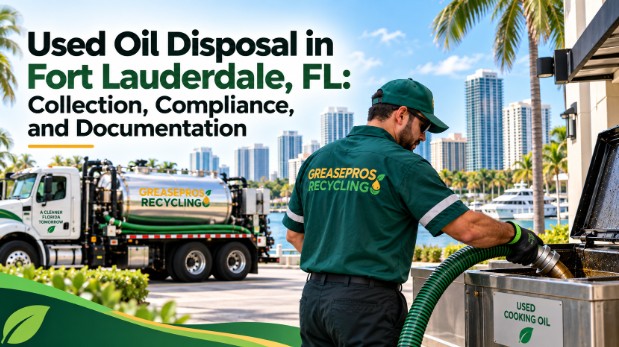
Used oil disposal in Fort Lauderdale means a collection service schedules the removal of spent fryer oil from a commercial kitchen and routes it to a processing facility, not a drain or dumpster.
Fryer oil sits outside both Florida regimes that operators usually assume cover it, which changes what paperwork a kitchen actually needs.
GreasePros Recycling provides scheduled used oil pickup across Fort Lauderdale under USDOT #4136566.
Fryer oil and interceptor waste follow different rules and different schedules — set up Fort Lauderdale service for both with GreasePros Recycling.

Two waste streams leave a Fort Lauderdale kitchen, and each falls under a different framework. Operators who treat them as one subject end up with the wrong expectations about paperwork.
Question | Used cooking oil (yellow grease) | Grease trap waste (brown grease) |
What it is | Spent fryer oil held in a dedicated collection container | Material retained inside a grease interceptor or trap |
Florida grease waste statute, § 403.0741 | Does not apply — the definition expressly excludes receptacles designed for collecting used cooking oil | Applies — hauler contract, signed service manifest, one-year on-site retention |
Florida used oil rules, Chapter 62-710, F.A.C. | Does not apply — used oil excludes products derived from vegetable or animal fats | Does not apply |
Sewer discharge | Prohibited under the county pretreatment program for facilities discharging to public treatment works | Prohibited, with the interceptor itself serving as the required control device |
Documentation | Collection records supplied by the hauler as a business record | Signed manifest required, with copies to the originator, county, and municipality within 30 days |
The used oil exclusion comes from Section 403.75, Florida Statutes, which underpins Florida DEP’s used oil recycling program — a program built around petroleum-derived oil, not kitchen fats.
The grease waste exclusion appears in Florida Statute § 403.0741 itself, whose definition of grease waste covers material retained in an interceptor and carves out used cooking oil receptacles. Interceptor obligations run through Florida DEP’s grease waste program under Chapter 62-705, F.A.C.
For fryer oil, the sewer prohibition is the constraint that reaches every Fort Lauderdale kitchen.
Broward County food service facilities discharging to public treatment works fall under Broward County’s Industrial Pretreatment Program, part of the national pretreatment framework Florida DEP administers through its domestic wastewater pretreatment program.
The reason is infrastructure: the U.S. Environmental Protection Agency lists fats, oils, and grease among the materials that cause blockages and sanitary sewer overflows.
Storage area conditions and the collection agreement with the hauler set the day-to-day handling terms between pickups.
Section 403.0741(6) also lets local governments adopt stricter rules than the state minimum, which is why Broward and Miami-Dade operators follow different county procedures under the same statute.
Kitchens running a regular fryer program generally fill containers fast enough that scheduled collection is more practical than occasional calls.
Fort Lauderdale’s fryer-heavy segments span several distinct districts. Las Olas Boulevard restaurants and bars, the Himmarshee and Riverfront corridor, beachfront hotel kitchens along A1A, marina and yacht-provisioning galleys, Port Everglades cruise terminal catering, and airport concession kitchens all run volumes that outpace a monthly calendar.
Institutional kitchens add a second pattern. Hospital cafeterias, school kitchens, and corporate dining halls produce oil on a census-driven curve rather than a walk-in traffic curve, and often run several outlets through shared infrastructure.
GreasePros Recycling covers surrounding Broward markets on the same routes, including Pompano Beach, Davie, Parkland, Weston, and Pembroke Pines, which matters for groups operating several Broward locations under one account.
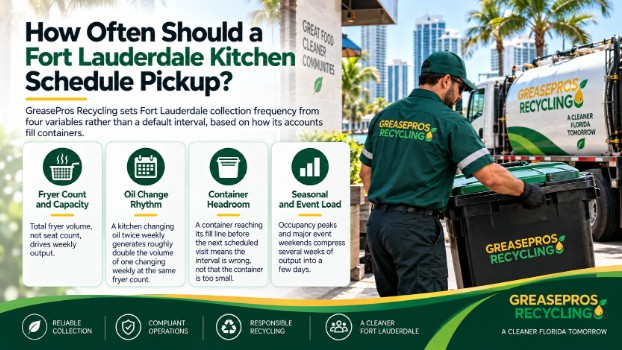
GreasePros Recycling sets Fort Lauderdale collection frequency from four variables rather than a default interval, based on how its accounts fill containers:
The working guideline the company applies: set the baseline interval so a container sits at roughly two-thirds capacity on collection day during an ordinary week. That headroom absorbs an unexpectedly busy weekend without an emergency call.
Peak-season volume arrives faster than a fixed calendar absorbs — set a volume-responsive Fort Lauderdale schedule with GreasePros Recycling before the next surge.

Ready to take the next step towards responsible used cooking oil disposal? Contact GreasePros Recycling today to schedule your free pickup and join us in making a positive impact on the environment. Our experienced team is standing by to provide efficient and reliable service, ensuring your used cooking oil is handled professionally and disposed of in an eco-friendly manner. Don’t wait—reach out now to experience hassle-free and sustainable waste management solutions. Together, let’s make a difference, one drop of oil at a time.
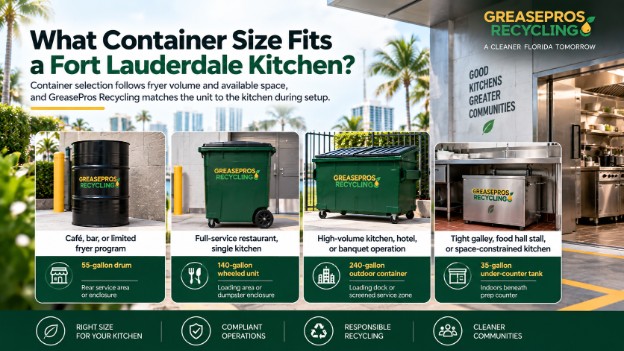
Container selection follows fryer volume and available space, and GreasePros Recycling matches the unit to the kitchen during setup.
Operation profile | Container | Typical placement |
Café, bar, or limited fryer program | 55-gallon drum | Rear service area or enclosure |
Full-service restaurant, single kitchen | 140-gallon wheeled unit | Loading area or dumpster enclosure |
High-volume kitchen, hotel, or banquet operation | 240-gallon outdoor container | Loading dock or screened service zone |
Tight galley, food hall stall, or space-constrained kitchen | 35-gallon under-counter tank | Indoors beneath prep counter |
Containers come at no charge with an active commercial account, each with a lockable lid, delivered and maintained by the company.
Locking matters in Fort Lauderdale for a practical reason the company encounters in the field: used cooking oil carries resale value, and containers left unsecured in accessible service alleys attract theft. The secured collection approach covers both theft and storm exposure.
Records for the two streams serve different purposes, and only one of them is statutory.
For fryer oil, GreasePros Recycling issues a signed collection record after each Fort Lauderdale pickup, identifying the origin kitchen, the hauler, the receiving facility, the date, and the volume collected.
That record is a business document rather than a state-mandated manifest, and it is what a kitchen produces when it needs to show where its oil went — during a pretreatment inquiry, a franchise audit, a sustainability report, or a property transaction.
For the interceptor stream, § 403.0741 sets actual requirements: the originator and hauler sign at the time of service, the hauler delivers a completed copy to the originator and to the county and municipality within 30 days of disposal, and both parties keep a copy on-site for one year.
Carrier status is independently verifiable for any provider. Fort Lauderdale operators can confirm GreasePros Recycling’s active registration by searching USDOT 4136566 in the FMCSA SAFER database, and permit documentation sits on the credentials and licensing page for vendor onboarding files.
Fort Lauderdale output swings enough across the year that a single fixed interval rarely fits every month of it.
GreasePros Recycling sees container fill rates climb across its Fort Lauderdale accounts during peak occupancy months, with major events concentrating demand into single weekends. A schedule built on a slow month has no mechanism to absorb that.
Storm risk pulls the other way. Florida’s hurricane season runs June 1 through November 30, and Fort Lauderdale’s coastal service areas, loading docks, and low-lying alleys leave containers exposed to wind and flooding.
GreasePros Recycling anchors outdoor containers, checks capacity ahead of a watch, and runs pre-storm collection for accounts on its priority list. The hurricane season planning resource covers the full sequence.
Ready to take the next step towards responsible used cooking oil disposal? Contact GreasePros Recycling today to schedule your free pickup and join us in making a positive impact on the environment. Our experienced team is standing by to provide efficient and reliable service, ensuring your used cooking oil is handled professionally and disposed of in an eco-friendly manner. Don’t wait—reach out now to experience hassle-free and sustainable waste management solutions. Together, let’s make a difference, one drop of oil at a time.
GreasePros Recycling dispatches Fort Lauderdale routes from its West Park base in southern Broward County.
Service covers scheduled used cooking oil collection, grease trap cleaning, hood cleaning, and commercial drain cleaning, which can be coordinated into a single off-hours window rather than three separate disruptions.
Same-day emergency retrieval covers overflows, fryer failures, and spills within the service area.
Collected oil goes to processing facilities where it is filtered, heated, and processed into renewable fuel.
The collection and processing sequence is documented at each transfer. Bilingual English and Spanish dispatch and field communication support the multilingual kitchen staff common across Broward food service.
Two streams, two schedules, one provider — arrange Fort Lauderdale collection with GreasePros Recycling at (786) 655-7070.
Is used cooking oil regulated as “used oil” in Florida?
No. Florida Statute § 403.75 defines used oil as oil refined from crude or synthetic oil, and Florida DEP guidance states that used oil does not include products derived from vegetable or animal fats. Therefore, Chapter 62-710 does not govern fryer oil.
Does Florida Statute § 403.0741 require a manifest for fryer oil?
No. Section 403.0741 governs grease waste retained in interceptors and traps, and its definition expressly excludes receptacles designed for collecting used cooking oil. Its manifest, hauler contract, and retention requirements apply to the interceptor stream.
What keeps fryer oil out of Fort Lauderdale sewers?
Broward County’s Industrial Pretreatment Program covers commercial food service facilities discharging to public treatment works under the national pretreatment framework. Fats, oils, and grease are among the materials that the program exists to keep out of the collection system.
What records should a Fort Lauderdale kitchen keep for fryer oil?
A signed collection record from the hauler showing origin kitchen, hauler, receiving facility, date, and volume. That record is a business document rather than a statutory manifest, and it is what proves where the oil went if anyone asks.
How long must a Fort Lauderdale kitchen keep grease trap manifests?
Signed manifests for the interceptor stream stay on-site for one year. Florida Statute § 403.0741 sets that retention period for both the originator and the hauler that performed the service, alongside the 30-day copy delivery requirement.
Do Fort Lauderdale rules differ from Miami-Dade rules?
Broward and Miami-Dade operators follow different county procedures. Florida Statute § 403.0741(6) permits local governments to adopt requirements stricter than the state minimum, and Miami-Dade added a county permit and portal reporting layer that Broward handles differently.
How can a Fort Lauderdale restaurant verify a hauler’s carrier registration?
Search USDOT 4136566 in the FMCSA SAFER database at safer.fmcsa.dot.gov to confirm active carrier status, classification, and inspection history. Running that check on any provider before signing a collection agreement takes a few minutes.
What container sizes does GreasePros Recycling provide in Fort Lauderdale?
Options cover 35-gallon under-counter tanks, 55-gallon drums, 140-gallon wheeled units, and 240-gallon outdoor containers. Each comes at no charge with an active commercial account, includes a lockable lid, and is delivered and maintained by the company.
What happens to used cooking oil collected in Fort Lauderdale?
Collected oil moves to processing facilities where it is filtered, heated, and processed into renewable fuel. Each transfer is documented, and clients receive a signed record showing the facility that received their oil.
Founded with a vision to revolutionize the used cooking oil recycling industry, GreasePros Recycling has established itself as a trusted and leading provider of sustainable waste management solutions. With over 20 years of experience, our dedicated team brings extensive expertise and a commitment to environmental stewardship.
Quick Links
Contact Information
Get in Touch with GreasePros
