
Trusted and leading provider of sustainable waste management solutions from 20 years. (786) 655-7070
We've Expanded: Now Serving All of Florida!
West Palm Beach restaurants manage two separate waste streams on two separate schedules: used cooking oil collected from a sealed container, and grease trap waste serviced under local pretreatment requirements.
GreasePros Recycling LLC provides oil collection at no charge for kitchens producing 40 or more gallons monthly, with free containers in four sizes, through scheduled used cooking oil pickup.
Restaurant volume climbs through the winter months in Palm Beach County. GreasePros Recycling adjusts collection intervals before volumes rise — schedule collection.

Three layers apply, and the local one decides the specifics. At the federal level, the U.S. Environmental Protection Agency’s pretreatment rules at 40 CFR 403.5(b)(3) prohibit discharging solid or viscous pollutants in amounts that obstruct flow.
EPA’s 2012 pretreatment fact sheet for food service establishments, citing its earlier report to Congress, identified grease as the most common cause of reported sewer blockages at 47% of incidents.
The applicable local authority depends on the address. West Palm Beach Public Utilities maintains more than 500 miles of sanitary sewer carrying wastewater to the East Central Regional Water Reclamation Facility for city customers.
Properties elsewhere in the county fall under the Palm Beach County Water Utilities Department, which administers its own pretreatment program through the Palm Beach County Sewers and Sewage Disposal Ordinance and the department’s Uniform Policies and Procedures.
Establishing which utility serves the building is the first practical step, since the inspection cadence, documentation, and surcharge structure follow from it.
Palm Beach County Water Utilities runs an Oil/Grease Interceptor Monitoring Program with published requirements for food service customers in its service area.
Placement carries its own rules. County wastewater design standards require grease traps and oil/grease interceptors to sit outside buildings, preferably in grass areas, at least ten feet from any department-owned facility, and never in traffic areas, parking spaces, walkways, or storm retention areas without prior approval.
Devices must conform to PDI-G101, with PDI Size 50 units rated for a maximum flow of 25 gallons per minute in the PBCWUD service area.
The answer turns on how the building handles sewage, which is the detail most compliance summaries flatten. Rule 62-6.010, F.A.C., requires a service person to hold an annual operating permit before cleaning a septic tank, grease interceptor, or other receptacle associated with an onsite sewage treatment and disposal system.
The rule sits in the onsite sewage chapter, originally administered by the Florida Department of Health as Rule 64E-6.010 and since transferred to the Department of Environmental Protection, which now issues the permit on Form DEP 4012.
A restaurant connected to municipal sewer generally falls outside that trigger. For those kitchens, hauler obligations come from Section 403.0741, Florida Statutes — disposal at a permitted facility, a signed service manifest for every removal, and one-year retention by both the restaurant and the hauler — plus whatever the serving utility requires.
The City of West Palm Beach comprehensive plan reflects this split precisely when it directs FOG and septage transporters to obtain an annual written permit “when required.”
The practical step for an operator is to ask a prospective hauler which permits it holds and which apply to the building’s system type, rather than accepting a general claim of being licensed.
The two streams look similar but behave very differently. Section 403.0741, Florida Statutes, defines a grease interceptor in terms that expressly exclude receptacles designed specifically for collecting used cooking oil, which is why they are contracted and documented separately.
Factor | Used cooking oil (yellow grease) | Grease trap waste (brown grease) |
Source | Drained directly from the fryer | Fats separated from wash water in an interceptor |
Storage | Sealed collection container supplied by the hauler | Held in the interceptor until pumped |
Servicing | Scheduled collection by a used oil hauler | Pump-out by a permitted service company |
Documentation | Collection record showing date, volume, destination | Signed service manifest retained one year |
Destination | Renewable fuel feedstock | Permitted grease waste disposal facility |
Value | Earns a per-gallon rebate when clean | Disposal cost to the restaurant |
Mixing them eliminates the rebate and complicates the trap servicing record. Kitchens run grease trap cleaning and used oil collection as two services because the law and the market both treat them as two materials.

Ready to take the next step towards responsible used cooking oil disposal? Contact GreasePros Recycling today to schedule your free pickup and join us in making a positive impact on the environment. Our experienced team is standing by to provide efficient and reliable service, ensuring your used cooking oil is handled professionally and disposed of in an eco-friendly manner. Don’t wait—reach out now to experience hassle-free and sustainable waste management solutions. Together, let’s make a difference, one drop of oil at a time.
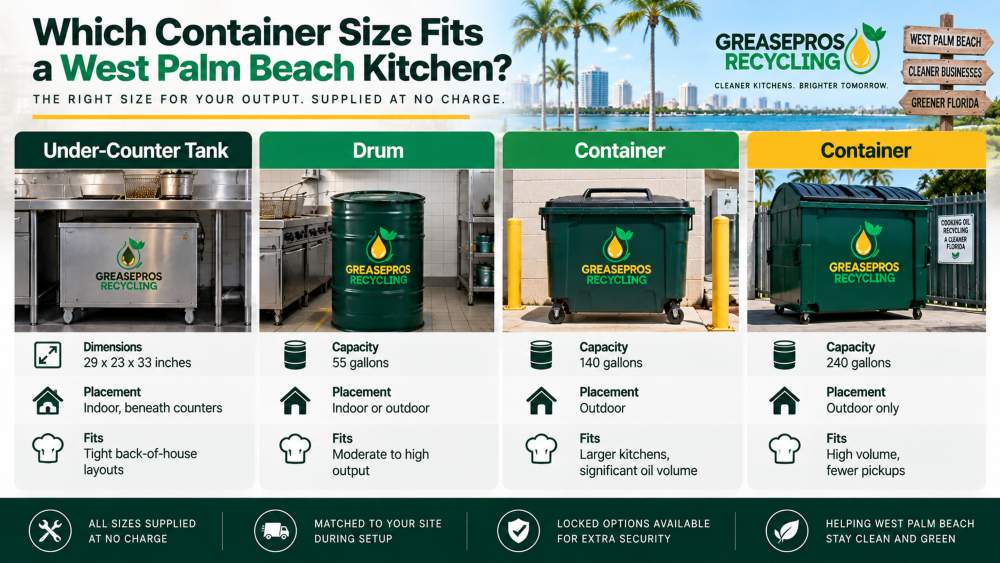
Container choice follows fryer output and available space. GreasePros Recycling supplies all four sizes at no charge under its current published terms.
Container | Capacity | Placement | Fits |
Under-counter tank | 29 x 23 x 33 inches | Indoor, beneath counters | Tight back-of-house layouts |
Drum | 55 gallons | Indoor or outdoor | Moderate to high output |
Container | 140 gallons | Outdoor | Larger kitchens, significant oil volume |
Container | 240 gallons | Outdoor only | High volume, fewer pickups |
Sizes remain subject to availability and are matched to the site during setup. Where containers sit in an open alley or shared service area, locked and tamper-resistant versions reduce exposure to used cooking oil theft.
Annual cleaning and six-month sampling leave little room for missing records. GreasePros Recycling documents every Palm Beach County collection — request service.
Collection costs a qualifying kitchen nothing, and clean oil returns a rebate. The figures below reflect GreasePros Recycling’s current published service terms and should be confirmed at quote, since rebate rates move with feedstock markets.
Water intrusion and contamination reduce the grade and the rebate, which is why container lids and placement matter as much as pickup frequency.
The analysis of used cooking oil pickup returns breaks down the economics further.
Seven items determine whether a collection arrangement will hold up under inspection and through a busy season. These apply to any collector, not only to GreasePros Recycling.
GreasePros Recycling publishes its credentials and licensing for the first item and outlines the service sequence in its collection process.
Ready to take the next step towards responsible used cooking oil disposal? Contact GreasePros Recycling today to schedule your free pickup and join us in making a positive impact on the environment. Our experienced team is standing by to provide efficient and reliable service, ensuring your used cooking oil is handled professionally and disposed of in an eco-friendly manner. Don’t wait—reach out now to experience hassle-free and sustainable waste management solutions. Together, let’s make a difference, one drop of oil at a time.
Palm Beach County kitchens run a pronounced seasonal curve, with restaurant volume concentrating in the winter months. Higher covers mean higher fryer output and a shorter interval before a container fills, so a schedule set during a quiet summer often needs revisiting before the season builds.
Hurricane season runs June through November and imposes the opposite problem. GreasePros Recycling states that it activates a 48-hour pre-storm collection protocol when the National Hurricane Center issues a tropical storm watch for a service area, and its published materials describe containers rated for sustained winds above 150 mph.
The company advises operators to request collection when a watch is issued rather than waiting for a warning, since every food service operator in the county becomes a caller at the same time.
The hurricane grease management guide includes container anchoring and the full pre-storm sequence.
Collected oil leaves the county as feedstock, not waste. The U.S. Department of Energy identifies recycled restaurant grease as a source material for biodiesel, and GreasePros Recycling states that the oil it collects goes to Florida DEP-approved facilities for biodiesel and sustainable aviation fuel processing.
Restaurants, hotels, clubs, schools, and franchise kitchens across Palm Beach County all feed the same stream.
Who regulates used cooking oil disposal in West Palm Beach?
Three layers apply. Federal pretreatment rules bar discharges that obstruct sewers, the City of West Palm Beach Public Utilities Department administers local sewer requirements, and Palm Beach County Water Utilities runs pretreatment for its service area. Confirm which utility serves the address.
Does a grease hauler need a permit in Palm Beach County?
It depends on the system. Rule 62-6.010, F.A.C. requires an annual operating permit before cleaning a grease interceptor tied to an onsite sewage system. Restaurants on municipal sewer follow Section 403.0741 hauler and manifest duties in Palm Beach County.
How often must a Palm Beach County grease trap be cleaned?
Palm Beach County Water Utilities requires restaurants and food service facilities in its service area to maintain and clean grease traps and oil/grease interceptors at least annually. The department samples and inspects those devices every six months, with surcharges when limits are exceeded.
What records must a restaurant keep?
Palm Beach County Water Utilities requires customers with grease traps to document when the trap was cleaned and where the waste was disposed of, and to keep those records on site. Trap solids go to a trash container rather than into the sanitary sewer system.
Where must a grease interceptor be located?
County wastewater design standards require grease traps and oil/grease interceptors to be outside buildings, preferably in grass areas, at least ten feet from department-owned facilities, and never in traffic areas, parking spaces, walkways, or storm retention areas without prior approval from the department.
Does GreasePros charge West Palm Beach restaurants for pickup?
Collection is free for kitchens producing 40 or more gallons monthly under current published terms, with no setup fee and no container charge. Rebates range from $0.15 to $0.55 per gallon, and rates should be confirmed at the time of quote.
Which container size suits a small West Palm Beach kitchen?
Under-counter tanks measuring 29 by 23 by 33 inches fit kitchens with limited back-of-house space, which suits kitchens in older downtown buildings. Larger operations typically use 55-gallon drums or 140-gallon containers, depending on weekly fryer output and pickup intervals.
How does season affect collection frequency?
Palm Beach County restaurant volume concentrates in the winter months, which raises fryer output and shortens the interval before containers fill. Service schedules set during quieter summer months often need revisiting before the season builds toward its peak.
What happens to containers during hurricane season?
GreasePros Recycling states that it activates a 48-hour pre-storm collection protocol when the National Hurricane Center issues a tropical storm watch, using containers it describes as rated above 150 mph sustained winds. An emptied, anchored container cannot spill.
Does fryer oil go in the grease trap?
No. A grease interceptor holds brown grease from wash water and is serviced under Section 403.0741, Florida Statutes. Fryer oil is yellow grease and belongs in a separate sealed container, collected on its own pickup schedule.
What should a restaurant verify before hiring any collector?
Confirm which permits match the building’s sewer or onsite system, the collector’s vehicle registrations, the service threshold and rebate basis, container sizing and placement, pickup interval, documentation per collection, and storm procedures before signing any collection service agreement. Ask in writing.
A West Palm Beach kitchen runs two streams on two schedules. Yellow grease goes into a sealed container supplied at no charge, collected free above 40 gallons monthly, returning $0.15 to $0.55 per gallon depending on quality.
Grease trap waste follows the pretreatment program of whichever utility serves the address—for Palm Beach County Water Utilities customers, that means cleaning at least annually, sampling every six months, keeping on-site cleaning records, and installing interceptors sized to county design standards.
Hauler permitting splits by system type: Rule 62-6.010, F.A.C., covers interceptors on on-site sewage systems, while sewered restaurants look to Section 403.0741 manifest duties. Local variables are seasonal rather than regulatory: winter covers raise output, and storm watches compress the collection window.
Storm watches compress the collection window across Palm Beach County. GreasePros Recycling empties containers ahead of landfall — book West Palm Beach pickup.
Founded with a vision to revolutionize the used cooking oil recycling industry, GreasePros Recycling has established itself as a trusted and leading provider of sustainable waste management solutions. With over 20 years of experience, our dedicated team brings extensive expertise and a commitment to environmental stewardship.
Quick Links
Contact Information
Get in Touch with GreasePros
