
Trusted and leading provider of sustainable waste management solutions from 20 years. (786) 655-7070
We've Expanded: Now Serving All of Florida!
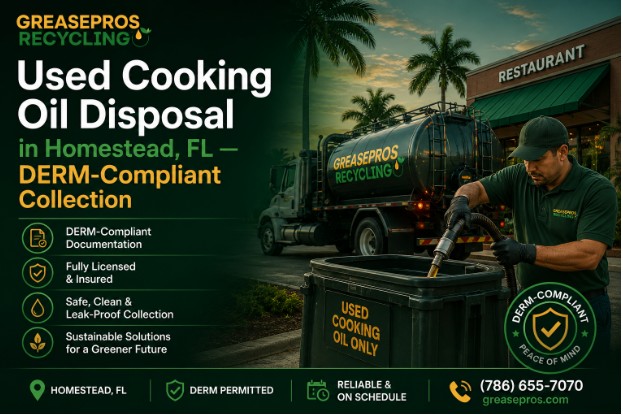
Homestead restaurants, food processors, and agricultural kitchens require a used cooking oil hauler with active Miami-Dade DERM permits, DERM-formatted manifests, and hurricane-rated containers to remain in compliance with Miami-Dade Ordinance No. 18-22 and Florida Statute § 403.0741.
GreasePros Recycling LLC (DOT #4136566) provides free locked container installation, same-day emergency response, and bilingual English and Spanish service to Homestead food service operations — from Krome Avenue restaurants to Redland-area agricultural processors.
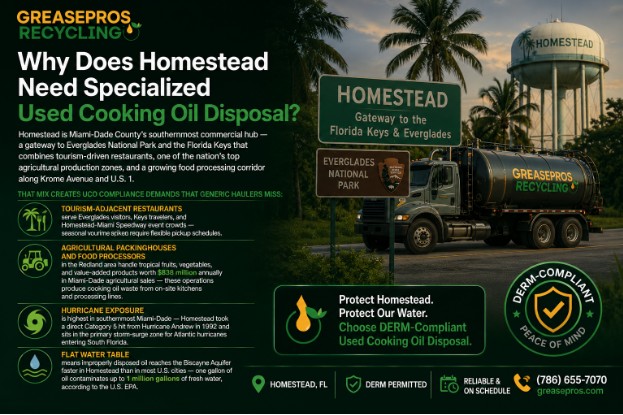
Homestead is Miami-Dade County’s southernmost commercial hub — a gateway to Everglades National Park and the Florida Keys that combines tourism-driven restaurants, one of the nation’s top agricultural production zones, and a growing food processing corridor along Krome Avenue and U.S. 1.
That mix creates UCO compliance demands that generic haulers miss:
Every food service establishment in Homestead requires a current Grease Discharge Operating (GDO) Permit from Miami-Dade DERM under Section 24-42.6 of the Miami-Dade County Code — the same rules that apply in Miami Beach, Coral Gables, or any of the county’s 34 municipalities.
Homestead operators must maintain these 5 compliance elements:
Miami-Dade’s automated nightly audit assesses a $250 administrative fee when a pump-out log is more than 90 days old. Homestead restaurants that miss a single manifest cycle risk both the fee and a triggered DERM inspection.
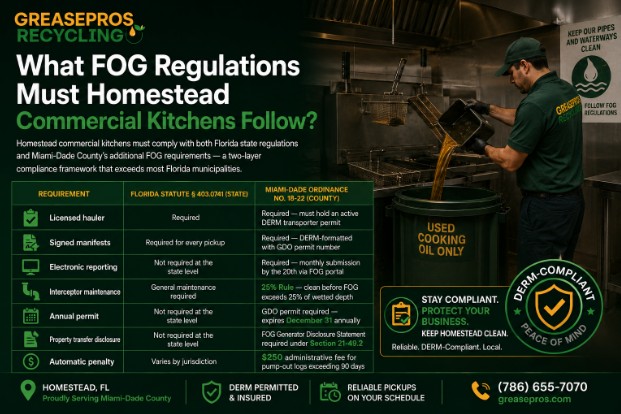
Homestead commercial kitchens must comply with both Florida state regulations and Miami-Dade County’s additional FOG requirements — a two-layer compliance framework that exceeds most Florida municipalities.
Requirement | Florida Statute § 403.0741 (State) | Miami-Dade Ordinance No. 18-22 (County) |
Licensed hauler | Required | Required — must hold an active DERM transporter permit |
Signed manifests | Required for every pickup | Required — DERM-formatted with GDO permit number |
Electronic reporting | Not required at the state level | Required — monthly submission by the 20th via FOG portal |
Interceptor maintenance | General maintenance required | 25% Rule — clean before FOG exceeds 25% of wetted depth |
Annual permit | Not required at the state level | GDO permit required — expires December 31 annually |
Property transfer disclosure | Not required at the state level | FOG Generator Disclosure Statement required under Section 21-49.2 |
Automatic penalty | Varies by jurisdiction | $250 administrative fee for pump-out logs exceeding 90 days |
Homestead restaurants that rely on a hauler operating under state-only compliance risk documentation gaps that trigger DERM enforcement at the county level.
Homestead’s DERM inspection cycle doesn’t pause for hurricane season — GreasePros Recycling provides DERM-formatted manifests from your first pickup and 48-hour pre-storm collection when a tropical storm watch is issued. Call (786) 655-7070.
Homestead’s Redland agricultural district — ranked second in Florida for agricultural and ornamental plant production value according to UF/IFAS Extension — includes food processing operations that produce UCO waste from on-site kitchens, frying lines, and value-added product manufacturing.
Food processors face 3 compliance requirements beyond standard restaurant GDO obligations:
GreasePros Recycling serves Homestead packinghouses and food processors with the same DERM-compliant manifest system used for restaurant collections — one hauler, one manifest format, one compliance trail.
GreasePros Recycling LLC provides DERM-compliant used cooking oil collection across all Homestead ZIP codes from its West Park, Florida base — approximately 35 miles north on the Florida Turnpike.
Homestead service includes:
GreasePros Recycling routes all Homestead UCO to certified Florida processing facilities that convert waste oil into ASTM-grade biodiesel through transesterification.

Ready to take the next step towards responsible used cooking oil disposal? Contact GreasePros Recycling today to schedule your free pickup and join us in making a positive impact on the environment. Our experienced team is standing by to provide efficient and reliable service, ensuring your used cooking oil is handled professionally and disposed of in an eco-friendly manner. Don’t wait—reach out now to experience hassle-free and sustainable waste management solutions. Together, let’s make a difference, one drop of oil at a time.
GreasePros Recycling installs free locked containers in 4 sizes at Homestead food service locations — matched to each operation’s weekly volume and available space.
Container | Capacity | Best For | Placement |
55-gallon drum | 55 gallons | Food trucks, small cafés, juice bars (10–20 gal/week) | Indoor or outdoor |
140-gallon container | 140 gallons | Mid-volume restaurants, bakeries (20–40 gal/week) | Indoor or outdoor |
240-gallon container | 240 gallons | High-volume restaurants, hotel kitchens, QSRs (40–80 gal/week) | Outdoor only |
Under-counter tank | Compact (29×23×33 in.) | Small kitchens with limited floor space | Indoor only |
All containers include hurricane-rated construction, locked tamper-proof lids, and anti-corrosion coatings. GreasePros delivers and installs containers within the first service week at no charge.
GreasePros Recycling provides free used cooking oil collection for Homestead restaurants that generate 40 or more gallons per month — no setup fees, no monthly charges, and no long-term contracts required.
Homestead cost and rebate structure:
Restaurants producing fewer than 40 gallons per month should contact GreasePros at (786) 655-7070 to discuss service options for lower-volume operations.
GreasePros Recycling transports all Homestead UCO to certified Florida processing facilities, where filtered yellow grease is converted into ASTM D6751-grade biodiesel through transesterification — a chemical reaction that yields 90–97% fuel recovery per gallon of feedstock.
Homestead’s recycled oil enters 3 end-use pathways:
Every gallon recycled instead of improperly disposed prevents contamination of up to 1 million gallons of fresh water and displaces approximately 22 pounds of CO₂ when converted to biodiesel — protecting Homestead’s Biscayne Aquifer and supporting Florida’s biodiesel production framework under Florida Statutes § 206.874 and § 215.47.
Homestead kitchens generate high-value biodiesel feedstock worth $0.15–$0.55 per gallon in rebates. GreasePros Recycling collects it free, installs locked containers at no charge, and delivers DERM-compliant manifests that keep your GDO permit current. Call (786) 655-7070 or schedule service online.
Is Homestead under Miami-Dade DERM jurisdiction for grease disposal?
Homestead is an incorporated city within Miami-Dade County and falls under full DERM jurisdiction. Every Homestead food service establishment requires a GDO permit from DERM, annual renewal by December 31, and monthly electronic manifest submission through the county’s FOG portal.
What ZIP codes does GreasePros Recycling serve in Homestead?
GreasePros Recycling serves all Homestead ZIP codes, including 33030, 33031, 33032, 33033, 33034, and 33035. Service extends to surrounding areas, including Florida City, the Redland agricultural district, and the U.S. 1 corridor approaching the Florida Keys.
Do Homestead agricultural food processors need a GDO permit?
Food processing operations in Homestead that produce used cooking oil from on-site kitchens or frying lines require a GDO permit from DERM under the same Section 24-42.6 rules that apply to restaurants. Processors generating more than 25 gallons per month must use a licensed DERM-permitted hauler for collection.
What is the 25% Rule for grease interceptors in Homestead?
Miami-Dade DERM requires all GDO permit holders — including Homestead restaurants — to clean grease interceptors before FOG accumulation exceeds 25% of the wetted depth. Exceeding this threshold during a DERM inspection triggers enforcement action and potential permit suspension.
How does hurricane season affect grease collection in Homestead?
Homestead sits in Miami-Dade’s highest hurricane-exposure zone and is the southernmost commercial area in the county. GreasePros Recycling activates 48-hour pre-storm collection when the National Hurricane Center issues a tropical storm watch, preventing container breaches that cause spills and DERM violations.
Does GreasePros provide bilingual service for Homestead restaurants?
GreasePros Recycling provides full bilingual English and Spanish service across dispatch, field crews, documentation, and emergency communication. Homestead’s food service workforce includes a significant Spanish-speaking population, and bilingual manifest documentation reduces compliance errors from language barriers.
How much can a Homestead restaurant earn from used cooking oil?
Homestead restaurants earn $0.15–$0.55 per gallon from GreasePros Recycling, depending on volume and oil quality. A mid-volume restaurant producing 150 gallons per month earns approximately $60–$75 in rebates per month while eliminating disposal fees that otherwise range from $60–$300 per month.
What happens if a Homestead restaurant misses a manifest submission?
Miami-Dade’s automated nightly manifest audit assesses a $250 administrative fee when a pump-out log is more than 90 days old. A missed manifest also flags the restaurant’s GDO permit for DERM review, which can trigger an on-site inspection before the permit is cleared for continued operation.
Does GreasePros serve Florida City and the Redland area near Homestead?
GreasePros Recycling serves Florida City, the Redland agricultural district, and all surrounding areas within southern Miami-Dade County. Agricultural packinghouses, food processors, and farm-to-table restaurants in the Redland area receive the same DERM-compliant collection service as those in Homestead.
What makes Homestead’s grease disposal requirements different from those of other Florida cities?
Homestead is within Miami-Dade County, which enforces GDO permit requirements, the 25% Rule, electronic FOG portal reporting, and automatic $250 penalties that exceed the state baseline under Florida Statute § 403.0741. Most Florida cities outside Miami-Dade operate under state-level requirements only, with no county-specific permit or electronic reporting mandate.
Ready to take the next step towards responsible used cooking oil disposal? Contact GreasePros Recycling today to schedule your free pickup and join us in making a positive impact on the environment. Our experienced team is standing by to provide efficient and reliable service, ensuring your used cooking oil is handled professionally and disposed of in an eco-friendly manner. Don’t wait—reach out now to experience hassle-free and sustainable waste management solutions. Together, let’s make a difference, one drop of oil at a time.
Founded with a vision to revolutionize the used cooking oil recycling industry, GreasePros Recycling has established itself as a trusted and leading provider of sustainable waste management solutions. With over 20 years of experience, our dedicated team brings extensive expertise and a commitment to environmental stewardship.
Quick Links
Contact Information
Get in Touch with GreasePros
