
Trusted and leading provider of sustainable waste management solutions from 20 years. (786) 655-7070
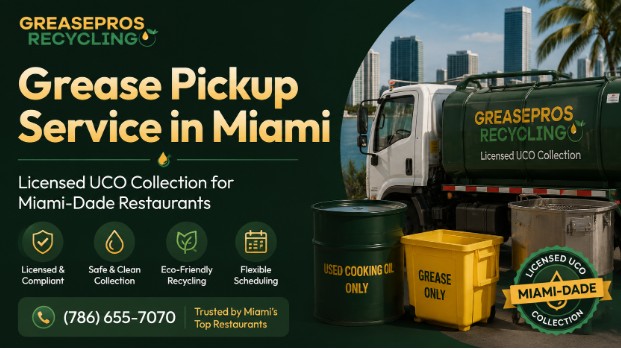
GreasePros Recycling provides licensed used cooking oil pickup and grease management services for restaurants, hotels, and commercial kitchens throughout Miami-Dade County, Florida.
Food service establishments in Brickell, Wynwood, Little Havana, Coral Gables, Coconut Grove, South Beach, Hialeah, Kendall, and all 34 incorporated municipalities receive free containers, scheduled collection, and full FOG compliance documentation.
Struggling with grease compliance or overdue FOG documentation? GreasePros Recycling delivers fast, bilingual used cooking oil pickup across Miami-Dade. Contact GreasePros today to protect your kitchen from violations.
GreasePros Recycling is a licensed used cooking oil (UCO) pickup and grease recycling company serving food service businesses throughout Miami-Dade County. The company provides free grease storage containers, scheduled and emergency oil collection, DERM-compliant pickup manifests, and bilingual customer service in English and Spanish.
Restaurants, hotels, cafeterias, food trucks, and commercial kitchens across all 34 municipalities in Miami-Dade receive the same standard of service: on-time pickups, full compliance documentation, and containers sized to match kitchen output.
Miami-Dade’s FOG Control Program under Section 24-42.6 of the County Code requires every non-residential food service establishment to use a DERM-permitted liquid waste transporter. GreasePros Recycling operates under that permit structure, meaning every pickup automatically generates the manifest documentation your GDO permit renewal depends on.
GreasePros Recycling operates active service routes across all major Miami-Dade neighborhoods and municipalities. The company maintains scheduled routes in Brickell, Wynwood, Downtown Miami, Little Havana, Coral Gables, Coconut Grove, South Beach, Mid-Beach, North Beach, Hialeah, Kendall, Doral, Aventura, Homestead, Pembroke Pines, and all surrounding municipalities. Same-day emergency service is available countywide at (786) 655-7070.
Each neighborhood presents different operational demands. Brickell’s high-rise restaurant floors require compact equipment that navigates freight elevators and tight service corridors. Wynwood’s event-driven surge volumes during Art Basel and major festivals call for flexible scheduling.
Little Havana’s family-run Cuban kitchens often benefit most from the bilingual service team that handles both English and Spanish documentation without friction.
Coral Gables and Coconut Grove fine dining establishments receive discreet, low-profile service that maintains the aesthetic standards their properties require.
Miami-Dade County’s Fats, Oils, and Grease (FOG) Control Program requires every food service establishment to obtain an annual Grease Discharge Operating (GDO) Permit, install a properly sized grease interceptor, maintain pump-out manifests for three years, and use a DERM-permitted hauler for all collections.
Fines for first-offense violations range from $300 to $1,200, escalating to $2,500 or more for repeat violations, with permit suspension and business closure possible for ongoing noncompliance.
Miami-Dade County enacted its current FOG Control Program under Ordinance No. 18-22, which became effective on March 5, 2018, pursuant to a federal court consent decree involving the U.S. Environmental Protection Agency and the Florida Department of Environmental Protection.
Every food service establishment in the county — restaurants, cafeterias, bakeries, coffee shops, juice bars, and any facility that introduces FOG into building drains — falls under this program.
The program operates under Section 24-42.6 of the Code of Miami-Dade County. Key compliance obligations include obtaining a GDO permit before opening, maintaining an interceptor that meets county sizing standards using the seats-and-meals calculation method, cleaning interceptors before FOG and solids exceed 25 percent of total liquid depth (the “25% Rule”), using only DERM-permitted haulers for all pump-outs, and electronically reporting each pump-out date and hauler name through the county’s FOG portal within the required window.
The county’s automated portal cross-checks manifests nightly — when a log shows more than 90 days without a documented service ticket, the system auto-issues a $250 administrative fee before an inspector visits the site.
Cleaning intervals by interceptor type under Miami-Dade County Code § 24-42.6 are as follows: automatic hydromechanical grease interceptors require monthly cleaning by a permitted transporter; manual hydromechanical grease interceptors also require monthly cleaning; gravity grease interceptors require cleaning every 60 days, extended to a maximum of 180 days only when a functional monitoring device is in place. All intervals are subject to the 25% Rule regardless of schedule — if capacity is exceeded before the scheduled date, pump-out is required immediately.
The table below summarizes the core compliance requirements that every Miami-Dade food service establishment must meet under Section 24-42.6 of Ordinance No. 18-22.
| Requirement | Regulatory Authority | Deadline or Frequency |
| Annual GDO Permit | Miami-Dade DERM, § 24-42.6 | Renewed annually; renewal packets arrive 45 days before expiry |
| Grease interceptor installation | Miami-Dade County Code § 24-42.6(9) | Required before opening; sized by the seats-and-meals calculation |
| Pump-out by DERM-permitted hauler | § 24-42.6, Ordinance 18-22 | Monthly (hydromechanical) or every 60 days (gravity) |
| 25% Rule compliance | Miami-Dade DERM | Continuous; pump-out required whenever the threshold is reached |
| Electronic manifest reporting | Miami-Dade FOG portal | Within the required window after each pump-out |
| Maintenance log retention | § 24-42.6 | Three years on-site and available for inspection |
| Sampling port access | § 24-42.6(8) | Maintained and accessible at all times |
| Grease storage area compliance | § 24-42.6 | Continuous; lids locked, no overfill, absorbent-only spill cleanup |
Failure to hold a valid GDO permit carries first-offense fines of $300 to $1,200, rising to $2,500 or more for repeat violations. Ongoing noncompliance can result in immediate business closure under county enforcement authority.
DERM’s FOG program line at (305) 372-6983 handles permit questions and compliance clarification.
GreasePros Recycling provides the manifest documentation, scheduled collection cadence, and DERM-compliant reporting that your GDO permit renewal depends on. Schedule service today and eliminate the compliance gap before the next inspection cycle.
Miami-Dade County’s food service industry operates within one of the most tourism-intensive economies in the United States, supported by 34 incorporated municipalities, 2.7 million residents, and continuous high visitor volume.
The county’s scale and density create ongoing demand for grease collection services that cities with smaller food-service footprints do not experience to the same extent.
Miami-Dade County is home to 34 incorporated municipalities and more than 2.7 million residents, making it Florida’s most populous county and the economic anchor of South Florida’s food service corridor.
The county supports thousands of active restaurant and café establishments in urban and coastal zones, generating cooking oil volumes that require consistent, professionally managed collection to stay within FOG compliance thresholds.
Tourism amplifies this output substantially. PortMiami handled a record 7.3 million cruise passengers in 2023, and major events, including Art Basel, Ultra Music Festival, and convention season at the Miami Beach Convention Center, drive kitchen output well beyond baseline volumes.
Neighborhoods like Wynwood, Brickell, and South Beach experience week-over-week volume swings during peak event periods, requiring flexible pickup scheduling rather than fixed monthly cadences.
Florida’s restaurant industry generated substantial sales in 2024, with Miami-Dade County accounting for 25 percent of the state’s total tourism tax revenue.
The county’s food service establishments represent a critical segment of that output — and the grease those kitchens produce must be collected, manifested, and recycled under a compliance framework that has grown steadily stricter since the 2018 federal court order.
Kitchens serving this volume of covers produce used cooking oil at a pace that makes ad-hoc, unlicensed, or infrequent collection a direct compliance liability.
GreasePros Recycling maintains active routes across Brickell, Wynwood, Little Havana, Hialeah, Kendall, and all Miami-Dade service corridors — from emergency oil retrieval for overflow situations to scheduled used oil pickup plans calibrated to kitchen output — so establishments never approach their interceptor’s 25% capacity trigger without a service date on the calendar.
GreasePros Recycling provides free container options to Miami-Dade food service establishments: 55-gallon drums for cafés and food trucks producing 50 to 150 meals per day, 140-gallon wheeled containers for mid-sized restaurants serving 200 to 400 covers daily, 240-gallon outdoor units for hotels and high-volume venues, and under-counter tanks measuring 29″ × 23″ × 33″ for space-limited South Beach kitchens.
All containers include lockable lids, anti-corrosion coatings, and hurricane-rated construction.
Container selection depends on daily cover count, kitchen configuration, and local storage constraints. Miami’s high-density commercial corridors — South Beach, Brickell, the Design District — frequently require compact footprints that do not obstruct service lanes or violate health inspection standards.
Coastal humidity, salt-air exposure, and year-round outdoor placement demand container materials rated for those conditions.
GreasePros Recycling delivers, installs, and maintains all containers at no charge. The free container program removes one of the most common points of FOG violations — improperly stored grease in open or unlocked bins — by providing sealed, regulation-ready storage from day one. The used cooking oil recycling and storage services model applies to Miami-Dade operations as well, with containers sized and positioned to keep grease storage areas fully compliant with Section 24-42.6’s requirements for locked lids and no overfill.
The following table matches container type to kitchen output and a typical Miami-Dade use case.
| Container | Capacity | Typical Output | Best For |
| Under-counter tank | 35 gallons | 30–100 meals/day | Tight South Beach kitchens, cafés, juice bars |
| 55-gallon drum | 55 gallons | 50–150 meals/day | Food trucks, small cafés, Little Havana family kitchens |
| 140-gallon wheeled | 140 gallons | 200–400 covers/day | Mid-sized Coral Gables, Coconut Grove, Wynwood restaurants |
| 240-gallon outdoor | 240 gallons | 500+ meals/day | South Beach hotels, Hialeah high-volume kitchens, Brickell venues |
GreasePros Recycling provides 48-hour pre-storm used cooking oil collection throughout Miami-Dade County during hurricane season (June 1 through November 30) and 24/7 emergency response year-round at (786) 655-7070.
All containers are rated for high-wind conditions, and post-storm service prioritizes restaurants supporting Miami-Dade’s hospitality recovery operations.
Miami-Dade’s hurricane season represents the highest-risk window for FOG compliance violations. Operators who have not completed pump-outs before a storm risk overflow, grease release onto pavement or into storm drains, and the immediate environmental fines that follow — fines that insurance typically does not cover. Miami-Dade DERM guidance instructs operators to inspect grease interceptors for damage, overflow, and loose components within 24 hours after major storms.
GreasePros Recycling maintains hurricane-specific protocols that protect Miami-Dade food businesses throughout the storm cycle. Pre-storm collection is available with 48 hours’ notice for any establishment along active service routes.
The company maintains backup trucks year-round for rapid response when primary fleet units are staged elsewhere during storm preparation. Post-storm service prioritizes establishments supporting tourism recovery, including South Beach hotels, Brickell corporate dining operations, and Coral Gables fine dining venues that reopen immediately after mandatory evacuations lift.
For emergency retrieval situations outside hurricane season — overflowing containers, equipment failures, failed health inspections, surprise DERM audits — the team responds same day throughout Miami-Dade. Call (786) 655-7070 to reach a live dispatch representative at any hour.
Miami-Dade’s event calendar creates predictable UCO volume surges that standard monthly or bi-monthly pickup schedules cannot accommodate without risking overflow.
GreasePros Recycling builds surge-ready scheduling for the following peak windows: Art Basel in December; Ultra Music Festival and Spring Break in the March-April window; cruise-season arrivals throughout the year at PortMiami; and convention season at the Miami Beach Convention Center.
Establishments in South Beach, Wynwood, and Downtown Miami that operate during these events can request temporary schedule increases without contract renegotiation.
GreasePros Recycling provides bilingual used cooking oil pickup service in English and Spanish throughout Miami-Dade County. Spanish-speaking dispatchers, drivers, and service representatives handle scheduling, manifest documentation, compliance explanations, and staff education for Miami-Dade’s diverse food service workforce without communication delays or translation errors.
Miami-Dade County’s food service workforce is one of the most linguistically diverse in the United States.
Little Havana’s Cuban cafeterías, Hialeah’s Latin American family operations, and the multilingual staff of South Beach hotels and Wynwood restaurants depend on service providers who can accurately communicate compliance requirements in the kitchen team’s language.
A missed manifest, an incorrectly signed pump-out record, or a misunderstood interceptor-cleaning instruction carries the same $250 automatic administrative fee regardless of the language barrier that caused it.
The bilingual team communicates the 25% Rule, GDO permit requirements, and manifest reporting procedures directly with kitchen staff in English or Spanish, reducing the risk of documentation errors that trigger the $250 automatic administrative fee Miami-Dade’s FOG portal issues for pump-out logs exceeding 90 days. Hablamos español — and we document your compliance in both languages.
GreasePros Recycling converts collected Miami-Dade used cooking oil into biodiesel and renewable diesel, diverting FOG from Biscayne Bay, the Everglades water system, and Miami-Dade’s coastal stormwater infrastructure.
Every gallon collected under a valid DERM manifest prevents the sewer blockages, beach closures, and environmental fines that unmanaged grease discharge produces along Miami’s coastline.
Miami-Dade’s FOG program exists specifically because improperly discharged fats, oils, and grease reach Biscayne Bay, stormwater channels, and the Everglades water system.
When FOG enters sewer pipes, it cools, solidifies, and accumulates on pipe walls, causing blockages and sewage overflows that contaminate the coastal environment Miami’s tourism economy depends on.
Miami-Dade County and its municipalities remain under a federal court consent decree requiring continuous improvement of FOG discharge controls precisely because of the environmental damage this pathway creates.
GreasePros Recycling’s grease recycling process transforms collected UCO into biofuel inputs.
The power of recycled cooking oil in fueling renewable applications is a direct extension of the same collection process that keeps Miami-Dade kitchens compliant and Miami’s waterways protected. Responsible disposal and environmental benefit are the same service.
What FOG regulations apply to Miami-Dade restaurants?
Miami-Dade County enforces Section 24-42.6 of the County Code, which became effective on March 5, 2018, pursuant to a federal court consent decree. Every food service establishment must hold an annual Grease Discharge Operating (GDO) Permit, use a DERM-permitted hauler, and electronically report all pump-outs through the county’s FOG portal.
What are the fines for FOG violations in Miami-Dade County?
First-offense GDO permit violations carry fines of $300 to $1,200. Repeat violations escalate to $2,500 or more. Ongoing noncompliance allows Miami-Dade County to issue immediate business closure orders until compliance is restored. The county’s automated portal also charges a $250 administrative fee for pump-out logs that exceed 90 days.
Does GreasePros Recycling serve all Miami-Dade neighborhoods?
GreasePros Recycling provides scheduled and emergency used cooking oil pickup in Brickell, Wynwood, Little Havana, Coral Gables, Coconut Grove, South Beach, Hialeah, Kendall, Doral, Aventura, Homestead, and all 34 incorporated municipalities in Miami-Dade County. Call (786) 655-7070 to confirm service availability at your address.
What free containers does GreasePros Recycling provide to Miami restaurants?
GreasePros Recycling provides container options at no cost: 35-gallon under-counter tanks, 55-gallon drums, 140-gallon wheeled units, and 240-gallon outdoor containers. All containers include lockable lids and anti-corrosion coatings rated for Miami’s coastal humidity, salt air, and hurricane-season wind conditions.
Does GreasePros Recycling offer Spanish-language grease pickup service in Miami?
GreasePros Recycling provides full bilingual service in English and Spanish throughout Miami-Dade County. Spanish-speaking dispatchers, drivers, and compliance representatives handle scheduling, manifests, and FOG documentation for Little Havana, Hialeah, and any multilingual kitchen team in the county. Hablamos español.
How does GreasePros Recycling handle grease pickup before a hurricane?
GreasePros Recycling offers 48-hour pre-storm used cooking oil collection across Miami-Dade County during hurricane season, which runs from June 1 through November 30. Emergency response is available 24/7 at (786) 655-7070 for overflow, spill, and post-storm compliance situations.
How often must Miami-Dade restaurants pump out their grease interceptors?
Miami-Dade County Code § 24-42.6 sets cleaning intervals by device type: monthly for hydromechanical interceptors and every 60 days for gravity interceptors, extendable to 180 days with a functional monitoring device. All intervals are overridden by the 25% Rule — pump-out is required whenever FOG and solids reach one-quarter of the total liquid depth.
What happens if my Miami restaurant misses a FOG manifest submission?
Miami-Dade’s automated FOG portal runs nightly audits against all registered GDO permits. A log showing more than 90 days without a documented service ticket triggers a $250 administrative fee and queues a violation letter. Using a DERM-permitted hauler like GreasePros Recycling ensures manifests are filed on time every cycle.
Founded with a vision to revolutionize the used cooking oil recycling industry, GreasePros Recycling has established itself as a trusted and leading provider of sustainable waste management solutions. With over 20 years of experience, our dedicated team brings extensive expertise and a commitment to environmental stewardship.
Quick Links
Contact Information
Get in Touch with GreasePros
