
Trusted and leading provider of sustainable waste management solutions from 20 years. (786) 655-7070
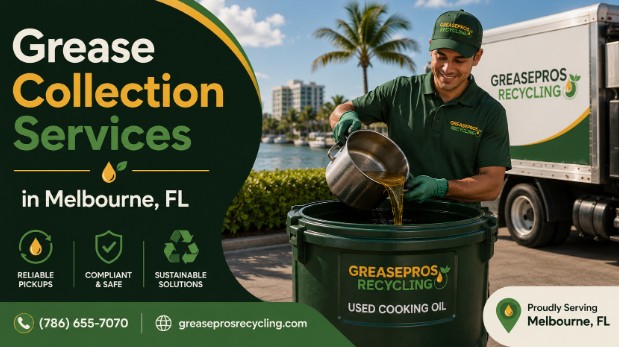
Melbourne restaurants, aerospace cafeterias, and hotel kitchens need a licensed grease hauler that provides scheduled collection sized to the Space Coast’s tourism and aerospace employment cycles, Brevard County FOG compliance documentation, and emergency response for hurricane season.
GreasePros Recycling LLC, a licensed Florida used cooking oil hauler with over 20 years of operation serving all Florida cities from its South Florida and Cape Canaveral facilities, provides free locked containers, flexible pickup schedules, and 24/7 emergency service across Melbourne and Brevard County.
Melbourne kitchens deserve a grease partner built for the Space Coast — schedule a free container delivery with GreasePros Recycling today.
GreasePros Recycling provides complete used cooking oil collection, grease trap support, and emergency retrieval for restaurants, hotels, schools, hospitals, and corporate cafeterias across Melbourne and Brevard County.
The company delivers free lockable containers in 55-gallon, 140-gallon, and 240-gallon sizes, schedules weekly, bi-weekly, or monthly pickups matched to each kitchen’s oil output, and provides signed service manifests documenting every collection for regulatory compliance.
Melbourne’s food service landscape spans casual diners along US-1, waterfront seafood restaurants on the Indian River Lagoon, Florida Tech and Eastern Florida State College campus cafeterias, and corporate dining halls at Northrop Grumman and L3Harris aerospace facilities.
Each operation type produces different volumes at different schedules, and GreasePros Recycling tailors container sizing and pickup frequency accordingly.
The company also provides professional hood cleaning and commercial drain maintenance for Melbourne kitchens, consolidating back-of-house services with a single provider.
GreasePros Recycling now serves all Florida cities — from its original South Florida base to its Cape Canaveral facility at 166 Center St., Suite 235 — providing consistent service standards, centralized billing, and statewide compliance documentation for multi-location restaurant groups operating across Brevard, Orange, Volusia, and Indian River counties.
If you’re ready to get started, call us now!
Brevard County Code Chapter 110, Article II, establishes the county’s Fats, Oils, and Grease Management Program. Every food service establishment in Melbourne that discharges FOG into the county-owned sewer collection system must install an approved grease interceptor sized in accordance with Chapter 64E of the Florida Administrative Code.
Brevard County amended its FOG ordinance through Ordinance No. 2021-04 in February 2021 to strengthen enforcement and align with regional compliance standards.
Brevard County’s FOG program requires grease interceptors to be properly operated, maintained, and documented. The county applies a monthly assessment and program fee through the utility bill for participating food service establishments.
Non-compliance can result in additional inspection charges applied to the water bill, the cost of county-ordered grease trap pumping charged to the operator, and in extreme cases, termination of the establishment’s water services.
Florida Statute § 403.0741 governs statewide hauler licensing and manifest requirements for grease waste transportation. Melbourne restaurants must use a licensed hauler that provides signed service manifests for every pump-out and collection event.
The Florida Department of Health — Brevard County Environmental Health Services division conducts food safety inspections under Section 381.0072 of the Florida Statutes, and inspectors may check grease trap maintenance records as part of routine food establishment inspections.
GreasePros Recycling generates manifests that meet both the Brevard County utility inspection framework and the Florida DOH food safety documentation standard, allowing Melbourne restaurant operators to maintain a single compliance file that covers both regulatory layers.
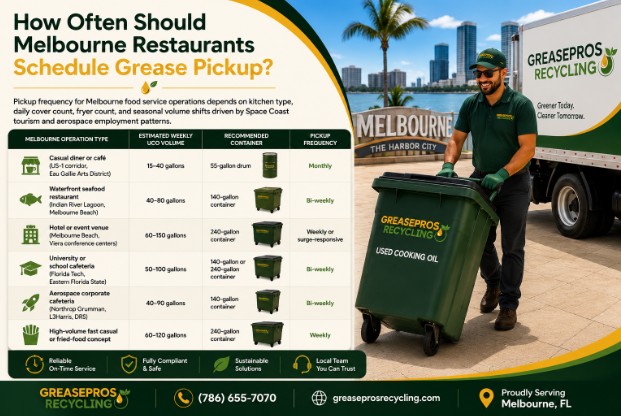
Pickup frequency for Melbourne food service operations depends on kitchen type, daily cover count, fryer count, and seasonal volume shifts driven by Space Coast tourism and aerospace employment patterns.
| Melbourne Operation Type | Estimated Weekly UCO Volume | Recommended Container | Pickup Frequency |
| Casual diner or café (US-1 corridor, Eau Gallie Arts District) | 15–40 gallons | 55-gallon drum | Monthly |
| Waterfront seafood restaurant (Indian River Lagoon, Melbourne Beach) | 40–80 gallons | 140-gallon container | Bi-weekly |
| Hotel or event venue (Melbourne Beach, Viera conference centers) | 60–150 gallons | 240-gallon container | Weekly or surge-responsive |
| University or school cafeteria (Florida Tech, Eastern Florida State) | 50–100 gallons | 140-gallon or 240-gallon container | Bi-weekly |
| Aerospace corporate cafeteria (Northrop Grumman, L3Harris, DRS) | 40–90 gallons | 140-gallon container | Bi-weekly |
| High-volume fast-casual or fried-food concept | 60–120 gallons | 240-gallon container | Weekly |
GreasePros Recycling adjusts pickup frequency to match Melbourne’s seasonal patterns. Waterfront restaurants along the Indian River Lagoon and Melbourne Beach see volume surges during the November-through-April tourist season that can double baseline oil output.
Aerospace cafeterias maintain steadier year-round production tied to employment schedules rather than tourism.
The company provides on-call surge pickup — one call to (786) 655-7070 adds an extra collection during a high-volume week with no contract adjustment required.
If you’re ready to get started, call us now!
Melbourne sits at the intersection of three demand drivers that create a grease management profile unlike Miami’s tourism-heavy corridor or Orlando’s theme-park economy.
The aerospace employment base, the Indian River Lagoon’s environmental sensitivity, and the seasonal tourism cycle along the Space Coast each shape how Melbourne kitchens produce and dispose of used cooking oil.
Northrop Grumman, L3Harris Technologies, and DRS Defense Solutions operate major facilities in Melbourne that include employee cafeterias serving hundreds of workers daily.
These cafeterias produce steady weekday volume with minimal weekend output — a pattern that requires bi-weekly pickup on a Monday-through-Friday production cycle rather than the seven-day schedules common in tourism-driven markets.
Florida Tech and Eastern Florida State College add campus cafeteria volume during academic terms, which drops significantly during summer and holiday breaks.
The Indian River Lagoon is one of the most biologically diverse estuaries in North America, and FOG releases from Melbourne’s waterfront restaurants pose a direct environmental threat to the lagoon’s water quality.
Brevard County’s FOG Management Program under Chapter 110 exists in part to protect the lagoon and the county’s broader waterway infrastructure from grease-related sewer overflows.
GreasePros Recycling’s locked containers and spill-prevention protocols protect Melbourne restaurants from the environmental liability that an unsecured container creates near the lagoon’s drainage basin.
Florida’s hurricane season runs from June 1 through November 30, and Melbourne’s coastal location on the Space Coast places the city in the direct path of Atlantic storms.
NOAA’s May 2026 outlook projects a 55% chance of a below-normal season, but Brevard County has experienced direct hurricane impacts from storms including Matthew (2016), Irma (2017), and Nicole (2022).
GreasePros Recycling activates a 48-hour pre-storm collection protocol for Melbourne clients when the National Hurricane Center issues a tropical storm watch for the Space Coast. The protocol includes the following protections:
Protect your Melbourne kitchen from the next storm and the next inspection — call GreasePros Recycling at (786) 655-7070 to schedule your free container delivery and lock in hurricane-ready service.
What grease collection services does GreasePros Recycling provide in Melbourne, FL?
GreasePros Recycling provides free locked containers, scheduled used cooking oil pickup, emergency retrieval, hood cleaning, and commercial drain maintenance for restaurants, hotels, schools, hospitals, and aerospace cafeterias across Melbourne and Brevard County.
What FOG regulations apply to Melbourne restaurants under Brevard County code?
Brevard County Code Chapter 110, Article II, requires every food service establishment discharging FOG to the county sewer system to install and maintain an approved grease interceptor. Non-compliance can result in utility bill surcharges and potential water service termination.
How often should a Melbourne restaurant schedule grease pickup?
Pickup frequency depends on kitchen type and volume. Casual diners typically need monthly collection, waterfront seafood restaurants need bi-weekly service, and high-volume operations or hotel kitchens need weekly pickup with on-call surge capacity.
Does GreasePros Recycling serve all of Brevard County or only Melbourne?
GreasePros Recycling serves all Brevard County cities, including Melbourne, Palm Bay, Titusville, Cocoa, Merritt Island, and Viera, from its Cape Canaveral facility. The company also operates statewide across South Florida, Central Florida, and the Gulf Coast.
Does GreasePros Recycling provide hurricane-season grease service for Melbourne restaurants?
GreasePros Recycling activates 48-hour pre-storm collection protocols when the National Hurricane Center issues a tropical storm watch for the Space Coast. Hurricane-rated containers withstand 150+ mph winds, and post-storm priority service accelerates reopening.
What happens to the used cooking oil collected from Melbourne kitchens?
Every gallon of used cooking oil collected from Melbourne restaurants is transported to GreasePros Recycling’s processing facility and recycled into renewable biodiesel fuel, keeping FOG out of Brevard County’s sewer system and the Indian River Lagoon.
Founded with a vision to revolutionize the used cooking oil recycling industry, GreasePros Recycling has established itself as a trusted and leading provider of sustainable waste management solutions. With over 20 years of experience, our dedicated team brings extensive expertise and a commitment to environmental stewardship.
Quick Links
Contact Information
Get in Touch with GreasePros
