
Trusted and leading provider of sustainable waste management solutions from 20 years. (786) 655-7070
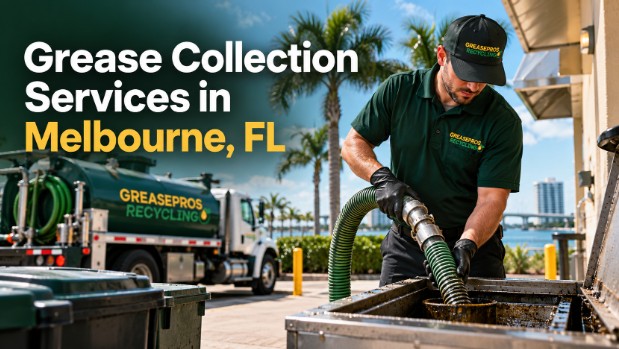
Grease collection in Melbourne covers two separate waste streams: wastewater grease captured in a plumbed interceptor, and spent fryer oil stored in a sealed container.
Each stream follows a different rule, and the governing rule depends on whether a kitchen’s sewer connects to the City of Melbourne system or Brevard County’s.
Most Melbourne restaurants connect to the city system, so City Code Chapter 58 governs their interceptor rather than county code.
GreasePros Recycling LLC, a licensed used cooking oil transporter serving Melbourne, Florida, provides used cooking oil collection across Brevard County.
A short call establishes which utility serves the address and what the kitchen needs. Melbourne operators can request a service assessment from GreasePros Recycling.
GreasePros Recycling provides scheduled used cooking oil collection, emergency retrieval, hood cleaning, commercial drain maintenance, and grease interceptor service for restaurants, hotels, schools, hospitals, and corporate cafeterias in Melbourne.
Free lockable containers come in 55-gallon, 140-gallon, and 240-gallon sizes. Collection runs weekly, biweekly, or monthly, and the schedule is set based on an on-site review of a kitchen’s actual fryer output rather than a figure assigned by business type — a distinction that matters most for seasonal operations whose output shifts throughout the year.
Interceptor pump-out and used cooking oil collection require different credentials, and a provider’s authority for one does not grant authority for the other.
Operators evaluating any hauler, including this one, should ask which entity performs each service and under which current license. The company publishes its credentials on its credentials and licensing page.
The City of Melbourne regulates it directly. The city’s public works and utilities department runs its own water reclamation system — the David B. Lee facility in the north at 6 million gallons per day and the Grant Street facility in the south at 5.5 million gallons per day — serving more than 29,000 households and businesses across about 45 square miles, mostly within the incorporated city.
Grease rules follow the sewer connection, not the postal address. A restaurant on the city system must comply with City Code Chapter 58, Article IV, Division 3, the sewer use regulations.
Brevard County’s separate program governs facilities discharging into the county-owned collection system, which is a different network with different requirements.
Operators who do not know which system serves their building should confirm it with the utility before applying any interval or threshold they have read about.
The two codes differ materially, and a service schedule built against the wrong one may not satisfy the authority that actually inspects.
Section 58-287(c) requires the user to install grease, oil, and sand interceptors whenever the utilities coordinator or the building department determines wastewater carries excessive grease, oil, or sand. Residential users are exempt.
Four duties follow from that provision. The interceptor must be of a type and capacity approved by the city. It must sit where it is easily accessible for cleaning and inspection.
The owner must properly remove and dispose of captured material by appropriate means. The owner must maintain records of the dates and methods of removal and disposal, subject to city review.
The provision states no fixed interval, which does not reduce the maintenance obligation. Proper removal and disposal, interceptor condition, approved capacity, and any site-specific permit conditions set by the utility all remain in force independently of how often service occurs.
Recordkeeping is one duty among those, not a substitute for them. A waste disposal firm must remove and haul in accordance with department regulations, and section 58-289 requires waste haulers to hold wastewater discharge permits.
If you’re ready to get started, call us now!
Out of the building in a sealed container, not into the sewer. Section 58-281(b)(7) prohibits introducing substances that may solidify or become viscous at temperatures between 32 and 100 degrees Fahrenheit, which describes cooling fryer oil.
Two further prohibitions in the same section reinforce it: no solids greater than one-half inch in any dimension, and no wastewater above 140 degrees Fahrenheit.
| Factor | Interceptor Waste | Spent Fryer Oil |
| Source | Sink, dishwasher, and food prep wastewater | Oil poured directly from fryers |
| Path | Plumbed interceptor, pumped out on site | Sealed, lockable container collected on schedule |
| City rule | Section 58-287 installation and recordkeeping duties | Section 58-281 prohibits discharge to the sewer |
| State framework | Florida Statute 403.0741 grease waste provisions | Expressly outside 403.0741’s interceptor definition |
| Documentation | Statutory service manifest | Collection record issued by the hauler |
| Destination | Facility permitted to receive grease waste | Processing facility for recycled fuel products |
An interceptor pump-out does nothing about fryer oil, and an oil pickup does nothing about the interceptor. Grease trap cleaning and oil pickup differ in equipment, schedule, and paperwork, and collected oil moves on to biodiesel processing.
The two streams generate different paperwork, and the statute says so directly. Section 403.0741 defines a grease interceptor or grease trap as a receptacle wastewater flows through before entering a drainage system, and states that the term does not include receptacles designed specifically for collecting used cooking oil or fats and bones.
That exclusion is the dividing line. Interceptor waste falls inside the statutory manifest regime; used cooking oil collected from a dedicated container does not.
A hauler still issues collection records for oil pickup, but those are business documentation rather than a statutory service manifest, and the two should be filed as what they are.
For interceptor service, the statute requires a signed manifest that includes the names, addresses, and phone numbers for the originator, hauler, and disposal facility; the condition of the interceptor; confirmation that the device was cleaned without returning graywater; the amounts removed and disposed; and the facility’s billing receipt or ticket number.
The originator and hauler sign after removal; the facility operator and hauler sign after disposal.
Within 30 days, copies go to the originator and to the county and municipality, and both the originator and hauler retain the signed manifest on site for one year.
Section 403.0741 also assumes an originator has a contract with a hauler for grease waste removal, which an inspecting entity verifies.
A Melbourne kitchen preparing for an inspection can work through a short list:
Container size and pickup frequency follow an on-site look at actual output. Melbourne kitchens can book that assessment with GreasePros Recycling at no charge.
Addresses served by Brevard County’s collection system fall under a more prescriptive regime, with fixed intervals and numeric thresholds that city code does not impose.
| Requirement | City of Melbourne System | Brevard County System |
| Governing code | City Code ch. 58, art. IV, div. 3 | County Code §§ 110-70 to 110-73 |
| Permit | Wastewater discharge permit provisions | Fats, oil and grease discharge certificate, 12 months |
| Device required when | Coordinator or building department determines it necessary | Required for new facilities discharging FOG to the county system |
| Service interval | None stated in the cited provision | Interceptors every 90 days; traps every 30 days |
| Failure thresholds | Not specified numerically | Grease over 6 inches, solids over 8 inches, or over 25% of water column |
| Owner duties | Approved type and capacity, accessibility, proper disposal, records | Scheduled pump-outs plus threshold compliance |
The county program also sets a minimum 80% removal efficiency for animal fats and vegetable oils and outright prohibits connecting fryers to an interceptor.
Operators running sites on both systems — common for groups with locations in Melbourne and in Merritt Island or Palm Bay — need each address scheduled against whichever rule governs it.
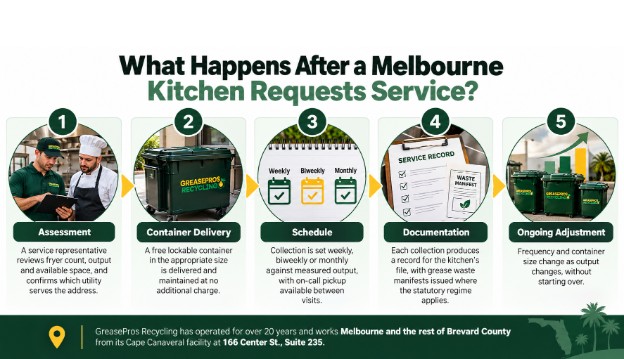
Service begins with an assessment rather than a phone quote, because container sizing depends on output that varies by kitchen.
GreasePros Recycling has operated for over 20 years and works Melbourne and the rest of Brevard County from its Cape Canaveral facility at 166 Center St., Suite 235.
Emergency retrieval for overflows, spills, and container damage runs 24/7 at (786) 655-7070 — especially during hurricane season, which the National Hurricane Center sets as June 1 through November 30, when a full container ahead of a storm becomes both a spill risk and a reopening delay.
The service process page details each visit, and emergency retrieval is documented separately.
Separate streams need separate paperwork, and one provider can provide both sets of records. Melbourne restaurants can set up collection with GreasePros Recycling this month.
Does a Melbourne restaurant need a grease interceptor?
City of Melbourne Code section 58-287 requires grease, oil, and sand interceptors when the utilities coordinator or building department determines wastewater carries excessive grease, oil, or sand. Residential users are exempt. The city must approve the type and capacity before installation. Accessibility for inspection is also required.
How often must a Melbourne grease interceptor be cleaned?
City Code states no fixed cleaning interval inside Melbourne city limits. Section 58-287 places responsibility on the owner to properly remove and dispose of captured material and to maintain records of removal dates and methods, subject to city review. Site-specific conditions may apply.
Does Florida’s grease waste manifest law cover used cooking oil?
No. Florida Statute 403.0741 defines a grease interceptor or grease trap as a receptacle wastewater flows through and expressly excludes receptacles designed specifically to collect used cooking oil. Haulers document oil collection in hauler-issued records, not statutory service manifests.
Can fryer oil be poured down a Melbourne drain?
No. Section 58-281 prohibits discharging substances that solidify or become viscous between 32 and 100 degrees Fahrenheit, which describes cooling fryer oil. The same section bars solids over one-half inch and wastewater above 140 degrees. Place spent oil in a sealed container.
What must a grease waste manifest contain?
Florida Statute 403.0741 requires the originator, hauler, and disposal facility names and addresses, phone numbers, the interceptor’s condition, confirmation that graywater was not returned, the amounts removed and disposed, and the facility’s billing receipt or ticket number. Signatures follow removal and disposal.
How long must grease waste records be kept?
Florida Statute 403.0741 requires the originator and hauler to keep the signed manifest on site for one year and deliver copies to the originator, county, and municipality within 30 days of disposal. City recordkeeping duties under section 58-287 run alongside.
Do Brevard County rules apply to restaurants in Melbourne?
Brevard County Code sections 110-70 through 110-73 govern facilities discharging into the county-owned collection system. Restaurants connected to the City of Melbourne’s wastewater system follow City Code Chapter 58. The serving utility, not the mailing address, determines which applies to a site.
Who may haul grease waste from a Melbourne kitchen?
Section 58-287 requires a waste disposal firm to remove and haul grease waste in compliance with department regulations, and section 58-289 requires waste haulers to hold wastewater discharge permits. Florida DEP licenses grease waste haulers separately under Chapter 62-705, Florida Administrative Code, before service begins.
How are container size and pickup frequency decided?
GreasePros Recycling sets both after an on-site assessment of a kitchen’s actual fryer output rather than assigning a figure by business category. Containers come in 55-gallon, 140-gallon, and 240-gallon sizes, with weekly, biweekly, or monthly collection. Schedules adjust as output changes.
Which areas does GreasePros Recycling serve from Cape Canaveral?
From its Cape Canaveral facility, GreasePros Recycling serves Melbourne, Palm Bay, Titusville, Cocoa, Merritt Island, and Viera, and operates statewide with centralized billing for operators running multiple locations across different counties and utility jurisdictions. Each location keeps its own records.
Founded with a vision to revolutionize the used cooking oil recycling industry, GreasePros Recycling has established itself as a trusted and leading provider of sustainable waste management solutions. With over 20 years of experience, our dedicated team brings extensive expertise and a commitment to environmental stewardship.
Quick Links
Contact Information
Get in Touch with GreasePros
