Trusted and leading provider of sustainable waste management solutions from 20 years. (786) 655-7070
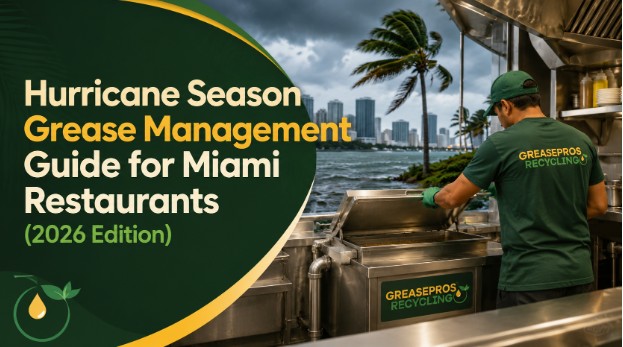
Miami restaurants that fail to secure grease containers and maintain FOG compliance documentation before a hurricane face DERM fines, DBPR emergency closures, and environmental penalties that insurance does not cover.
GreasePros Recycling LLC, a licensed South Florida used cooking oil hauler with over 20 years of operation and DERM permits across all 34 Miami-Dade municipalities, provides emergency oil retrieval with 48-hour pre-storm collection, hurricane-rated containers built to withstand 150+ mph winds, and post-storm priority service to help restaurants reopen faster.
A single unsecured grease drum can cost a Miami restaurant thousands in cleanup fines and weeks of lost revenue — schedule a pre-storm pickup with GreasePros Recycling before the next watch is issued.
NOAA’s May 2026 Atlantic hurricane season outlook projects a 55% chance of a below-normal season, with 8 to 14 named storms, 3 to 6 hurricanes, and 1 to 3 major hurricanes expected between June 1 and November 30, 2026.
A developing El Niño pattern is expected to increase vertical wind shear across the tropical Atlantic, which historically suppresses storm formation. Colorado State University’s June 2026 forecast similarly projects 13 named storms, 6 hurricanes, and 2 major hurricanes.
A below-normal seasonal forecast does not eliminate the risk of a single catastrophic landfall in South Florida. Hurricane Andrew struck Miami-Dade County in 1992 during an El Niño year, producing Category 5 winds that destroyed thousands of structures.
One hurricane making landfall in Miami-Dade can overwhelm grease infrastructure across the county in a matter of hours — flooding ground-level grease interceptors, toppling unsecured oil drums, and pushing fats, oils, and grease directly into the storm drain system.
Storm surges can flood ground-level grease interceptors, diluting contents and pushing FOG into municipal sewer lines. High winds can displace unsecured outdoor oil containers, creating oil spills across parking lots, dumpster pads, and drainage pathways.
Power outages disable automated grease trap monitoring systems, leaving operators unable to track interceptor capacity. Extended closures allow residual grease to solidify inside plumbing, creating blockages that compound when the restaurant attempts to reopen.
Miami-Dade County operates under a federal court order that requires strict FOG control through its Grease Discharge Operating Permit program. That enforcement framework does not pause during hurricane season — it intensifies.
Operators who allow FOG to enter the sewer system during a storm face the same fines and compliance actions as operators who violate the program under normal conditions.
If you’re ready to get started, call us now!
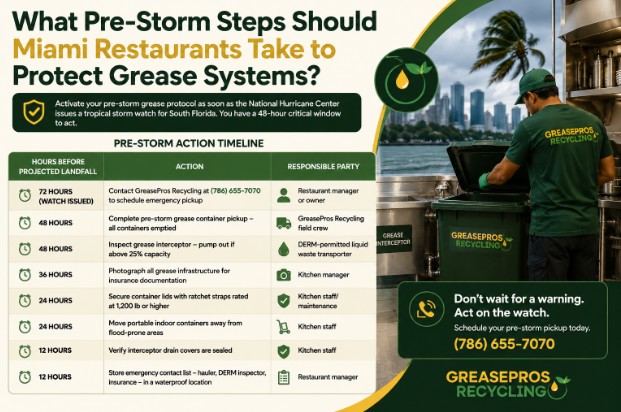
Every Miami restaurant operating under a GDO permit should activate a pre-storm grease protocol the moment the National Hurricane Center issues a tropical storm watch for South Florida. The 48-hour window between a watch and potential landfall is the critical action period for grease management.
GreasePros Recycling activates a documented pre-storm collection protocol when a tropical storm watch is issued for any part of South Florida. The protocol works on a simple principle: an empty container cannot spill.
Restaurants should contact their UCO hauler immediately upon a watch announcement — not when a warning is upgraded — because hauler capacity fills rapidly as every food service operator in the county requests service simultaneously.
| Hours Before Projected Landfall | Action | Responsible Party |
| 72 hours (watch issued) | Contact GreasePros Recycling at (786) 655-7070 to schedule an emergency pickup | Restaurant manager or owner |
| 48 hours | Complete pre-storm grease container pickup — all containers emptied | GreasePros Recycling field crew |
| 48 hours | Inspect grease interceptor — pump out if above 25% capacity | DERM-permitted liquid waste transporter |
| 36 hours | Photograph all grease infrastructure for insurance documentation | Kitchen manager |
| 24 hours | Secure container lids with ratchet straps rated at 1,200 lb or higher | Kitchen staff/maintenance |
| 24 hours | Move portable indoor containers away from flood-prone areas | Kitchen staff |
| 12 hours | Verify interceptor drain covers are sealed | Kitchen staff |
| 12 hours | Store emergency contact list — hauler, DERM inspector, insurance — in a waterproof location | Restaurant manager |
Restaurants that wait until a hurricane warning is issued — typically 36 hours before landfall — often find haulers at capacity, with no trucks available. The 48-hour pre-storm pickup window exists specifically to prevent that bottleneck.
Outdoor used cooking oil containers that are not anchored to a permanent structure become projectiles in hurricane-force winds.
A standard 240-gallon container filled with oil weighs approximately 1,800 pounds, but a Category 4 hurricane producing sustained winds above 130 mph can displace containers that lack engineered anchoring.
GreasePros Recycling provides hurricane-rated, locked containers engineered to withstand 150+ mph winds through a combination of ground-bolt anchoring, reinforced lid latches, and a low-profile design that reduces wind load.
The 150 mph rating exceeds Category 4 sustained wind speeds on the Saffir-Simpson scale, which top out at 156 mph.
| Security Measure | Standard | Verification Method |
| Ground-bolt anchoring | Bolted to concrete pad or permanent structure | Visual inspection of bolt integrity — quarterly and before each storm |
| Lid latch rating | Ratchet straps rated at 1,200 lb minimum | Check strap condition and replacement date |
| Container wind rating | 150+ mph sustained wind resistance | Verify with the hauler’s documentation |
| Placement elevation | Above the projected storm surge line for the specific location | Cross-reference with Miami-Dade flood zone maps |
| Tamper-proof lock | Cast locking mechanism on container lid | Confirm lock engagement before evacuation |
| Secondary containment | Spill berms or containment trays around outdoor containers | Inspect for cracks, gaps, or drainage obstructions |
Restaurants using containers not rated for hurricane conditions should replace them before the season begins. GreasePros Recycling provides free hurricane-rated containers in 55-gallon, 140-gallon, and 240-gallon sizes, plus compact under-counter tanks for tight kitchen configurations.
Your grease containers are either hurricane-ready or they are a liability — request free hurricane-rated containers from GreasePros Recycling before the next storm watch.
If you’re ready to get started, call us now!
The hours after a hurricane passes through Miami-Dade County are among the most compliance-intensive for restaurant operators.
Three separate regulatory frameworks apply simultaneously: Miami-Dade DERM’s FOG control program, the Florida DBPR’s Division of Hotels and Restaurants food safety inspection requirements, and the FDA’s post-disaster reopening guidelines.
Miami-Dade DERM requires restaurant operators to inspect grease interceptors for damage, overflow, and loose components within 24 hours after any significant storm under Ordinance No. 18-22.
That 24-hour clock starts when the storm passes — not when the restaurant reopens. Operators who delay the post-storm interceptor inspection risk automatic enforcement action when DERM inspectors begin their own rounds, which typically occur within 48 to 72 hours after a named storm.
The Florida DBPR’s Division of Hotels and Restaurants can require a post-storm inspection before a restaurant resumes operations if the establishment experienced flooding, structural damage, or extended power loss. The FDA’s post-hurricane reopening guidance requires food service establishments to verify the following before serving food again:
All refrigeration equipment must maintain time and temperature control for safety (TCS) foods at 41°F or below. Cooking equipment must reach 145°F or higher for raw animal foods. Perishable food held above 40°F for 2 cumulative hours or more must be discarded.
The establishment must confirm potable water supply, complete pest inspection, sanitize all food-contact surfaces with approved chemical sanitizers, and verify that the sewer system is functioning without backups.
Restaurants should follow this sequence within the first 24 hours after the storm passes, before contacting DBPR for a reopening inspection:
Inspect all outdoor grease containers for displacement, lid breaches, and structural cracks. Photograph damage for insurance and compliance records. Check grease interceptors for flooding — storm surges can push water and debris into ground-level units, diluting trapped FOG and causing overflow into sewer connections.
Contact GreasePros Recycling at (786) 655-7070 for priority post-storm pickup — the company provides priority service for restaurants supporting Miami-Dade’s tourism recovery.
Verify that the sewer connection from the interceptor to the municipal system is functioning before running any kitchen equipment. Schedule a grease trap pump-out if the interceptor was flooded, even if the last cleaning occurred recently.
DERM’s electronic FOG portal does not pause enforcement during storms. Miami-Dade County Code § 24-42.6 requires electronic reporting of every grease interceptor pump-out by the 20th of the following month, and the portal’s automated system cross-checks permits and pump-out logs nightly.
A hurricane that disrupts normal pump-out schedules creates documentation gaps that trigger automatic administrative fees.
| Document | Purpose | Deadline |
| Post-storm interceptor inspection photos (timestamped) | Proves 24-hour compliance with Ordinance No. 18-22 | Within 24 hours of the storm passing |
| Emergency pump-out manifest from DERM-permitted hauler | Documents post-storm FOG removal for portal reporting | Before reopening |
| DERM electronic FOG portal report | Records pump-out date and hauler name | By the 20th of the following month |
| Food temperature logs (TCS food monitoring) | Demonstrates FDA compliance for DBPR inspection | Continuous from power restoration |
| Equipment sanitization records | Confirms decontamination of food-contact surfaces | Before reopening |
| Container damage assessment (photos + written log) | Supports insurance claims and documents compliance efforts | Within 48 hours of the storm passing |
| Staff training acknowledgment (post-storm procedures) | Satisfies DERM quarterly training documentation under § 24-42.6 | Within 7 days of reopening |
GreasePros Recycling generates signed service manifests formatted for submission to Miami-Dade’s electronic FOG portal under Section 24-42.6 and supports GDO permit renewal documentation specifically for Miami-Dade operators.
Restaurants that use a hauler without DERM-specific manifest formatting face a higher administrative burden when reconciling post-storm pump-outs with portal records.
Protect your Miami restaurant from the next storm — call GreasePros Recycling at (786) 655-7070 to schedule your pre-season grease system audit and lock in priority hurricane response.
When should a Miami restaurant schedule a pre-storm grease pickup?
Miami restaurants should schedule a pre-storm grease pickup within the first 12 hours after the National Hurricane Center issues a tropical storm watch for South Florida. GreasePros Recycling completes pre-storm collection within 48 hours of a forecasted landfall, but hauler capacity fills quickly when all operators call simultaneously.
What wind rating should grease containers have for the Miami-Dade hurricane season?
Grease containers in Miami-Dade County should be rated for sustained winds of 150 mph or higher, which exceeds Category 4 hurricane wind speeds on the Saffir-Simpson scale. GreasePros Recycling provides free hurricane-rated locked containers in 55-gallon, 140-gallon, and 240-gallon sizes that meet this standard.
Does Miami-Dade DERM require grease interceptor inspection after a hurricane?
Miami-Dade DERM requires restaurant operators to inspect grease interceptors for damage, overflow, and loose components within 24 hours after any significant storm under Ordinance No. 18-22. Failure to complete the inspection within that window can trigger enforcement action during the post-storm DERM inspection cycle.
What happens to grease containers if a restaurant evacuates before a hurricane?
Containers left in place during evacuation must be fully emptied, anchored with ground bolts, and secured with ratchet straps rated at 1,200 lb or higher before the restaurant staff departs. GreasePros Recycling completes pre-storm pickup and container securing as part of the 48-hour pre-storm protocol.
Can a Miami restaurant reopen after a hurricane without a health inspection?
Florida DBPR may require a post-storm inspection before a restaurant resumes operations if the establishment experienced flooding, structural damage, or extended power loss. The FDA requires all food service establishments affected by hurricanes to obtain authorization from the local or state regulatory authority before reopening.
What food must be discarded after a hurricane-related power outage?
All perishable TCS foods — including meat, poultry, seafood, dairy, and cut produce — that are held above 40°F for a cumulative total of 2 hours or more must be discarded, per FDA Food Code requirements. Frozen TCS food that has fully thawed above 32°F cannot be refrozen and must be cooked immediately or discarded.
How does FOG portal reporting work after a storm disrupts the normal pump-out schedule?
Miami-Dade County Code § 24-42.6 requires electronic reporting of every grease interceptor pump-out by the 20th of the following month, regardless of storm disruptions. Restaurants should schedule an emergency post-storm pump-out and report it through the DERM electronic FOG portal before the monthly deadline.
Does GreasePros Recycling provide post-hurricane priority grease service?
GreasePros Recycling provides post-storm priority service for restaurants supporting Miami-Dade’s tourism recovery. The company dispatches from its West Park, Florida, facility, with 2- to 4-hour emergency response times across all 34 incorporated Miami-Dade municipalities, available 24/7 at (786) 655-7070.
What documentation should restaurants photograph before a hurricane for insurance purposes?
Restaurant operators should photograph all outdoor grease containers, grease interceptor access points, secondary containment structures, and indoor oil storage tanks, with timestamps, at least 24 hours before the projected landfall. These pre-storm photos establish a baseline that accelerates insurance claim processing for storm-related damage to grease infrastructure.
Are FOG fines covered by hurricane insurance policies?
Environmental fines issued by Miami-Dade DERM for FOG releases into stormwater or sewer systems are typically not covered by standard commercial property or hurricane insurance policies. The restaurant operator bears full financial responsibility for cleanup costs and regulatory penalties resulting from improper FOG discharge during or after a storm.
Founded with a vision to revolutionize the used cooking oil recycling industry, GreasePros Recycling has established itself as a trusted and leading provider of sustainable waste management solutions. With over 20 years of experience, our dedicated team brings extensive expertise and a commitment to environmental stewardship.
Quick Links
Contact Information
Get in Touch with GreasePros