Trusted and leading provider of sustainable waste management solutions from 20 years. (786) 655-7070
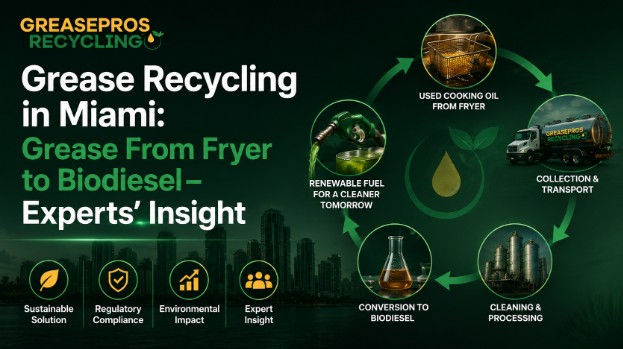
Miami’s 15,000-plus food service establishments generate approximately 2.3 million gallons of used cooking oil annually, and licensed haulers convert that waste into ASTM D6751-grade biodiesel through a chemical process called transesterification — yielding up to 90–97% fuel recovery per gallon of feedstock while reducing lifecycle greenhouse gas emissions by up to 86% compared to petroleum diesel.
One gallon of improperly disposed of cooking oil can contaminate up to 1 million gallons of fresh water, according to the U.S. Environmental Protection Agency.
Miami restaurants that recycle through a licensed hauler under Florida Statute § 403.0741 prevent contamination, maintain compliance with Miami-Dade DERM, and route high-value feedstock into South Florida’s renewable diesel supply chain.
Miami-Dade County’s restaurant industry generates approximately 2.3 million gallons of used cooking oil annually across more than 15,000 food service establishments, according to GreasePros Recycling’s Miami service data.
A single full-service kitchen produces 35 pounds of spent fryer oil per day on average — approximately 150 gallons per month for a restaurant operating 4 fryers on a standard schedule.
Miami-Dade’s total UCO output represents a substantial fraction of the national waste stream. The U.S. Environmental Protection Agency estimated in 2017 that American restaurants and hotels generate 3 billion gallons of used cooking oil per year — enough to offset approximately 10% of domestic diesel demand if fully converted to biodiesel.
Miami-Dade’s 2.3-million-gallon share reflects the county’s position as one of the nation’s densest concentrations of food-service establishments, driven by a $15.9 billion hospitality economy that serves over 26 million annual visitors.
That volume also creates a significant environmental liability. Miami’s humid subtropical climate accelerates grease decomposition in sewer lines, and the county’s flat water table means FOG (Fats, Oils, and Grease) discharges threaten Biscayne Bay’s ecosystem faster than in most U.S. metropolitan areas.
Restaurants that fail to maintain GDO permits and proper hauler documentation risk an automatic $250 administrative fee per missed manifest cycle under Miami-Dade Ordinance No. 18-22.
If you’re ready to get started, call us now!
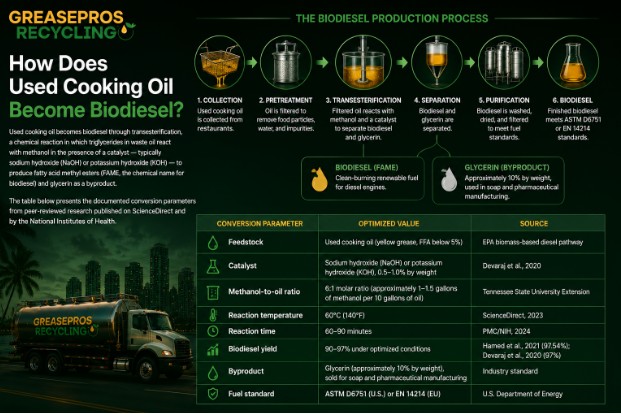
Used cooking oil becomes biodiesel through transesterification, a chemical reaction in which triglycerides in waste oil react with methanol in the presence of a catalyst — typically sodium hydroxide (NaOH) or potassium hydroxide (KOH) — to produce fatty acid methyl esters (FAME, the chemical name for biodiesel) and glycerin as a byproduct.
The table below presents the documented conversion parameters from peer-reviewed research published on ScienceDirect and by the National Institutes of Health.
| Conversion Parameter | Optimized Value | Source |
| Feedstock | Used cooking oil (yellow grease, FFA below 5%) | EPA biomass-based diesel pathway |
| Catalyst | Sodium hydroxide (NaOH) or potassium hydroxide (KOH), 0.5–1.0% by weight | Devaraj et al., 2020 |
| Methanol-to-oil ratio | 6:1 molar ratio (approximately 1–1.5 gallons of methanol per 10 gallons of oil) | Tennessee State University Extension |
| Reaction temperature | 60°C (140°F) | ScienceDirect, 2023 |
| Reaction time | 60–90 minutes | PMC/NIH, 2024 |
| Biodiesel yield | 90–97% under optimized conditions | Hamed et al., 2021 (97.54%); Devaraj et al., 2020 (97%) |
| Byproduct | Glycerin (approximately 10% by weight) is sold for soap and pharmaceutical manufacturing | Industry standard |
| Fuel standard | ASTM D6751 (U.S.) or EN 14214 (EU) | U.S. Department of Energy |
The conversion process follows 5 documented stages. Licensed processors first filter collected UCO to remove food particles and water. Heated oil then mixes with methanol and the catalyst in a reaction vessel for 60–90 minutes at 60°C.
The resulting mixture separates into two layers — biodiesel on top and glycerin on the bottom. Processors wash the biodiesel with water to remove residual catalyst and methanol, then test the final product against ASTM D6751 standards before distribution.
GreasePros Recycling routes all collected Miami-Dade UCO to certified Florida processing facilities that produce ASTM-grade biodiesel and renewable diesel for regional distribution.
Recycling Miami’s 2.3 million gallons of used cooking oil prevents two categories of environmental damage: water contamination from improper disposal and greenhouse gas emissions from petroleum diesel consumption.
Water contamination: One gallon of improperly disposed oil contaminates up to 1 million gallons of fresh water — a year’s drinking supply for 50 people — according to the U.S. EPA. Oil that enters storm drains or sewer systems forms a surface film that blocks oxygen exchange and suffocates aquatic life.
In Miami-Dade County, where the flat water table sits less than 10 feet below the surface in most areas, FOG discharges reach Biscayne Bay’s ecosystem within hours through the county’s limestone bedrock.
Greenhouse gas reduction: The EPA classifies waste-grease biodiesel as a “biomass-based diesel” pathway under the Renewable Fuel Standard (RFS2), requiring a minimum 50% lifecycle greenhouse gas reduction compared to petroleum diesel.
Independent lifecycle analyses find that UCO-derived biodiesel delivers up to an 86% CO₂-equivalent reduction. Each gallon of biodiesel that displaces petroleum diesel keeps approximately 22 pounds of CO₂ from entering the atmosphere.
The table below quantifies the environmental impact of Miami’s annual UCO volume at documented conversion rates.
| Metric | Value | Calculation Basis |
| Annual UCO generated (Miami-Dade) | 2.3 million gallons | 15,000+ restaurants, ~150 gal/month average |
| Biodiesel yield at 90% conversion | 2.07 million gallons | 2.3M × 0.90 |
| CO₂ displaced at 22 lbs/gallon | 45.5 million pounds (22,750 tons) | 2.07M × 22 lbs |
| Fresh water protected from contamination | 2.3 trillion gallons (if disposed of improperly) | 2.3M × 1 million gallons per EPA |
| GHG reduction vs. petroleum diesel | Up to 86% lifecycle reduction | EPA biomass-based diesel pathway; independent LCA studies |
Miami restaurants that dump fryer oil instead of recycling it waste a feedstock worth $0.15–$0.55 per gallon in rebates and risk $250 DERM fines per missed manifest — GreasePros Recycling collects for free with locked containers. Call (786) 655-7070.
Every food service establishment in Miami-Dade County — restaurants, cafeterias, bakeries, coffee shops, juice bars, and hotel kitchens — requires a current Grease Discharge Operating (GDO) Permit issued by the Miami-Dade Department of Environmental Resources Management (DERM) under Section 24-42.6 of the Miami-Dade County Code.
GDO permit holders must maintain 4 categories of documentation: a valid annual permit (all GDO permits expire December 31 and require renewal), a working grease interceptor with maintenance records, signed service manifests from a licensed UCO hauler for every collection event, and electronic Liquid Waste Transporter Manifest submissions by the 20th of each month through Miami-Dade’s FOG portal.
Miami-Dade’s automated nightly manifest audit assesses a $250 administrative fee whenever a pump-out log is more than 90 days old.
Restaurants that fail to maintain compliant hauler records also risk suspension of their GDO permit, which triggers a mandatory DERM inspection before service can resume.
Florida’s statewide regulatory framework under Florida Statute § 403.0741 sets the baseline — licensed haulers must transport UCO to permitted processing facilities and maintain signed manifests.
Miami-Dade’s Ordinance No. 18-22 adds county-specific requirements that exceed the state standard: the 25% Rule for interceptor maintenance, DERM-specific manifest formatting, and the FOG Generator Disclosure Statement requirement for commercial property transfers under Section 21-49.2.
Miami-Dade restaurants earn $0.15–$0.55 per gallon of used cooking oil from licensed haulers, with the June 2025 national average rebate sitting at approximately $0.34 per gallon according to industry pricing data.
Miami-Dade kitchens consistently report rebates at the upper end of that range — $0.40 per gallon or higher — because South Florida’s proximity to biodiesel processing facilities reduces freight deductions.
A mid-volume restaurant operating 4 fryers and producing 150 gallons of UCO per month earns approximately $60–$75 per month in rebates — $720–$900 annually — while eliminating waste disposal fees that range from $60–$300 per month for restaurants that pay for hauling instead of receiving rebates.
High-volume QSR (quick-service restaurant) operations producing 400–600 gallons per month report rebates exceeding $200 monthly.
Three factors determine rebate value: oil quality (FFA below 10% commands a 15–20% premium), monthly volume (100+ gallons unlocks premium pricing tiers), and pickup consistency (stable schedules reduce hauler logistics costs).
Restaurants that filter nightly and use locked containers to prevent oil theft see average checks 15% higher than comparable-volume operations with open or unsecured storage.
If you’re ready to get started, call us now!
Licensed haulers transport Miami’s collected UCO to certified processing facilities in South Florida, where filtered yellow grease enters the transesterification pipeline to produce 3 end products: ASTM D6751-grade biodiesel, renewable diesel (hydrotreated vegetable oil), and glycerin for soap and pharmaceutical manufacturing.
Biodiesel from Miami’s UCO stream powers commercial truck fleets, marine vessels, and backup generators throughout the Southeast — typically blended as B20 (20% biodiesel, 80% petroleum diesel) for use in standard compression-ignition engines without modification.
Renewable diesel, a chemically distinct product produced by hydrotreatment rather than transesterification, serves as a drop-in replacement for petroleum diesel in any engine or infrastructure designed for conventional diesel fuel.
Florida’s biodiesel regulatory framework supports this supply chain through 4 state-level policies documented by the U.S. Department of Energy’s Alternative Fuels Data Center:
Florida Statutes § 163.3177 and § 403.973 (Alternative Fuel Economic Development expedited permitting), § 206.874 (Biodiesel Producer Fuel Tax), § 287.16 (Biofuels Promotion for state fleet analysis), and § 215.47 (Renewable Fuels Investment authority for the State Board of Administration).
The federal Renewable Fuel Standard (RFS2) creates additional demand by mandating minimum annual volumes of biomass-based diesel — a category that includes UCO-derived biodiesel — in the national fuel supply.
GreasePros Recycling LLC (DOT #4136566) operates as a licensed used cooking oil hauler under Florida Statute § 403.0741 with DERM permits for all 34 Miami-Dade municipalities, collecting UCO from food service establishments across Miami-Dade, Broward, Palm Beach, Brevard, Orange, and Volusia counties and routing all feedstock to certified Florida biodiesel processing facilities.
The company’s collection process follows a 4-stage protocol. GreasePros installs free hurricane-rated locked containers in 4 sizes at the restaurant site.
Scheduled collection trucks pump cooled oil from the containers into DOT-registered transport vehicles. Each pickup generates a DERM-formatted manifest that documents the restaurant’s GDO permit number, collection date, volume, and the hauler’s DOT registration.
Certified Florida processors then convert the collected UCO into ASTM D6751-grade biodiesel via transesterification.
GreasePros Recycling’s 20-plus years of Miami-Dade service include bilingual English and Spanish dispatch, field crews, and documentation; 48-hour pre-storm collection protocols during hurricane season (June 1 through November 30); and same-day emergency response from the company’s West Park, Florida base for spills, overflows, and compliance emergencies.
Every gallon your kitchen produces is worth $0.15–$0.55 in rebates and displaces 22 pounds of CO₂ when converted to biodiesel. GreasePros Recycling collects it for free, provides DERM-compliant manifests, and keeps your GDO permit current. Call (786) 655-7070 or request service online.
How many gallons of used cooking oil does Miami produce each year?
Miami-Dade County’s 15,000-plus food service establishments generate approximately 2.3 million gallons of used cooking oil annually. A single full-service kitchen averages 150 gallons per month from 4 fryers, making Miami-Dade one of the densest UCO-producing markets in the United States.
What is transesterification, and how does it convert oil to biodiesel?
Transesterification is a chemical reaction in which triglycerides in used cooking oil react with methanol and a catalyst — sodium hydroxide or potassium hydroxide — to produce fatty acid methyl esters and glycerin. Optimized conditions yield 90–97% biodiesel recovery per gallon of feedstock.
How much CO₂ does recycling one gallon of cooking oil prevent?
Each gallon of UCO-derived biodiesel that replaces petroleum diesel keeps approximately 22 pounds of CO₂ from entering the atmosphere. The EPA classifies waste-grease biodiesel under the Renewable Fuel Standard as biomass-based diesel, requiring a minimum 50% lifecycle greenhouse gas reduction.
Can one gallon of cooking oil really contaminate a million gallons of water?
The U.S. Environmental Protection Agency confirms that one gallon of improperly disposed oil contaminates up to one million gallons of fresh water — enough drinking water for 50 people for an entire year. Oil forms a surface film that blocks oxygen exchange and suffocates aquatic life.
How much money can Miami restaurants earn from used cooking oil?
Miami-Dade restaurants earn $0.15–$0.55 per gallon from licensed haulers, with local rates averaging $0.40 per gallon or higher due to proximity to biodiesel processing facilities. A mid-volume restaurant producing 150 gallons per month earns approximately $60–$75 in rebates per month.
What fuel standard does biodiesel from used cooking oil meet?
Biodiesel produced from used cooking oil must meet the ASTM D6751 standard in the United States or the EN 14214 standard in the European Union before distribution. Certified processing facilities test every batch for viscosity, flash point, sulfur content, and cetane number before releasing the fuel for commercial sale.
Does Florida have laws supporting biodiesel production from restaurant oil?
Florida maintains 4 biodiesel-related statutes documented by the U.S. Department of Energy: Florida Statutes § 163.3177 and § 403.973 for expedited biofuel facility permitting; § 206.874 for biodiesel producer fuel tax; § 287.16 for state fleet biofuels analysis; and § 215.47 authorizing renewable fuels investment.
What is the difference between biodiesel and renewable diesel?
Biodiesel is produced through transesterification and blended with petroleum diesel — typically as B20 — for use in standard engines. Renewable diesel is produced through hydrotreatment, a different chemical process, and functions as a drop-in replacement for petroleum diesel with no blending requirement or engine modification.
Do all Miami-Dade restaurants need a GDO permit for grease disposal?
Every food service establishment in Miami-Dade County is required to hold a current Grease Discharge Operating Permit from DERM under Section 24-42.6 of the Miami-Dade County Code. All GDO permits expire on December 31 annually, and the county’s automated manifest audit assesses a $250 fee when pump-out logs are more than 90 days old.
What happens to the glycerin byproduct from biodiesel conversion?
Glycerin accounts for approximately 10% by weight of the transesterification output and sells as a commercial feedstock for soap manufacturing, pharmaceutical production, cosmetics, and food-grade applications. Glycerin revenue offsets processing costs for biodiesel facilities, improving the overall economics of the UCO-to-fuel conversion chain.
How does GreasePros Recycling prevent oil theft from restaurant containers?
GreasePros Recycling installs free hurricane-rated locked containers with tamper-proof lids across all 4 container sizes. Locked storage prevents the estimated $250 per month in oil theft losses reported by Miami restaurants with open or unsecured containers, while maintaining chain-of-custody documentation for DERM compliance.
What is the B20 biodiesel blend, and where is it used?
B20 is a fuel blend containing 20% biodiesel and 80% petroleum diesel, compatible with standard compression-ignition engines without modification. Miami-Dade County tested B20 blends in transit buses after Hurricane Irma to extend emergency fuel supplies and reduce black-smoke emissions on evacuation routes.
Founded with a vision to revolutionize the used cooking oil recycling industry, GreasePros Recycling has established itself as a trusted and leading provider of sustainable waste management solutions. With over 20 years of experience, our dedicated team brings extensive expertise and a commitment to environmental stewardship.
Quick Links
Contact Information
Get in Touch with GreasePros