
Trusted and leading provider of sustainable waste management solutions from 20 years. (786) 655-7070
Used cooking oil pickup in Orlando means scheduled collection of spent fryer oil from a sealed container supplied to the kitchen.
GreasePros Recycling LLC, a used cooking oil hauler serving Orlando, Florida, runs scheduled oil collection across Orange County.
Grease captured in a plumbed interceptor is a separate matter, governed by the City of Orlando or Orange County depending on the sewer connection.
A free site assessment sizes the container against real fryer output. Orlando operators can book that assessment with GreasePros Recycling.
GreasePros Recycling provides scheduled fryer oil collection, container delivery, hood cleaning, and 24/7 emergency retrieval for restaurants, hotels, hospitals, schools, food trucks, and institutional kitchens across Orlando and Orange County.
GreasePros Recycling supplies containers in 55-gallon, 140-gallon, and 240-gallon sizes, plus an under-counter unit for kitchens short on floor space, and maintains them at no extra charge.
Collection runs weekly, biweekly, or monthly, with on-call pickup available between scheduled visits. Hood cleaning covers hoods, filters, ducts, and fans.
Interceptor pumping is a separate service under separate licensing and is not what this page describes.
Orlando routes run from the Cape Canaveral dispatch base, covering Orange County and the Space Coast, and collect oil that is routed to DEP-approved processing facilities for refining into biodiesel and other recovered fuel products. Transporter credentials appear on the credentials and licensing page.
Two authorities operate side by side, and the sewer connection decides which one applies.
Within the city, the City of Orlando’s Water Reclamation Division within Public Works runs the Grease Management Program. Businesses discharging fats, oil, and grease into the city sewer register with the program, and food service establishments do so through a Grease Management Program Certificate obtained via the city’s permitting site.
The program limits grease entering the city’s public sanitary sewer network, where blockages can cause overflows. Facilities discharging petroleum-based oils, such as car washes and mechanic shops, also register. The governing provision sits in city code Chapter 30.
Outside the city, the Orange County system applies county requirements instead, administered through the Environmental Compliance Section of the county’s Water Reclamation Division.
The water and sewer bill is the quickest way to tell which applies: an account billed by the City of Orlando points to the city program, and an account billed by Orange County Utilities points to the county’s.
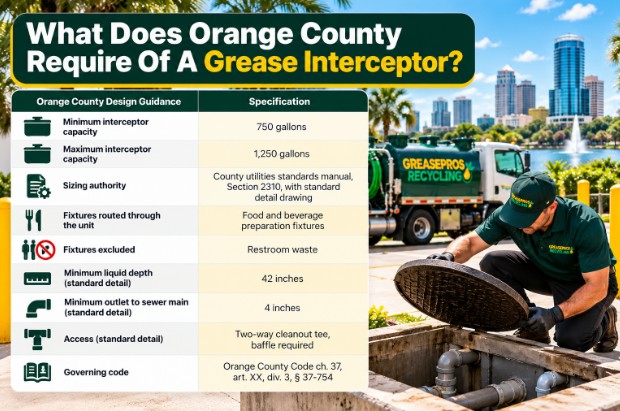
The figures below come from Orange County’s interceptor design guidance and apply to units installed for sites discharging to the county wastewater system.
County development engineering reviews sizing during permitting rather than leaving it to the installer, so the specification for any given site is set at that review.
| Orange County Design Guidance | Specification |
| Minimum interceptor capacity | 750 gallons |
| Maximum interceptor capacity | 1,250 gallons |
| Sizing authority | County utilities standards manual, Section 2310, with standard detail drawing |
| Fixtures routed through the unit | Food and beverage preparation fixtures |
| Fixtures excluded | Restroom waste |
| Minimum liquid depth (standard detail) | 42 inches |
| Minimum outlet to sewer main (standard detail) | 4 inches |
| Access (standard detail) | Two-way cleanout tee, baffle required |
| Governing code | Orange County Code ch. 37, art. XX, div. 3, § 37-754 |
A variance route exists for operations generating limited oil and grease where no grilling, frying, or cooking occurs.
Those establishments can apply to install an appropriately sized under-counter grease trap instead of meeting the 750-gallon minimum, subject to county approval by environmental compliance staff.
The county’s design guidelines also refer to the Florida Plumbing Code for underlying plumbing requirements, and alternative baffle designs are permitted when they meet code.
Collection frequency should follow seasonal output rather than staying fixed year-round. Orlando kitchens can set up oil collection through GreasePros Recycling.
If you’re ready to get started, call us now!
Into a sealed container collected on its own schedule, never into the interceptor or a drain. The two streams follow different rules and go to different destinations.
| Factor | Spent Fryer Oil | Interceptor Waste |
| Source | Oil poured straight from fryers | Food and beverage prep fixture wastewater |
| Storage | Sealed container supplied to the kitchen | Plumbed grease interceptor |
| Local authority | Outside the interceptor sizing and permitting rules | City Grease Management Program, or Orange County Code ch. 37 |
| Position under § 403.0741 | Outside that statute’s interceptor definition | Inside that statute’s manifest regime |
| Documentation under § 403.0741 | No duty arises under that section | Signed service manifest, retained one year |
| Business documentation | Hauler-issued collection record | Pump-out records for the governing authority |
The comparison above addresses Florida Statute 403.0741 specifically. That section governs grease held in a plumbed interceptor or trap and the manifests that accompany its removal, and Florida DEP licenses grease waste haulers under Chapter 62-705 on the same footing.
Separate transport, local permitting, and commercial requirements may still bear on fryer oil, and a kitchen confirming its own obligations should treat this as the boundary of one regime rather than a complete map.
Routing fryer oil into the interceptor also adds volume the unit was never sized to receive, which matters more in Orange County than elsewhere because capacity is capped at 1,250 gallons. Interceptor pumping and oil pickup differ in crew, equipment, and documentation.
Service opens with a free site assessment, and both container sizing and pricing follow from what it finds.
The assessment records the number of fryers in active use, each fryer’s oil capacity, how often oil is changed, and which days carry peak volume.
A kitchen running three fryers changed twice weekly produces a very different figure from one running the same three changed once every two weeks, which is why business type alone predicts output poorly.
Those figures set the opening container size and collection frequency, and onboarding typically completes within a week of first contact.
GreasePros Recycling then revises that opening schedule against measured data rather than leaving it fixed: driver fill logs over the first weeks of service show actual rates, and frequency moves up or down accordingly.
Each collection records the volume removed and the service date for the kitchen’s file. The service process page covers what a visit involves, and emergency retrieval runs 24/7 at (786) 655-7070 for overflows, spills, and container damage.
Orlando’s hospitality and visitor-driven kitchens produce uneven output throughout the year, so a schedule set at signup often doesn’t fit by the following quarter.
Convention activity, school calendars, holiday catering, and peak travel months all pull kitchen volume in different directions, and a hotel banquet operation can swing further between its quiet and busy periods than a neighborhood restaurant on the same street.
A container sized against a slow month fills early during a busy one, and the consequence shows up as overflow risk rather than as a billing line.
The company’s practice of reviewing frequency against driver fill data catches issues before they become problems, and on-call pickup covers the single-event spikes no schedule can anticipate. A sealed, lockable container also protects oil quality between visits, since processors must remove water and debris before refining. Kitchens in Kissimmee and St. Cloud sit on the same Central Florida routes.
Fryer oil collection and interceptor pumping are separate services with separate paperwork. Orlando restaurants can arrange oil collection with GreasePros Recycling.
Who regulates grease discharge for an Orlando restaurant?
The City of Orlando’s Water Reclamation Division runs a Grease Management Program for businesses on the city sewer, with food service establishments registering through a Grease Management Program Certificate. Addresses on the Orange County system follow county requirements instead of the city program.
What size grease interceptor does Orange County require?
Orange County’s interceptor design guidance sets capacity between 750 and 1,250 gallons for units discharging to the county system. Establishments doing no grilling, frying, or cooking may seek approval for an appropriately sized under-counter trap instead of the minimum.
Does Florida’s grease waste manifest law apply to used cooking oil?
Florida Statute 403.0741 defines a grease interceptor or trap as a wastewater device, and that definition does not include containers built to collect used cooking oil. That statute’s manifest duty therefore covers interceptor waste, not fryer oil.
Can fryer oil be poured into an Orlando drain?
No. Cooking oil contributes to deposits and blockages in sewer lines, which the city’s grease program aims to limit across its sanitary sewer network. Spent oil belongs in a sealed collection container emptied on a set schedule.
How quickly can a new Orlando account start service?
Service begins with a free site assessment, followed by container delivery and a first scheduled collection. Onboarding typically completes within a week of first contact, and the opening frequency is reviewed once real fill data comes in from the route.
How does seasonal demand affect collection in Orlando?
Hospitality and visitor-driven kitchens produce uneven output through the year, so a schedule set in a quiet month can under-serve a busy one. GreasePros Recycling reviews collection frequency against measured fill data rather than leaving it fixed for the full term.
What container sizes does GreasePros Recycling provide in Orlando?
GreasePros Recycling supplies free sealed containers in 55-gallon, 140-gallon, and 240-gallon sizes, plus an under-counter unit for space-constrained kitchens. Sizing follows a site assessment of actual fryer output rather than business category. Containers are maintained at no extra charge.
Does GreasePros Recycling offer emergency pickup in Orlando?
GreasePros Recycling provides 24/7 emergency retrieval for overflows, spills, and container damage, reachable at (786) 655-7070. Orlando routes run from the company’s Cape Canaveral dispatch base, which covers Orange County, the Space Coast, and the rest of Central Florida.
Founded with a vision to revolutionize the used cooking oil recycling industry, GreasePros Recycling has established itself as a trusted and leading provider of sustainable waste management solutions. With over 20 years of experience, our dedicated team brings extensive expertise and a commitment to environmental stewardship.
Quick Links
Contact Information
Get in Touch with GreasePros
