Trusted and leading provider of sustainable waste management solutions from 20 years. (786) 655-7070
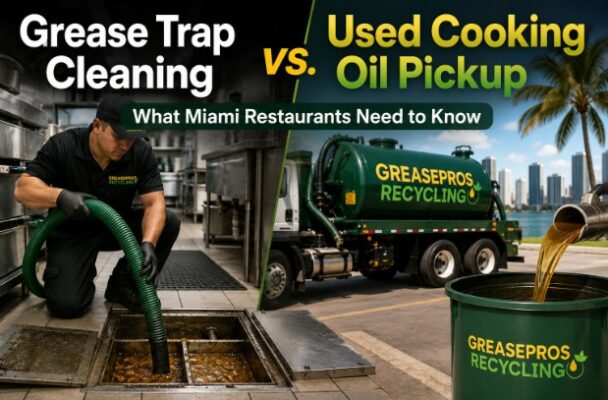
Grease trap cleaning and used cooking oil pickup are two separate services for Miami-Dade restaurants, and most full-service kitchens need both. They are governed by different rules and cover different waste streams.
Grease trap cleaning removes fats, oils, grease (FOG), and solids that build up inside a plumbed grease interceptor, while used cooking oil pickup collects spent fryer oil from a separate storage container before it ever reaches a drain.
Confusing the two — or assuming one service covers both — is a common cause of Miami-Dade compliance gaps.
Confusing these two services is one of the most common Miami-Dade compliance gaps GreasePros Recycling sees. Schedule an assessment to confirm which services your kitchen actually needs.
Grease trap cleaning is the removal of accumulated fats, oils, grease, and solids from a plumbed grease interceptor or grease trap, performed by a liquid waste transporter permitted for the task.
The waste comes from wastewater — dishwashing, food prep runoff, and drain discharge — that passes through the interceptor before reaching the sewer line, not directly from a restaurant’s fryers.
Miami-Dade classifies grease interceptors as either hydromechanical (smaller, often installed indoors, relying on flow control and baffles) or gravity units (larger, tank-based, retention systems).
Under Miami-Dade County Code § 24-42.6, a gravity interceptor fitted with a functional monitoring device must be cleaned by a permitted liquid waste transporter at an interval not exceeding 180 days, and every interceptor — regardless of type — must be pumped out before combined FOG and solids depth reaches 25% of total liquid depth, a standard commonly called the 25% Rule.
Used cooking oil pickup is the collection of spent fryer and other cooking oil from a sealed storage container by a certified transporter for delivery to a processing facility, where it is converted into biodiesel or another recycled product.
Unlike grease trap waste, this oil never enters the plumbing system — kitchen staff pour cooled fryer oil directly into a locked, dedicated container.
This service falls under a separate state framework: Florida Administrative Code Rule 62-710, the Florida DEP’s used oil transporter certification program, which prohibits generators from using a transporter that isn’t certified or registered with the state.
If you’re ready to get started, call us now!
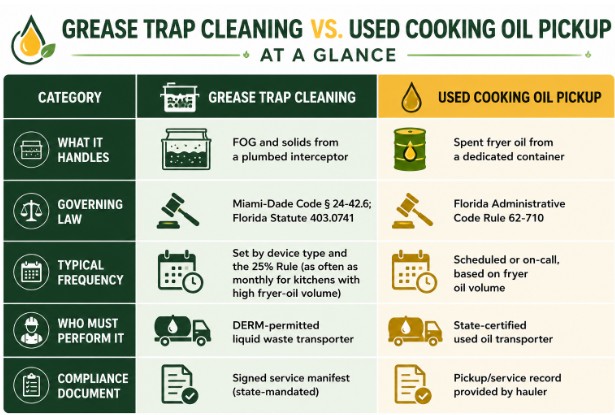
The two services are cleanly separated by waste source, governing law, and typical frequency, which is why a single “grease service” often doesn’t cover a kitchen’s full obligations.
Grease Trap Cleaning vs. Used Cooking Oil Pickup at a Glance
| Category | Grease Trap Cleaning | Used Cooking Oil Pickup |
| What it handles | FOG and solids from a plumbed interceptor | Spent fryer oil from a dedicated container |
| Governing law | Miami-Dade Code § 24-42.6; Florida Statute 403.0741 | Florida Administrative Code Rule 62-710 |
| Typical frequency | Set by device type and the 25% Rule (as often as monthly for kitchens with high fryer-oil volume) | Scheduled or on-call, based on fryer oil volume |
| Who must perform it | DERM-permitted liquid waste transporter | State-certified used oil transporter |
| Compliance document | Signed service manifest (state-mandated) | Collection manifest (hauler-provided documentation) |
In practice, a kitchen’s fryer oil follows one path — dedicated UCO container to certified transporter to processing facility — while its sink and dishwashing wastewater follows a different one: drain to grease interceptor to permitted pump-out.
A restaurant that only arranges one of these two paths has addressed just one of its two waste streams.
An unmaintained grease interceptor puts a Miami-Dade kitchen at risk of sewer backups, DERM fines, and permit suspension, so the county sets clear requirements to prevent that outcome.
Any non-residential facility that introduces FOG-laden wastewater into the sewer system must hold a current Grease Discharge Operating (GDO) permit issued by DERM under Miami-Dade County Code § 24-42.6.
GDO permits run from January 1 through December 31 each year, and DERM sends renewal forms to facility operators at least 45 days before expiration, so restaurants keep continuous coverage without a compliance gap.
A permitted liquid waste transporter must perform the cleaning, and every pump-out requires a signed service manifest.
Florida Statute 403.0741 separately requires the originator and hauler to retain a copy of that manifest on-site, with Florida DEP’s own guidance confirming a minimum one-year retention period.
Exact pump-out intervals depend on the interceptor’s classification and permit conditions, so restaurant owners should confirm their specific schedule directly with DERM rather than assuming a single statewide interval applies.
An uncertified hauler collecting fryer oil puts a restaurant out of compliance with state law, even if the kitchen itself has done nothing wrong, so verifying hauler certification matters as much as scheduling the pickup.
Used cooking oil pickup falls outside the grease trap framework because Florida Statute 403.0741 explicitly excludes receptacles built specifically for collecting used cooking oil from its definition of a “grease interceptor or grease trap.”
Instead, UCO collection is governed by Florida DEP’s used oil transporter certification program under Rule 62-710, which requires the hauler — not the restaurant — to hold state certification.
Restaurants remain responsible for confirming their hauler’s certification status and for storing oil in a sealed, secure container between pickups.
GreasePros Recycling documents its own Rule 62-710 certification directly on its licensing page, along with the manifest fields it issues after every collection.
Restaurant staff pouring fryer oil down a sink or into the grease interceptor is the most frequent mistake behind both a Miami-Dade FOG disposal violation and a faster-filling interceptor that trips the 25% Rule sooner than expected. Several other mistakes recur across Miami-Dade kitchens:
If you’re ready to get started, call us now!
Running grease trap cleaning and used cooking oil pickup through separate vendors means tracking two schedules, two manifest formats, and two compliance records for what a DERM or state inspection will treat as related but distinct obligations.
The determining factor is whether a provider holds the appropriate authorization for each waste stream and documents both correctly — consolidating with one vendor is an operational convenience, not itself a compliance requirement.
GreasePros Recycling provides grease trap cleaning and UCO pickup under one account, so a Miami-Dade kitchen manager reviews one service history rather than reconciling records from separate providers.
A combined provider also simplifies container logistics: fryer oil goes into a locked UCO container the kitchen deep cleaning crew never touches, while the grease interceptor stays on its own DERM-permitted pump-out schedule — both documented through the same hauler relationship rather than two unrelated ones.
Overflow, spill, or storm-related situations don’t wait for a scheduled pickup. A dedicated emergency retrieval service covers both waste streams so a kitchen isn’t left choosing which vendor to call first.
Is grease trap cleaning the same as used cooking oil pickup? No. Grease trap cleaning removes FOG and solids from a plumbed interceptor under Miami-Dade Code § 24-42.6, while used cooking oil pickup collects fryer oil from a dedicated container under Florida Rule 62-710 — two different regulatory frameworks.
Does a Miami restaurant need both services? Most full-service kitchens need both: a grease interceptor to treat wastewater before it reaches the sewer, and a used cooking oil pickup service for fryer oil that never enters the plumbing. Requirements depend on the kitchen’s equipment and food service type.
Who is allowed to clean a grease trap in Miami-Dade? Only a liquid waste transporter permitted by Miami-Dade County under Code § 24-42.6 may legally clean and pump out a grease interceptor. Restaurants remain responsible for verifying the hauler’s permit before service begins.
How can I verify that a grease trap or used cooking oil hauler is properly permitted or certified? For grease trap service, DERM issues permit decals to authorized vehicles and publishes lists of permitted liquid waste transporters with permit numbers. For used cooking oil, Florida DEP publishes an annual list of registered used oil handlers restaurants can check before signing a service agreement.
What is the 25% Rule, and what happens if a grease trap exceeds it between cleanings? The 25% Rule requires a Miami-Dade grease interceptor to be pumped out before combined floating FOG and settled solids reach 25% of the unit’s total liquid depth. Exceeding that threshold puts the interceptor out of compliance regardless of the regular schedule, requiring an early pump-out.
How often does a Miami-Dade grease interceptor need to be cleaned? Cleaning frequency depends on interceptor type, permit conditions, and how quickly the 25% Rule threshold is reached. Miami-Dade County Code sets a maximum 180-day interval for gravity interceptors with a functional monitoring device.
What is a GDO permit, and who needs one? A Grease Discharge Operating (GDO) permit is an annual permit DERM issues to any non-residential facility that discharges FOG-laden wastewater into the Miami-Dade sewer system. The permit runs January 1 through December 31 and requires annual renewal.
Who is allowed to collect used cooking oil in Florida? Only transporters certified under Florida Administrative Code Rule 62-710 may legally collect and transport used cooking oil from commercial kitchens. This certification is separate from the local permit that covers grease trap haulers.
What records should a Miami-Dade restaurant keep for grease trap cleaning and used cooking oil pickup? Florida Statute 403.0741 requires signed grease waste manifests retained on-site for a minimum of one year, though specific Miami-Dade permit conditions may call for longer retention. Used cooking oil collections should be documented through the hauler’s collection manifest for each pickup.
What should restaurant staff do with used cooking oil between pickups? Staff should pour cooled fryer oil directly into the sealed, locked container provided by their certified hauler and never into a sink or grease interceptor. Miami-Dade County Code § 24-42.6 prohibits discharging FOG or food waste into the sewer system or stormwater drainage.
What happens if used cooking oil is poured into a sink or grease interceptor? This violates Miami-Dade County Code § 24-42.6’s prohibition on discharging FOG or food waste into the sewer system or stormwater drainage, and it adds fryer oil volume the interceptor wasn’t sized for, which can push FOG and solids past the 25% Rule threshold sooner than expected.
Can one company legally provide both grease trap cleaning and used cooking oil pickup? Yes, provided the company holds both the Miami-Dade liquid waste transporter permit for grease trap service and the state Rule 62-710 certification for used cooking oil transport. GreasePros Recycling documents both credentials on its licensing page.
Two waste streams, two sets of rules, one provider that documents both correctly. Contact GreasePros Recycling to set up grease trap cleaning and used cooking oil pickup on a single account.
Founded with a vision to revolutionize the used cooking oil recycling industry, GreasePros Recycling has established itself as a trusted and leading provider of sustainable waste management solutions. With over 20 years of experience, our dedicated team brings extensive expertise and a commitment to environmental stewardship.
Quick Links
Contact Information
Get in Touch with GreasePros