Trusted and leading provider of sustainable waste management solutions from 20 years. (786) 655-7070
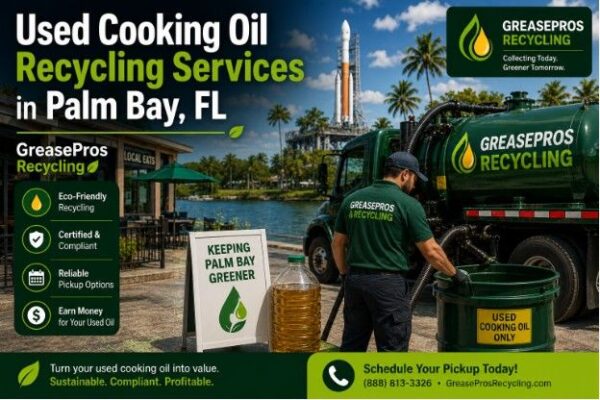
Used cooking oil recycling in Palm Bay is regulated at the point of collection. Florida Administrative Code Rule 62-710.401(4) prohibits a generator, including a restaurant, from using a transporter that lacks an EPA identification number, state certification, or current state registration.
GreasePros Recycling LLC, a licensed Florida used cooking oil hauler or transporter operating under USDOT #4136566 with over 20 years of operation, provides free lockable containers, flexible pickup scheduling, and 24/7 emergency retrieval across Palm Bay and Brevard County.
No contracts, no hidden fees — schedule a free container delivery with GreasePros Recycling to support your Palm Bay kitchen’s inspection readiness.
GreasePros Recycling provides scheduled used cooking oil collection, free container delivery, hood cleaning, and emergency retrieval for restaurants, hotels, and institutional kitchens across Palm Bay and Brevard County.
The company states it provides:
GreasePros Recycling documents its Florida transporter credentials directly on its credentials and licensing page, giving Palm Bay restaurant groups a single reference point whether they operate one location or several across Brevard County.
If you’re ready to get started, call us now!
Used cooking oil pickup and grease interceptor waste are separately regulated waste streams in Florida, and confusing the two is one of the most common compliance gaps a Palm Bay kitchen can run into.
Restaurants generating the oil, transporters moving it, and the state’s certification threshold are each governed slightly differently under the UCO framework.
Rule 62-710.401(4) prohibits any generator — including a Palm Bay restaurant — from using a transporter that does not have an EPA identification number and is not currently certified or registered with the State of Florida. This rule places the burden of confirming hauler status on the restaurant itself and does not require every restaurant to hold its own certification.
Florida Statute 403.767 and its implementing rule, 62-710.600, require certification for any transporter that moves more than 500 gallons of used oil annually over public highways — not for every hauler regardless of volume. The statute lists specific exceptions:
Restaurant owners can confirm which category applies to their hauler before signing an agreement.
Florida Statute 403.754 and Rule 62-710.500 require used oil transporters to register annually.
Registration stays valid from July 1 through June 30 of the following year and imposes its own distinct obligation separate from certification, so confirming that a hauler meets both gives a restaurant a clearer compliance picture than checking just one.
Grease interceptor waste is governed for Palm Bay restaurants at two local levels. Brevard County Code Chapter 110 requires any facility discharging fats, oils, and grease into the county-owned collection system to install an approved, properly operated grease interceptor.
Separately, the City of Palm Bay’s own FOG Policy & Procedure governs grease trap and interceptor requirements for facilities connected to the city’s sanitary sewer system, administered by the city’s FOG Inspector. Statewide, grease interceptor waste is also governed by Florida Statute 403.0741 and its implementing rule, Chapter 62-705, F.A.C., effective December 7, 2025.
Container size and pickup frequency depend on kitchen type and fryer volume. GreasePros Recycling adjusts recommendations for each kitchen after reviewing actual output, rather than applying a single fixed schedule.
| Palm Bay Business Type | Recommended Container | Typical Pickup Frequency |
| Restaurant or café | 55-gallon drum | Monthly |
| Hotel or resort | 140-gallon container | Biweekly |
| School, university, or hospital | 240-gallon container | Biweekly or weekly, based on kitchen volume |
| Catering company or food processing plant | 240-gallon container or multiple units | Weekly or on-demand |
These are illustrative starting points by business type, not measured Palm Bay volume data; GreasePros Recycling confirms the right container and schedule after assessing each kitchen directly.
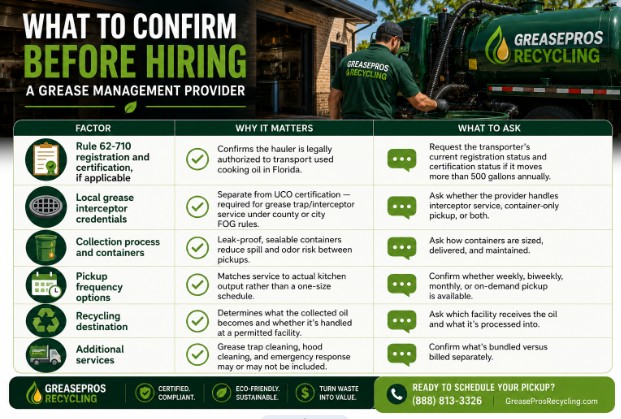
An uncertified or unregistered transporter puts a Palm Bay kitchen out of compliance with Rule 62-710.401(4) regardless of price or convenience, so confirming credentials before signing matters more than convenience alone.
The following factors help separate a properly credentialed provider from one that simply offers a lower price.
What to Confirm Before Hiring a Grease Management Provider
| Factor | Why It Matters | What to Ask |
| Rule 62-710 registration and certification, if applicable | Confirms the hauler is legally authorized to transport used cooking oil in Florida | Request the transporter’s current registration status and certification status if it moves more than 500 gallons annually |
| Local grease interceptor credentials | Separate from UCO certification — required for grease trap/interceptor service under county or city FOG rules | Ask whether the provider handles interceptor service, container-only pickup, or both |
| Collection process and containers | Leak-proof, sealable containers reduce spill and odor risk between pickups | Ask how containers are sized, delivered, and maintained |
| Pickup frequency options | Matches service to actual kitchen output rather than a one-size schedule | Confirm whether weekly, biweekly, monthly, or on-demand pickup is available |
| Recycling destination | Determines what the collected oil becomes and whether it’s handled at a permitted facility | Ask which facility receives the oil and what it’s processed into |
| Additional services | Grease trap cleaning, hood cleaning, and emergency response may or may not be included | Confirm what’s bundled versus billed separately |
If you’re ready to get started, call us now!
GreasePros Recycling states it serves a range of Palm Bay industries, each with different oil output and container needs:
The company documents its container and pickup options for each industry on its credentials and licensing page, from a small family-owned restaurant to a large food processing facility.
The company operates alongside the rest of Brevard County, and states its Palm Bay service includes:
Do Palm Bay restaurants have to use a certified used cooking oil transporter? Florida Rule 62-710.401(4) prohibits restaurants from using a transporter that lacks an EPA identification number and current state certification or registration. Certification applies specifically to transporters who move more than 500 gallons of used oil annually over public highways under Statute 403.767, with statutory exceptions for certain situations.
What grease trap requirements apply to Palm Bay restaurants? Brevard County Code Chapter 110 requires an approved grease interceptor for facilities discharging fats, oils, and grease into the county collection system, and the City of Palm Bay’s FOG Policy & Procedure governs requirements for the city’s sanitary sewer system. This is separate from used cooking oil pickup, which falls under state transporter rules.
Can I pour used cooking oil down the sink if I use hot water first? No. Pouring oil down a sink, even with hot water, allows it to solidify in the pipes and cause blockages. Used cooking oil should go into a sealed, dedicated container for scheduled pickup rather than any drain, sink, or floor grate.
What container sizes are available for Palm Bay kitchens? GreasePros Recycling offers 55-gallon, 140-gallon, and 240-gallon containers, sized to each location’s fryer volume after an on-site assessment by the company’s service team.
How can I verify GreasePros Recycling’s transporter credentials? GreasePros Recycling’s USDOT #4136566 registration can be independently verified through FMCSA’s public SAFER database. The company documents its Florida DEP transporter status on its own credentials and licensing page for reference.
Does GreasePros Recycling offer emergency pickup in Palm Bay? Yes. The company states it provides 24/7 emergency oil retrieval for overflows or spills, in addition to scheduled service, across Palm Bay and Brevard County.
Which industries does GreasePros Recycling serve in Palm Bay? The company states it serves restaurants, cafés, hotels, resorts, schools, universities, hospitals, food processing plants, and catering companies, tailoring container sizing and pickup frequency to each industry’s typical output.
What happens to used cooking oil collected from Palm Bay kitchens? The company states it routes used cooking oil collected from Palm Bay restaurants to Florida DEP-approved processing facilities. Those facility types are generally capable of producing biodiesel and other recycled products, though the specific downstream output for any individual batch of Palm Bay oil has not been independently verified for this article.
What should I look for before hiring a grease management company in Palm Bay? Confirm the provider’s Rule 62-710 registration and certification status if applicable, its local grease interceptor credentials if relevant, container quality, pickup flexibility, and where collected oil is processed. A provider offering only container pickup may not also handle grease trap service.
Can GreasePros Recycling handle both used cooking oil pickup and hood cleaning in Palm Bay? Yes. The company states it provides used cooking oil pickup and hood cleaning services for Palm Bay kitchens as two distinct services: removing grease and grime from hoods, filters, ducts, and fans, in addition to scheduled oil collection.
No contracts, no vague billing — GreasePros Recycling states it keeps its Palm Bay pickups on schedule. Contact GreasePros Recycling to schedule your first pickup in Palm Bay.
Founded with a vision to revolutionize the used cooking oil recycling industry, GreasePros Recycling has established itself as a trusted and leading provider of sustainable waste management solutions. With over 20 years of experience, our dedicated team brings extensive expertise and a commitment to environmental stewardship.
Quick Links
Contact Information
Get in Touch with GreasePros