Trusted and leading provider of sustainable waste management solutions from 20 years. (786) 655-7070
Every food service establishment operating in Miami-Dade County must hold a valid Grease Discharge Operating (GDO) Permit under Section 24-42.6 of the Miami-Dade County Code, Ordinance No. 18-22, effective March 5, 2018.
Restaurants and commercial kitchens that discharge fats, oils, and grease into the county sewer system face fines ranging from $100 per missing manifest to $5,000 or more for repeat disposal violations under Florida Statute § 403.0741, with permit suspension and forced closure for ongoing noncompliance.
GreasePros Recycling provides DERM-permitted used cooking oil collection, signed service manifests, and documented compliance support for Miami-Dade food businesses year-round.
Are you behind on your GDO permit or missing pump-out manifests? GreasePros Recycling handles licensed grease collection and DERM documentation for restaurants across all 34 Miami-Dade municipalities. Contact GreasePros today and close the compliance gap before the next inspection cycle.

Miami-Dade County’s Fats, Oils, and Grease (FOG) Control Program requires every non-residential food service establishment in the county to obtain an annual GDO Permit, install a properly sized grease interceptor, use a DERM-permitted hauler for all collections, and electronically report every pump-out through the county’s FOG portal.
The program is codified at Section 24-42.6 of the Miami-Dade County Code and became effective March 5, 2018, under Ordinance No. 18-22, passed by the Miami-Dade Board of County Commissioners on February 21, 2018, following a federal court consent decree requiring the county to correct FOG discharge violations affecting the public sewer system.
Any non-residential facility that handles, prepares, or processes food and introduces FOG into building sanitary drains or the public sewer system falls under this program.
Covered establishments include restaurants, cafeterias, bakeries, coffee shops, juice bars, hotel kitchens, hospital and nursing home food operations, school cafeterias, assisted living facility kitchens, and food processing plants operating in any of Miami-Dade County’s 34 incorporated municipalities.
Miami-Dade County’s Department of Environmental Resources Management (DERM) issues all GDO permits, reviews interceptor installation plans, conducts inspections, and enforces Section 24-42.6.
DERM’s Wastewater Section answers compliance and permit questions at (305) 372-6983, with Environmental Permitting renewals handled at option 6. GDO permits expire December 31 of each calendar year, and DERM mails renewal forms to the address on file at least 45 days before expiry.
New owners cannot transfer an existing permit — a full new GDO application is required on every change of ownership.
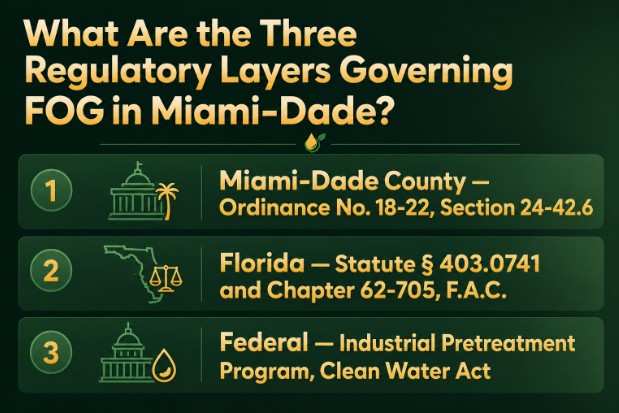
Miami-Dade restaurants operate under three overlapping regulatory frameworks: Miami-Dade Ordinance No. 18-22 at the county level, Florida Statute § 403.0741 at the state level, and the federal Industrial Pretreatment Program under the Clean Water Act at the federal level. Each layer imposes independent obligations, and stricter local rules take precedence over state minimums.
Miami-Dade Ordinance No. 18-22 is the primary local authority. Codified at Section 24-42.6 of the County Code, the ordinance establishes the GDO permit requirement, interceptor sizing and installation standards, the 25% Rule for maintenance, DERM-permitted hauler requirements, and the electronic reporting mandate through the county FOG portal.
Ordinance No. 18-22 was enacted pursuant to a federal consent decree among Miami-Dade County, the U.S. Environmental Protection Agency, and the Florida Department of Environmental Protection, approved by the EPA and FDEP in September 2017.
Florida Statute § 403.0741, enacted under Senate Bill 1110 (Chapter 2022-95) and effective July 1, 2022, establishes statewide grease waste hauler licensing requirements, service manifest obligations, and penalty schedules that apply to every food service establishment in Florida.
The Florida Department of Environmental Protection administers this program under Chapter 62-705, Florida Administrative Code. Miami-Dade’s local rules are stricter than the state minimum in several areas — Section § 403.0741(6)(b) explicitly permits local governments to adopt rules stricter than the state standard, which Miami-Dade has done.
The Florida DEP’s Domestic Wastewater Industrial Pretreatment Program oversees local pretreatment programs under Chapter 62-625, F.A.C., § 403.0885, Florida Statutes, and the federal Clean Water Act (33 U.S.C. § 1251 et seq.). The Industrial Pretreatment Program requires pollutant discharge limits for industrial and commercial users discharging into publicly owned treatment works.
Miami-Dade Water and Sewer Department operates under this framework, making FOG discharge from Miami-Dade restaurants subject to federal environmental law and county ordinance.
If you’re ready to get started, call us now!
Every non-residential food service establishment in Miami-Dade County must obtain a Grease Discharge Operating (GDO) Permit from DERM before opening. The permit is non-transferable, expires on December 31 each year, and must be renewed before that date to avoid automatic compliance violations.
The GDO permit process requires obtaining a Municipal Occupational License and Certificate of Use from the local municipality first, then submitting a FOG Discharge Control Operating Permit Application to Miami-Dade’s Department of Regulatory and Economic Resources.
The application requires accurate seat counts, square footage, outdoor seating figures, and plumbing documentation — any discrepancy between the application and DERM-reviewed plans causes processing delays.
Beginning April 14, 2023, under Section 21-49.2 of the Miami-Dade County Code, sellers and lessors of properties containing FOG generators must provide a FOG Generator Disclosure Statement to buyers or lessees prior to execution of the sale or lease.
Permit holders must also update their GDO application whenever ownership changes, the facility name changes, FOG control devices are modified, or the facility’s size or use changes.
Operating under an outdated or lapsed permit constitutes a violation regardless of whether a renewal application is in process.
GreasePros Recycling supports GDO permit compliance by providing the DERM-formatted manifests, pump-out documentation, and hauler records that the renewal application process requires. Schedule service today and build the documentation trail your next renewal depends on.
Miami-Dade County requires all covered food service establishments to install a grease interceptor — either a hydromechanical or gravity type — that meets the sizing and efficiency standards in the FOG 2.5 Control Device Guidance Manual published by DERM.
All compliant systems must achieve 99% FOG removal efficiency and include a solids interceptor before the grease interceptor and a sampling port on the discharge side, per Section 24-42.6(9) of the County Code and Section 24-18.
The table below compares the two primary interceptor types approved under Section 24-42.6 for Miami-Dade food service establishments.
| Feature | Gravity Interceptor | Hydromechanical Interceptor |
| Design basis | Retention time + liquid volume | Flow rate + mechanical separation |
| Sizing method | Seats-and-meals calculation, DFUs | Peak GPM flow rate + grease loading |
| Minimum size | Calculated per § 24-42.6(9)(a) | 20 GPM minimum per § 24-42.6(9)(b) |
| Efficiency required | 99% per FOG 2.5 Manual | 99% per FOG 2.5 Manual, third-party certified |
| Cleaning interval | Every 60 days (up to 180 with a monitoring device) | Monthly by DERM-permitted transporter |
| Typical installation cost | Up to $40,000 for gravity systems | Lower; varies by flow rate and configuration |
| Best for | Large-volume kitchens, hotels, high-output operations | Mid-sized restaurants, space-constrained kitchens |
Interceptor plans must be prepared by a Florida Professional Engineer and submitted to DERM for review before installation begins. Grease waste lines are the only drain connections permitted to these devices — sanitary sewage cannot enter the interceptor.
Construction inspections for new FOG control devices in incorporated municipalities are requested by emailing dermconstruction@miamidade.gov.
Miami-Dade County Code § 24-42.6 requires grease interceptors to be pumped out before the combined depth of floating FOG and settled solids reaches 25% of total liquid depth — this is the 25% Rule.
Cleaning intervals by device type are: monthly for automatic hydromechanical interceptors, monthly for manual hydromechanical interceptors, every 60 days for gravity interceptors, and up to every 180 days for gravity interceptors equipped with a functional monitoring device.
All intervals are subject to the 25% Rule — if capacity is reached before the scheduled date, immediate pump-out is required.
All pump-outs must be performed by a DERM-permitted liquid waste transporter. Skimming, decanting, or returning any waste back into the interceptor is prohibited under Section 24-42.6.
The county also prohibits enzyme additives or biological treatments as a substitute for mechanical cleaning. Every pump-out must be electronically reported through the county’s FOG portal with the date and hauler name within the required window — Miami-Dade’s automated system cross-checks permits and pump-out logs nightly, and a log showing more than 90 days without a documented service ticket triggers an automatic $250 administrative fee before any inspector visits the site.
Maintenance logs, manifests, service call records, repairs, and staff training records must be retained on-site for 3 years and made available immediately upon an inspector’s request.
Florida Statute § 403.0741(3)(e) separately requires that service manifests be retained on-site by the originator and the hauler for 1 year, with a copy delivered to the originator and the relevant county and municipality within 30 days of disposal.
Miami-Dade FOG violations carry fines under two parallel frameworks: Miami-Dade County Code Chapter 8CC civil penalties enforced by DERM, and Florida Statute § 403.0741 administrative fines enforced by the Florida DEP and authorized inspecting entities.
Both frameworks apply simultaneously — a single violation can generate fines under both.
The table below summarizes the current fine schedule as sourced from Florida Statute § 403.0741 and Miami-Dade DERM enforcement guidance.
| Violation | Authority | Fine Amount |
| Missing or unretained service manifest | FL Stat. § 403.0741(5)(a)1 | Up to $100 per failure |
| Failure to clean the grease interceptor or trap | FL Stat. § 403.0741(5)(a)2 | Up to $250 per failure |
| Automated portal: pump-out log exceeds 90 days | Miami-Dade DERM FOG portal | $250 automatic administrative fee |
| First-offense unlawful grease disposal | FL Stat. § 403.0741(5)(a)3 | Minimum $2,500 |
| Second or subsequent unlawful grease disposal | FL Stat. § 403.0741(5)(a)4 | Minimum $5,000 |
| Operating without a valid GDO permit | Miami-Dade County Code § 24-42.6 | $300–$1,200 first offense; $2,500+ repeat |
| Using an unlicensed hauler | Miami-Dade DERM | Enforcement action; potential permit revocation |
| Grease storage area noncompliance | Miami-Dade County Code § 24-42.6 | Subject to Chapter 8CC civil penalties |
| Permit revocation (ongoing noncompliance) | Miami-Dade County Code Chapter 24 | Revocation + additional Chapter 24 penalties |
Permit revocation under Section 24-42.6 operates in addition to — not instead of — any financial penalties assessed. DERM’s Environmental Code Enforcement Section uses progressive enforcement based on violation severity, environmental threat, and evidence obtained during inspection.
Environmental violations that reach Biscayne Bay or stormwater infrastructure carry the highest enforcement tier and can escalate to federal referral under the Clean Water Act consent decree.
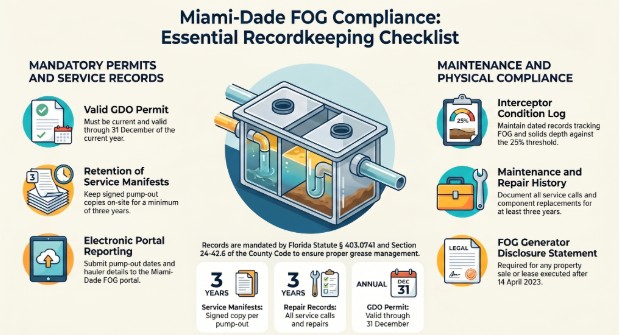
Miami-Dade food service establishments must retain a complete set of FOG compliance records on-site and available for immediate inspection at all times. Florida Statute § 403.0741 and Section 24-42.6 of the County Code together define the minimum documentation requirements.
The checklist below reflects mandatory records under Section 24-42.6 and § 403.0741. Every item must be on-site and available to inspectors without delay.
Each service manifest under Florida DEP’s grease waste program must identify the originator’s name, address, and phone number; the hauler’s name, address, and phone number; the disposal facility’s name, address, and phone number; the condition of the interceptor at time of service; confirmation that no graywater was returned to the interceptor; and the volume of grease waste removed and disposed.
Both the originator and the hauler must sign the manifest at the time of service, and the hauler must deliver a completed copy to the originator within 30 days of disposal.
GreasePros Recycling generates DERM-compliant service manifests on every pickup, signs them at the point of service, and delivers completed copies within the required window — so your three-year documentation trail builds automatically with every collection.
Restaurant operators who want a deeper look at interceptor scheduling can review the avoiding FOG violations resource, and the grease management best practices guide covers operational compliance in detail.
For questions about used oil disposal regulations, the Florida used oil disposal regulations article provides additional state-level context.
If you’re ready to get started, call us now!
DERM inspections verify four controllables: interceptor FOG and solids depth relative to the 25% threshold, compliance with grease storage area requirements, completeness of on-site documentation, and accessibility of the sampling port. Restaurants that maintain a current GDO permit, schedule pump-outs before the 25% trigger, and keep complete three-year manifest records pass inspections without remedial action.
Pre-opening inspections require a valid GDO permit, a DERM-approved interceptor installation with a compliant sampling port, all plumbing draining into the interceptor, and a Certificate of Use from the local municipality.
Routine inspections focus on maintenance log currency, manifest completeness, and storage area condition — inspectors use core sampling tools to verify the 25% threshold in real time. Missing records trigger a $250 charge and a return visit within 72 hours under DERM’s progressive enforcement protocol.
Operators should check interceptors for damage, overflow, or loose components within 24 hours after any storm, per Miami-Dade DERM guidance.
Post-storm FOG releases that reach stormwater drains or Biscayne Bay trigger the highest enforcement tier. Business owners bear the full costs of cleanup and fines for improper FOG releases — insurance policies typically do not cover penalties for environmental violations.
GreasePros Recycling operates as a DERM-permitted liquid waste transporter serving all 34 Miami-Dade municipalities, providing the three compliance deliverables required for every GDO permit renewal: licensed pump-outs, signed service manifests, and electronic portal reporting.
Every collection includes a manifest signed by the driver at the point of service, a copy delivered to the originator, and a portal submission within the required reporting window.
The company provides free grease storage containers in four sizes — 35-gallon under-counter tanks, 55-gallon drums, 140-gallon wheeled units, and 240-gallon outdoor containers — all with lockable lids and anti-corrosion coatings that keep storage areas compliant with Section 24-42.6’s grease storage requirements. Bilingual English and Spanish service covers the full Miami-Dade food service workforce, including Little Havana, Hialeah, and multilingual hotel and resort kitchens.
For emergency retrieval situations — surprise inspections, overflowing interceptors, pre-storm pump-outs — the team responds same-day at (786) 655-7070.
Restaurants that use GreasePros Recycling build a documented, timestamped compliance record automatically.
The restaurant oil disposal safety resource covers handling protocols, and the Miami grease pickup service page covers container options and service area coverage across Miami-Dade.
What is the Miami-Dade GDO permit, and who needs one?
The Grease Discharge Operating (GDO) Permit, required under Miami-Dade Ordinance No. 18-22 and Section 24-42.6, is an annual permit issued by DERM to every non-residential food service establishment that introduces fats, oils, or grease into the county sewer system. All permits expire December 31 and are non-transferable.
What are the fines for FOG violations in Miami-Dade County?
Florida Statute § 403.0741 sets fines of up to $100 per missing manifest, up to $250 per failure to clean an interceptor, a minimum of $2,500 for first-offense unlawful disposal, and a minimum of $5,000 for second-offense unlawful disposal. Miami-Dade’s portal separately auto-issues a $250 fee when pump-out logs exceed 90 days.
What does Florida Statute § 403.0741 require from Miami-Dade restaurants?
Florida Statute § 403.0741, effective July 1, 2022, requires every food service establishment to contract with a licensed grease waste hauler, document each pump-out on a signed service manifest, and retain manifests on-site for one year. The hauler must deliver completed manifests to the originator within 30 days of disposal.
What is the 25% Rule for grease interceptors in Miami-Dade?
The 25% Rule, established under Section 24-42.6 of the Miami-Dade County Code, requires pump-out whenever the combined depth of floating FOG and settled solids reaches 25% of total liquid depth. This threshold overrides any scheduled cleaning interval — if the 25% limit is reached before the next scheduled service, immediate pump-out is required.
How often must Miami-Dade restaurants pump out their grease interceptors?
Section 24-42.6 sets cleaning intervals by device: monthly for automatic and manual hydromechanical interceptors, every 60 days for gravity interceptors, and up to 180 days for gravity interceptors with a functional monitoring device. All intervals are subject to the 25% Rule — whichever trigger comes first controls the pump-out date.
What records must Miami-Dade restaurants keep for FOG compliance?
Miami-Dade restaurants must retain current GDO permits, signed service manifests for three years under Section 24-42.6 and one year under § 403.0741, interceptor condition logs, hauler verification records, staff training documentation, and maintenance and repair records on-site and available to DERM inspectors at all times.
What is the federal Industrial Pretreatment Program, and does it apply in Miami-Dade?
The Industrial Pretreatment Program, administered by Florida DEP under Chapter 62-625, F.A.C., § 403.0885, Florida Statutes, and the federal Clean Water Act (33 U.S.C. § 1251), regulates pollutant discharge from commercial facilities into publicly owned treatment works. Miami-Dade Water and Sewer operates under this framework, making restaurant FOG discharge subject to federal law as well as county ordinance.
How does GreasePros Recycling help Miami-Dade restaurants stay FOG compliant?
GreasePros Recycling operates as a DERM-permitted liquid waste transporter providing licensed pump-outs, signed service manifests, and FOG portal reporting for all 34 Miami-Dade municipalities. Every collection builds the three-year documentation record GDO permit renewals require, with manifests delivered to originators within the 30-day window required by § 403.0741.
Founded with a vision to revolutionize the used cooking oil recycling industry, GreasePros Recycling has established itself as a trusted and leading provider of sustainable waste management solutions. With over 20 years of experience, our dedicated team brings extensive expertise and a commitment to environmental stewardship.
Quick Links
Contact Information
Get in Touch with GreasePros