Trusted and leading provider of sustainable waste management solutions from 20 years. (786) 655-7070

South Florida hotels require volume-responsive pickup schedules, multi-container configurations sized to banquet-surge capacity, and FOG compliance documentation for every kitchen outlet because multi-kitchen, event-driven hotel operations produce 2 to 5 times the used cooking oil of a standalone restaurant.
GreasePros Recycling LLC, a licensed South Florida used cooking oil hauler with over 20 years of operation and DERM permits across all 34 Miami-Dade municipalities, provides hotel-specific grease pickup with discreet off-hours scheduling, hurricane-rated containers, and scalable collection across properties in Miami Beach, Brickell, and Coral Gables.
One overflowing drum at a beachfront resort costs the guest experience and triggers DERM enforcement — schedule a hotel grease assessment with GreasePros Recycling today.
Hotels are structurally different from standalone restaurants in ways that multiply grease management complexity. A single hotel property often operates three to five food service outlets under one roof, and all of those outlets drain into shared grease infrastructure under a single GDO permit.
A neighborhood restaurant with three fryers and one grease interceptor can track its oil volume with a simple spreadsheet. A 400-room hotel on Miami Beach cannot run a lobby restaurant, a pool grill, a room service kitchen, a banquet operation, and a rooftop bar.
Each outlet generates used cooking oil on its own production schedule, but DERM’s 25% interceptor capacity rule applies uniformly regardless of which outlet pushed the system past the threshold.
A banquet kitchen preparing a 500-guest New Year’s Eve gala can produce more oil in a single shift than the hotel’s lobby restaurant generates in an entire week.
Hotels that maintain a fixed monthly pickup schedule rather than a volume-responsive schedule routinely face container overflows during peak season that trigger the compliance failures DERM inspectors look for.
South Florida’s tourism cycle intensifies the volume problem. Hotels along the Miami Beach corridor, the Brickell waterfront, and the Coral Gables Miracle Mile dining district experience occupancy surges between November and April that can double weekly used cooking oil production.
A property averaging 120 gallons per week across its outlets during the September low season may produce 250 gallons during a February wedding weekend — and the fixed-schedule hauler who shows up on the 15th of each month has no mechanism to absorb that spike.
If you’re ready to get started, call us now!
Every non-residential food service establishment in Miami-Dade County must hold a current Grease Discharge Operating permit under Miami-Dade County Code § 24-42.6, and hotel properties are no exception.
Hotels with multiple food outlets typically operate under a single GDO permit but must maintain separate compliance documentation for each grease interceptor on the property.
| Requirement | Regulation | Hotel-Specific Application |
| GDO permit | Miami-Dade County Code § 24-42.6 | Required for every hotel food outlet discharging FOG to the public sewer — renewed annually by December 31 |
| 25% capacity rule | Miami-Dade DERM enforcement standard | Each interceptor pumps when grease and solids reach 25% of capacity — not on a fixed calendar |
| Licensed hauler | Florida Statute § 403.0741 | Hotels must use DERM-permitted haulers — manifests required for every pump-out |
| Electronic FOG portal reporting | Miami-Dade County Code § 24-42.6 | Every pump-out reported electronically by the 20th of the following month — portal cross-checks nightly |
| Staff training documentation | Miami-Dade County Code § 24-42.6 | Quarterly FOG training for existing employees, orientation for new hires — documented on-site across all outlets |
GreasePros Recycling generates signed service manifests formatted specifically for Miami-Dade’s electronic FOG portal under Section 24-42.6, eliminating the need for manual reformatting for each monthly portal deadline, so hotel engineering teams can redirect time to HVAC, plumbing, fire safety, and guest room maintenance.
Hotels that rely on a hauler without DERM-specific manifest formatting face administrative gaps that the portal’s nightly automated cross-check flags as missing records.
Your hotel’s FOG compliance is only as strong as the hauler behind it — lock in DERM-formatted manifests with GreasePros Recycling and eliminate portal reporting gaps.
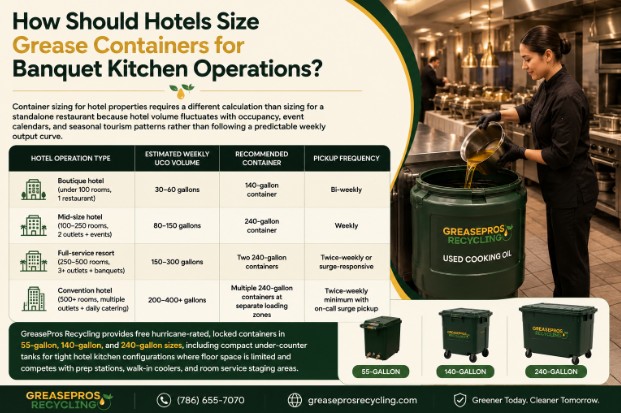
Container sizing for hotel properties requires a different calculation than sizing for a standalone restaurant because hotel volume fluctuates with occupancy, event calendars, and seasonal tourism patterns rather than following a predictable weekly output curve.
| Hotel Operation Type | Estimated Weekly UCO Volume | Recommended Container | Pickup Frequency |
| Boutique hotel (under 100 rooms, 1 restaurant) | 30–60 gallons | 140-gallon container | Bi-weekly |
| Mid-size hotel (100–250 rooms, 2 outlets + events) | 80–150 gallons | 240-gallon container | Weekly |
| Full-service resort (250–500 rooms, 3+ outlets + banquets) | 150–300 gallons | Two 240-gallon containers | Twice-weekly or surge-responsive |
| Convention hotel (500+ rooms, multiple outlets + daily catering) | 200–400+ gallons | Multiple 240-gallon containers at separate loading zones | Twice-weekly minimum with on-call surge pickup |
GreasePros Recycling provides free hurricane-rated, locked containers in 55-gallon, 140-gallon, and 240-gallon sizes, including compact under-counter tanks for tight hotel kitchen configurations where floor space is limited and competes with prep stations, walk-in coolers, and room service staging areas.
Hotels operating multiple kitchens on different floors or in separate buildings can deploy containers at each kitchen’s nearest loading access point, and the company services all containers on a single route to prevent any unit from reaching overflow between pickups.
The critical sizing mistake hotels make is calculating container capacity based on average weekly production without accounting for the banquet calendar.
GreasePros Recycling offers on-call surge pickup for hotel clients — one call to (786) 655-7070 adds an extra collection during a high-volume event weekend with no long-term contract adjustment required.
If you’re ready to get started, call us now!
Guest experience is the hotel’s product, and a vacuum truck idling at the front entrance during check-in erodes that product faster than a missed reservation.
Hotels along Miami Beach’s Ocean Drive, the Brickell financial district’s waterfront towers, and Coral Gables’ Miracle Mile hospitality corridor operate in environments where every back-of-house interaction either protects or damages the guest impression.
GreasePros Recycling provides discreet off-hours pickup protocols engineered for guest-facing properties.
The protocols include the following operational standards:
Hotels that work with a hauler lacking resort-level service design risk visible grease infrastructure in guest-facing zones — containers near pool decks, rooftop dining areas, or beachfront walkways- that compromise the aesthetic standard South Florida’s luxury hospitality market demands.
GreasePros Recycling coordinates hood cleaning and drain maintenance on the same off-hours window so hotels consolidate back-of-house service disruption into a single overnight visit.
South Florida’s hurricane season runs from June 1 through November 30, and resort properties face amplified storm risk compared to standalone restaurants.
A beachfront hotel with three kitchens, an outdoor pool grill, and a loading dock exposed to storm surge has more grease infrastructure vulnerable to wind and flooding than any single-location restaurant.
GreasePros Recycling activates a 48-hour pre-storm collection protocol when the National Hurricane Center issues a tropical storm watch for South Florida, and hotel properties receive priority scheduling because of the higher container count and the greater environmental risk of a multi-container breach.
NOAA’s May 2026 outlook projects a 55% chance of a below-normal season, but Hurricane Andrew struck Miami-Dade in 1992 during the same El Niño pattern developing in 2026 and produced Category 5 winds that destroyed hotel infrastructure across the county.
Resort properties should complete a pre-season grease system audit before June 1 each year, covering container wind-rating verification — GreasePros Recycling provides containers rated for 150+ mph sustained winds — along with ground-bolt anchoring inspection, interceptor capacity testing, and confirmation that emergency hauler contacts are current across all kitchen managers and hotel engineering staff.
Miami-Dade DERM requires operators to inspect grease interceptors for damage, overflow, and loose components within 24 hours of any significant storm, and hotels with multiple interceptors must complete inspections for every unit on the property within that window.
The Florida DBPR’s Division of Hotels and Restaurants may require a post-storm inspection before a hotel resumes food service if the property experienced flooding, structural damage, or extended power loss.
Your resort’s kitchens need a grease partner built for hurricane season — call GreasePros Recycling at (786) 655-7070 to lock in pre-storm priority service before the next watch is issued.
How much used cooking oil does a full-service South Florida hotel produce per week?
A full-service South Florida hotel running a lobby restaurant, pool grill, room service, and banquet kitchen produces 80 to 300 gallons of used cooking oil per week. Seasonal occupancy surges between November and April can double the baseline weekly production volume.
Does each hotel restaurant need a separate GDO permit in Miami-Dade County?
Miami-Dade hotel properties typically operate under a single GDO permit covering all food service outlets on the property. Each grease interceptor requires separate maintenance documentation and independent compliance with the 25% capacity rule under County Code § 24-42.6.
Can GreasePros Recycling schedule grease pickup during overnight hours for hotels?
GreasePros Recycling provides discreet off-hours collection between 2 AM and 6 AM for guest-facing hotel properties across Miami Beach, Brickell, and Coral Gables. Pickup timing coordinates with each hotel’s freight elevator and service dock access schedule.
What container size works best for a hotel with an active banquet kitchen?
Hotels with active banquet and catering operations typically need 240-gallon outdoor containers with on-call surge pickup capability for high-volume event weekends. GreasePros Recycling provides free hurricane-rated locked containers and adds extra collections with one call.
How does hurricane season affect hotel grease management in South Florida?
Hurricane season runs June 1 through November 30, and resort properties face amplified risk from higher container counts and exposed loading docks. GreasePros Recycling activates 48-hour pre-storm collection protocols and provides containers rated for 150+ mph sustained winds.
Does GreasePros Recycling provide bilingual service for hotel kitchen staff?
GreasePros Recycling provides full bilingual English and Spanish service across dispatch, field crews, documentation, and emergency communication in all 34 Miami-Dade municipalities. South Florida hotel kitchens employ multilingual staff who require language-aligned pickup coordination.
What happens if a hotel grease container overflows during a banquet weekend?
GreasePros Recycling provides same-day emergency retrieval for hotel clients experiencing overflow from event-driven volume spikes. One call to (786) 655-7070 dispatches a crew from the West Park, Florida, facility with 2-to-4-hour response times.
Are hotel grease manifests reported through Miami-Dade’s electronic FOG portal?
Miami-Dade requires electronic reporting of every hotel grease interceptor pump-out by the 20th of the following month through the DERM FOG portal. GreasePros Recycling generates manifests formatted specifically for portal submission under Section 24-42.6.
What FOG training documentation must hotels maintain on-site in Miami-Dade?
Miami-Dade County Code § 24-42.6 requires quarterly FOG training for existing food service employees and orientation training for new hires, with records maintained on-site. Hotels must document training completion across every kitchen outlet on the property.
Does GreasePros Recycling service hotel properties outside Miami-Dade County?
GreasePros Recycling services hotel and resort properties across South Florida, Central Florida, and the Gulf Coast, including Broward County, Palm Beach County, Orlando, and Tampa. Multi-location hotel groups benefit from centralized billing and consistent service across all properties.
Founded with a vision to revolutionize the used cooking oil recycling industry, GreasePros Recycling has established itself as a trusted and leading provider of sustainable waste management solutions. With over 20 years of experience, our dedicated team brings extensive expertise and a commitment to environmental stewardship.
Quick Links
Contact Information
Get in Touch with GreasePros