Trusted and leading provider of sustainable waste management solutions from 20 years. (786) 655-7070
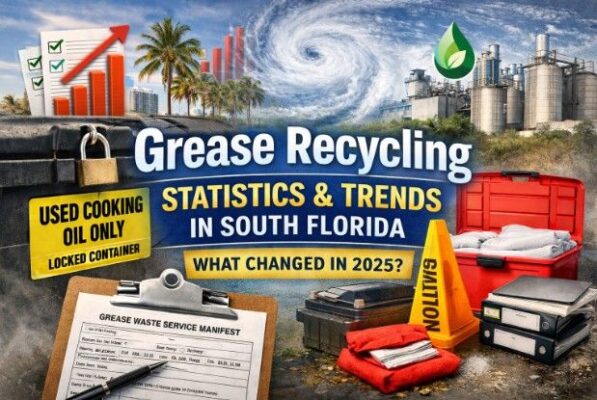
Grease recycling in South Florida in 2025 was shaped by two forces that operators could actually feel in day-to-day operations.
Market demand for clean used cooking oil remained active, as biofuel supply and inventory reporting continued to track meaningful volumes.
At the same time, Florida clarified documentation expectations, with updated grease waste forms effective December 7, 2025, and enforcement-ready workflows tied to Florida Statute 403.0741.
If you manage a restaurant, commissary, or multi-unit portfolio, 2025 reinforced one core reality.
Grease recycling is not just about pickups. It is a compliance and risk control system that needs KPIs, SOPs, and evidence.
In 2025, South Florida grease recycling became KPI-driven. Pickup cadence, contamination rate, container security, spill incidents, and manifest completion were directly predictive of overflows, odors, theft, downtime, liability, and inspection readiness.
Operators that tracked these metrics reduced surprises and stabilized collections.
Think of your grease program like a small operational dashboard. When one KPI drifts, problems tend to surface quickly.
| KPI | What the KPI signals | What to do next | Evidence to keep |
| Pickup cadence | Overflow and odor risk | Match the schedule to the weekly volume | Pickup log |
| Service manifest completion | Inspection readiness | Require a signed manifest for every service | Signed manifest |
| Container access control | Theft and tampering risk | Add locks and controlled access | Check log |
| Contamination rate | Lower recyclability and mess | Keep water and chemicals out | Notes by pickup |
| Spill and overflow count | Safety and cost exposure | Add SOPs and capacity | Incident log |
Operational tip: If you can choose only one KPI to tighten first, start with manifest completion. It forces discipline across scheduling, vendor communication, and record storage.
In South Florida, “grease recycling” typically includes used cooking oil from fryers and grease waste from traps or interceptors.
Used cooking oil handling focuses on cleanliness and safety. Grease waste removal requires formal documentation, including service manifests under Florida rules.
Most kitchens lump everything into “grease.” That is where programs break. You typically manage two streams with different levels of risk.
Used cooking oil is the fryer oil you store for collection. The operational priorities are simple and unforgiving.
Grease waste has a stronger compliance layer. Florida’s framework uses role-based responsibility.
Florida Statute 403.0741 uses “originator” and “hauler” and assigns duties to each party. That matters because your SOP needs a named owner for manifest handling and record storage.
Weekly volume should determine whether you rely on pickup or drop-off workflows. If your container fills faster than your schedule, overflow becomes inevitable.
If you’re ready to get started, call us now!
Florida strengthened documentation clarity in late 2025. Florida Statute 403.0741 requires a service manifest for grease waste removal and defines signature and copy requirements.
Florida DEP published updated Chapter 62-705 forms effective December 7, 2025, creating a cleaner baseline for inspections.
Two compliance realities matter most for operators.
Florida Statute 403.0741 requires that grease waste removal and disposal be documented on a service manifest.
The Florida DEP publishes state grease waste forms with effective dates, including updated forms effective December 7, 2025. Your paperwork can be “complete” but still wrong if you are using an outdated form.
| Compliance control | Why it matters | Proof |
| Signed service manifest | Required documentation | Signed copy stored |
| Copy delivery rules | Defines when copies must be provided or left on-site | Photo or scan of the manifest |
| Form version control | Outdated forms create gaps | Current PDF saved |
| Retention discipline | Retention supports inspections | Folder by month |
Practical standard: Store manifests in a month-by-month folder. Add a simple naming rule like YYYY-MM-DD Vendor Location. That one habit prevents most inspection panic.
In 2025, South Florida grease programs moved from “basic pickups” to risk controls. Operators tightened container security, adjusted pickup cadence to prevent overflows, and standardized safe-transfer SOPs to reduce burns and slips.
Many also added storm disruption planning for closures.
Here are the three patterns that showed up repeatedly.
Theft and tampering are not theoretical in South Florida. Container access drives both theft and contamination. Operators responded with controls you can audit.
Overflow risk rises when weekly volume outpaces pickup frequency. In 2025, more operators treated scheduling as a volume math problem rather than a vendor default.
Closures create a predictable hazard. Oil sits longer. Capacity tightens. Reopening days compress tasks into a short window. Operators reduced the risk of overflow with a storm-disruption SOP.
Keep your grease program clean and predictable with Grease Pros Recycling, using secure containers, consistent pickups, and compliance-ready documentation that prevents overflows and missed collections. Schedule service today.
If you’re ready to get started, call us now!
Demand for used cooking oil remained sensitive to conditions in the biofuel supply chain. EIA biofuel supply and inventory reporting supports a defensible explanation for persistent feedstock demand through 2025 and into 2026.
South Florida operators protected stability by preventing contamination, securing containers, and avoiding overflow.
Market context matters because it explains why collectors and processors maintain strict cleanliness standards.
The U.S. Energy Information Administration publishes national biofuel supply, consumption, and inventory context in EIA’s Short-Term Energy Outlook, including biofuel supply and inventory tables (eia.gov).
That ongoing tracking and forecasting signals continued market activity, which keeps pressure on collection programs to stay clean and consistent.
Here is how market pressure shows up operationally.
Two controls protect you regardless of where pricing goes.
A defensible grease program in 2026 ties controls to evidence you can produce on demand.
Under Florida Statute 403.0741, a hauler must document grease waste removal and disposal on a service manifest and comply with signature and copy requirements.
Florida DEP publishes the current forms and effective dates in Forms for Chapter 62-705.
Use this as your simple compliance backbone.
Build one folder structure that is boring, consistent, and inspection-ready. The goal is simple. If you get a call, you can prove compliance fast, without digging through emails.
If you operate in tighter enforcement zones, build Miami-specific workflows directly into the same folder system. Start by standardizing your cadence and documentation using inspection-ready grease trap scheduling in Miami.
Then align your SOP language to the county framework by referencing Miami-Dade FOG and GDO compliance steps for restaurants inside your internal training checklist.
In 2026, South Florida operators should monitor documentation rigor, container security, and storm disruption readiness.
Florida DEP’s Chapter 62-705 forms, effective December 7, 2025, set the compliance baseline, which you can confirm on Forms for Chapter 62-705.
The enforcement-ready standard remains Florida Statute 403.0741 for service manifests and signed copies.
| Watch item | Why it matters | Evidence |
| Manifest workflow | Defines compliance proof under 403.0741 | Signed manifestsare stored monthly |
| Form updates | Updates can be audited against DEP Chapter 62-705 forms | Current PDFs saved with effective dates |
| Container access | Theft and tampering risk rise when access is uncontrolled | Security check log plus photos |
| Storm disruption | Overflow risk rises during closures and reopening surges | SOP plus closure notes and service adjustments |
If you want a grease program that stays stable under inspections, peak-season volume, and storm disruptions, focus on three actions. Standardize documentation, harden container security, and match pickup cadence to weekly volume.
Start with compliance proof by building your workflow around Florida’s grease waste service manifest requirement in Florida Statute 403.0741.
Then keep forms current by pulling the latest Chapter 62-705 grease waste forms from the Florida DEP’s forms list, so your program aligns with the state’s effective-date baseline.
Next, harden operations by adding secure collection controls to control and log container access, reducing theft, tampering, and contamination.
Finally, reduce safety incidents by training teams on commercial oil-handling safety procedures so that transfers stay clean, spill risk decreases, and busy shifts do not lead to preventable injuries.
Stabilize your grease handling, prevent contamination, and stay inspection-ready with Grease Pros Recycling’s secure collection, scheduled pickups, and safety-first approach built for South Florida operators. Contact us today.
Do Florida restaurants need a grease waste service manifest for every removal?
Yes. If grease waste is removed by a hauler, the removal and disposal must be documented using a service manifest as required by Florida Statute 403.0741. Build a habit. No pickup is “complete” until the manifest is signed and filed.
How long should we keep grease waste manifests and related records?
Keep manifests and supporting logs in a month-by-month folder to quickly produce proof during an inspection. Your safest operational standard is consistent retention discipline tied to your service cadence and internal policy. If you manage multiple locations, use the same structure across all of them.
Where do we download the current Florida grease waste forms?
Use Florida DEP’s Forms for Chapter 62-705 to confirm you are using the current PDFs with the correct effective dates. Outdated forms can create avoidable compliance gaps.
What causes used cooking oil contamination that leads to rejected pickups?
The most common causes are water, cleaning chemicals, food scraps, and mixed waste streams. Prevent it by labeling containers, training staff on what can and cannot go in, and using secured lids or locked containers to reduce tampering.
How can we prevent theft of used cooking oil in South Florida?
Treat container access as a control. Add locks, restrict access points, and document checks. Operationally, the fastest improvement is implementing secure oil collection controls and logging compliance at the manager level.
How do we know if our pickup cadence is too slow?
If containers approach capacity before the next service date, you are operating on borrowed time. Track weekly volume for two to four weeks, then match container capacity and pickup frequency to that reality. Overflow and odor are scheduling problems first, not “bad luck.”
What should we do differently before hurricane closures?
Storm disruptions extend storage time and compress reopening tasks. Build an emergency plan that includes a pre-storm capacity check, documented container security, and a post-reopen pickup priority list. The goal is to prevent overflow during closure windows.
Founded with a vision to revolutionize the used cooking oil recycling industry, GreasePros Recycling has established itself as a trusted and leading provider of sustainable waste management solutions. With over 20 years of experience, our dedicated team brings extensive expertise and a commitment to environmental stewardship.
Quick Links
Contact Information
Get in Touch with GreasePros