Trusted and leading provider of sustainable waste management solutions from 20 years. (786) 655-7070
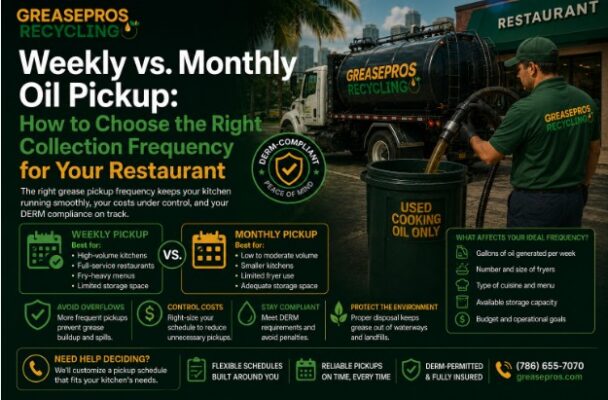
The right used cooking oil pickup frequency depends on one calculation: number of fryers × gallons per fryer per week = weekly UCO volume. Restaurants producing 75+ gallons per week need weekly pickup; 35–75 gallons need bi-weekly pickup; and under 35 gallons can schedule monthly pickup.
Miami-Dade DERM compliance requirements set the frequency floor regardless of volume.
GreasePros Recycling LLC (DOT #4136566) matches pickup frequency to each kitchen’s actual output at no additional cost — weekly, bi-weekly, and monthly schedules all include free locked containers and DERM-formatted manifests.
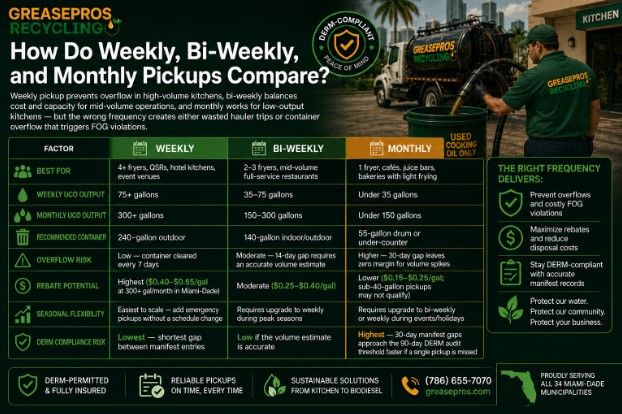
Weekly pickup prevents overflow in high-volume kitchens, bi-weekly balances cost and capacity for mid-volume operations, and monthly works for low-output kitchens — but the wrong frequency creates either wasted hauler trips or container overflow that triggers FOG violations.
| Factor | Weekly | Bi-Weekly | Monthly |
| Best for | 4+ fryers, QSRs, hotel kitchens, event venues | 2–3 fryers, mid-volume full-service restaurants | 1 fryer, cafés, juice bars, bakeries with light frying |
| Weekly UCO output | 75+ gallons | 35–75 gallons | Under 35 gallons |
| Monthly UCO output | 300+ gallons | 150–300 gallons | Under 150 gallons |
| Recommended container | 240-gallon outdoor | 140-gallon indoor/outdoor | 55-gallon drum or under-counter |
| Overflow risk | Low — container cleared every 7 days | Moderate — 14-day gap requires an accurate volume estimate | Higher — 30-day gap leaves zero margin for volume spikes |
| Rebate potential | Highest ($0.40–$0.55/gal at 300+ gal/month in Miami-Dade) | Moderate ($0.25–$0.40/gal) | Lower ($0.15–$0.25/gal; sub-40-gallon pickups may not qualify) |
| Seasonal flexibility | Easiest to scale — add emergency pickups without a schedule change | Requires upgrade to weekly during peak seasons | Requires upgrade to bi-weekly or weekly during events/holidays |
| DERM compliance risk | Lowest — shortest gap between manifest entries | Low if the volume estimate is accurate | Highest — 30-day manifest gaps approach the 90-day DERM audit threshold faster if a single pickup is missed |
If you’re ready to get started, call us now!
The pickup frequency calculation uses three inputs: the number of active fryers, the gallons produced per fryer per week, and the available container capacity. A standard commercial fryer produces 15–20 gallons of waste oil per week on a full-service schedule.
Formula: Fryers × gallons/fryer/week = weekly UCO volume
Worked examples by restaurant type:
A QSR with 6 fryers running full schedules produces approximately 6 × 18 = 108 gallons per week (432 gallons/month). A 240-gallon container fills in roughly 2.2 weeks — weekly pickup is required to prevent overflow.
A full-service restaurant with 3 fryers produces approximately 3 × 16 = 48 gallons per week (192 gallons/month). A 140-gallon container fills in approximately 2.9 weeks — bi-weekly pickup provides adequate margin.
A café with 1 fryer running 4 days per week produces approximately 1 × 10 = 10 gallons per week (40 gallons/month). A 55-gallon drum fills in approximately 5.5 weeks — monthly pickup works with a margin to spare.
Florida’s heat accelerates grease decomposition and odor formation, so the calendar frequency also depends on climate: a container that technically has a capacity for 30 days may create odor and pest problems after 14–18 days in South Florida’s subtropical conditions.
Restaurants should factor sanitation into their frequency decision alongside pure volume math.
Miami-Dade’s DERM FOG Control Program requires every food service establishment to maintain a GDO permit, generate signed manifests for every hauler pickup, and submit electronic reports by the 20th of each month through the FOG portal.
The automated nightly audit issues a $250 fee when pump-out logs exceed 90 days.
Pickup frequency affects DERM compliance in three ways.
First, manifest density creates a stronger audit trail. Weekly pickups generate 4 manifest entries per month — a documentation buffer that demonstrates active compliance even if one pickup is delayed.
Monthly pickups generate 1 entry, so a single missed pickup creates a 60-day manifest gap, moving the restaurant 2/3 of the way toward the 90-day penalty threshold.
Second, container overflow between pickups triggers FOG violations independently of manifest compliance.
A restaurant on a monthly schedule that experiences a volume spike — tourist season, catering events, expanded hours — risks a spill that violates the storage requirements of Miami-Dade Ordinance No. 18-22, even if all prior manifests are current.
Third, the 25% Rule for grease interceptors operates on a separate timeline from UCO container pickup. A restaurant’s interceptor may need cleaning every 30 or 60 days, regardless of UCO pickup frequency — the two schedules must be coordinated to avoid gaps in either compliance stream.
A single missed monthly pickup leaves your GDO permit 60 days from the $250 penalty threshold — weekly pickup builds a 4-manifest buffer that absorbs delays without compliance risk. GreasePros Recycling generates DERM-formatted manifests for every pickup. Call (786) 655-7070.
GreasePros Recycling provides free UCO collection at all three frequencies for restaurants producing 40+ gallons per month — the cost difference between weekly and monthly is zero in hauler fees because GreasePros absorbs route costs and recovers value through biodiesel feedstock processing.
The real cost difference appears in indirect expenses that the wrong frequency creates.
| Cost Category | Weekly Pickup | Monthly Pickup | Difference |
| Hauler collection fee (GreasePros) | $0 | $0 | No difference |
| Container installation | $0 | $0 | No difference |
| UCO rebate (Miami-Dade avg.) | $0.40–$0.55/gal (300+ gal/mo volume tier) | $0.15–$0.25/gal (sub-150 gal/mo tier) | Weekly earns $120–$165/mo vs. monthly’s $22–$37/mo at equivalent per-gallon rates |
| Overflow emergency cleanup | Rare — 7-day collection gap | $200–$500 per incident if the container overfills | Monthly carries a higher overflow risk |
| Missed manifest DERM penalty | Unlikely — 4 manifests/month buffer | $250 per missed cycle (1 manifest = 1 entry) | Monthly has zero buffer |
| Oil theft exposure | Lower — shorter storage window | Higher — 30 days of unsecured oil between pickups | Locked containers reduce both; a shorter window is still safer |
| Pest/odor remediation | Minimal — fresh container weekly | $100–$300 in pest control if grease attracts vermin during 30-day storage in South Florida heat | Monthly risk in a subtropical climate |
A restaurant should upgrade from monthly to weekly pickup when any of 5 volume or compliance triggers occur — waiting until a container overflows or a manifest gap triggers a DERM penalty costs more than the proactive schedule change.
GreasePros Recycling adjusts the frequency at no charge and without contract renegotiation — a restaurant can scale from monthly to weekly for peak season and back to monthly afterward with a single phone call to (786) 655-7070.
If you’re ready to get started, call us now!
Container sizing and pickup frequency are interdependent — a larger container extends the safe interval between pickups, while a smaller container requires more frequent collection to prevent overflow.
The 55-gallon drum pairs with a monthly pickup for kitchens producing under 35 gallons per week. The 140-gallon container pairs with bi-weekly pickup for mid-volume restaurants producing 35–75 gallons per week.
The 240-gallon outdoor container pairs with weekly pickup for high-volume operations producing 75+ gallons per week. The under-counter tank (29×23×33 inches) pairs with weekly or bi-weekly pickup for small kitchens with limited floor space that cannot accommodate a standard drum.
All GreasePros containers include hurricane-rated construction, locked tamper-proof lids, and anti-corrosion coatings at no charge.
Container upsizing or downsizing is available at any time without service fees — if a restaurant’s volume changes, GreasePros swaps the container on the next scheduled pickup.
GreasePros Recycling builds every pickup schedule from the kitchen’s actual output data — not a generic tier — during the free initial consultation using a 3-step process.
The assessment begins with a fryer inventory: number of active fryers, oil capacity per fryer, change frequency, and peak-volume days. GreasePros calculates weekly and monthly gallons, recommends the matching frequency and container size, and sets the initial schedule.
After 2–4 weeks of service, the driver’s volume logs confirm or adjust the frequency based on actual fill rates rather than estimates.
Seasonal adjustments happen automatically. GreasePros monitors fill rates across its Miami-Dade, Broward, Palm Beach, and Central Florida routes and proactively increases pickup frequency for restaurants in tourist corridors, event zones, and hurricane-season surge areas — no additional charge, no contract amendment, no service interruption.
The wrong pickup frequency costs more than the right one — overflow cleanup runs $200–$500 per incident, a missed DERM manifest triggers a $250 automatic fee, and oil theft from a 30-day-unattended container averages $250 per month in losses.
GreasePros Recycling matches your schedule to your actual volume at no cost. Call (786) 655-7070 or schedule your free consultation online.
How many gallons of oil per week does a weekly pickup require?
Restaurants producing 75 or more gallons of used cooking oil per week — typically kitchens with 4 or more fryers — need weekly pickup to prevent overflow. A 240-gallon container at that volume fills in approximately 2.2 weeks, leaving no safe margin for bi-weekly collection.
Is bi-weekly pickup enough for a mid-sized restaurant?
Bi-weekly pickup works for restaurants producing 35–75 gallons per week from 2–3 active fryers. A 140-gallon container provides adequate capacity for a 14-day collection gap at that output level, though restaurants should monitor fill rates during seasonal increases in volume.
Can a restaurant switch from monthly to weekly without penalty?
GreasePros Recycling adjusts pickup frequency at no charge and without requiring contract renegotiation. A restaurant can scale from monthly to weekly for peak season and return to monthly afterward with a single phone call, and the container can be upsized on the next scheduled visit.
How does pickup frequency affect UCO rebate rates?
Higher-volume restaurants on weekly schedules earn $0.40–$0.55 per gallon in Miami-Dade because volume above 300 gallons per month unlocks premium pricing tiers. Monthly-schedule kitchens producing under 150 gallons typically earn $0.15–$0.25 per gallon, and sub-40-gallon pickups may not qualify for rebates.
Does Miami-Dade DERM require a specific pickup frequency?
DERM does not mandate a specific UCO pickup frequency, but the automated manifest audit assesses a $250 fee when pump-out logs are more than 90 days old. Weekly pickup generates 4 manifest entries per month — a compliance buffer that absorbs delays without approaching the penalty threshold.
What happens if my container overflows between scheduled pickups?
A container overflow in Miami-Dade triggers a FOG violation under the storage requirements of Ordinance No. 18-22, independent of manifest compliance. GreasePros Recycling provides same-day emergency response from its West Park base for spills and overflows at no additional charge beyond the standard service agreement.
How does Florida’s climate affect the right pickup frequency?
South Florida’s subtropical heat accelerates grease decomposition and odor formation inside containers, so a 55-gallon drum with a technical capacity of 30 days may create sanitation and pest problems after 14–18 days. Restaurants should factor climate-driven odor into their frequency decision alongside pure volume calculations.
Does GreasePros charge more for weekly pickup than for monthly pickup?
GreasePros Recycling provides free used cooking oil collection at all three frequencies for restaurants producing 40 or more gallons per month. The hauler collection fee is $0 for weekly, bi-weekly, and monthly schedules — GreasePros recovers value through biodiesel feedstock processing rather than per-pickup charges.
How do I calculate the right frequency for my kitchen?
Multiply the number of active fryers by gallons produced per fryer per week — a standard commercial fryer produces 15–20 gallons per week on a full schedule. Weekly output above 75 gallons requires weekly pickup; 35–75 gallons requires bi-weekly pickup; and under 35 gallons requires monthly pickup.
Should I upgrade frequency during hurricane season?
GreasePros Recycling activates 48-hour pre-storm collection when the National Hurricane Center issues a tropical storm watch for any Florida service area. Restaurants on monthly schedules should consider upgrading to bi-weekly from June through November to reduce the volume of oil stored on-site during active storm periods.
Founded with a vision to revolutionize the used cooking oil recycling industry, GreasePros Recycling has established itself as a trusted and leading provider of sustainable waste management solutions. With over 20 years of experience, our dedicated team brings extensive expertise and a commitment to environmental stewardship.
Quick Links
Contact Information
Get in Touch with GreasePros