Trusted and leading provider of sustainable waste management solutions from 20 years. (786) 655-7070
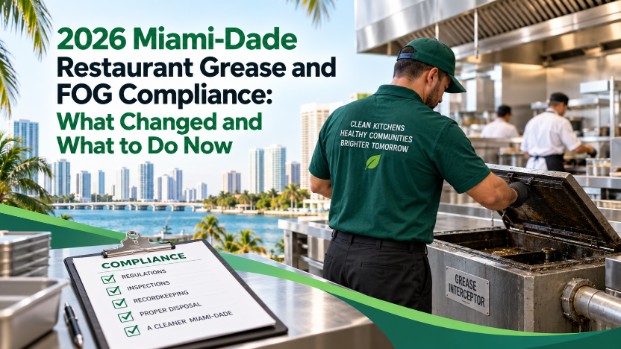
The 2026 change in Miami-Dade restaurant grease compliance came from Tallahassee, not from the county.
Chapter 62-705, Florida Administrative Code, took effect in December 2025 and now carries hauler licensing, a state service manifest form, and disposal facility certification, while Miami-Dade’s Grease Discharge Operating permit framework continued under the ordinance adopted in 2018.
Restaurants operate under both layers in 2026, and practical exposure centers on hauler licensing status and manifest records. GreasePros Recycling LLC provides licensed used-oil pickup and grease-waste service across Miami-Dade.
Hauler licensing status is now something a restaurant can be asked about — confirm current credentials with GreasePros Recycling before the next scheduled pump-out.
The 2022 statute set the obligations, and the 2025 rule supplied the licensing, forms, and deadlines that make them operational.
| Element | Under the 2022 statute alone | Under Chapter 62-705, F.A.C. in 2026 |
| Hauler status | Statutory duty to haul and dispose lawfully | State license required, applied for on DEP form 62-705.300(2) |
| Service manifest | Required, with content specified in statute | State manifest form 62-705.300(3) in use |
| Disposal facilities | Grease waste taken to a disposal facility | Certification required on DEP form 62-705.400(2), valid three years |
| Small-volume self-service | Not separately addressed | Self-cleaner category defined for volumes under 55 gallons |
| Compliance calendar | No licensing dates | Application, renewal, and certification deadlines in 2026 |
Senate Bill 1110 created Section 403.0741, Florida Statutes in 2022, requiring licensed hauling, signed service manifests, and a prohibition on returning graywater to interceptors as of July 1, 2022.
The statute lacked implementing machinery, which arrived with Chapter 62-705, Florida Administrative Code.
Florida DEP’s grease waste program defines a self-cleaner as an originator that removes and transports its own grease waste in volumes under 55 gallons. Self-cleaners follow every hauler rule except licensing, signed manifests included.
If you’re ready to get started, call us now!
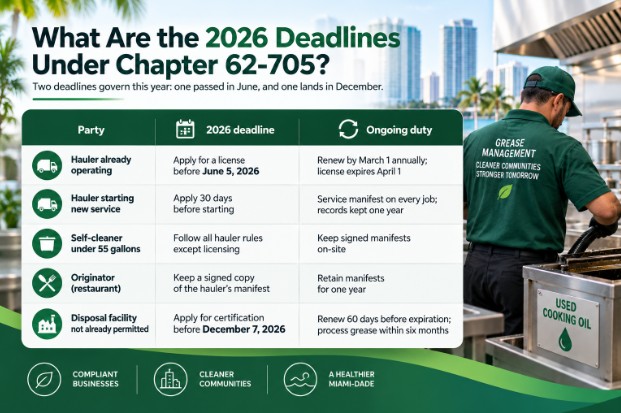
Two deadlines govern this year: one passed in June, and one lands in December.
| Party | 2026 deadline | Ongoing duty |
| Hauler already operating | Apply for a license before June 5, 2026 | Renew by March 1 annually; license expires April 1 |
| Hauler starting new service | Apply 30 days before starting | Service manifest on every job; records kept one year |
| Self-cleaner under 55 gallons | Follow all hauler rules except licensing | Keep signed manifests on-site |
| Originator (restaurant) | Keep a signed copy of the hauler’s manifest | Retain manifests for one year |
| Disposal facility not already permitted | Apply for certification before December 7, 2026 | Renew 60 days before expiration; process grease within six months |
The June 5 date has passed, which makes hauler verification a present-tense task rather than a planning item.
GreasePros Recycling treats a hauler’s current license number as a document the restaurant should keep rather than assume, since the restaurant holds the resulting manifests when an inspector asks who performed the service.
Miami-Dade publishes a list of DERM-approved haulers on the county’s fats, oils and grease page, and the state license number comes directly from the hauler. GreasePros Recycling publishes its own licensing and credential records for that check.
No new Miami-Dade FOG ordinance took effect in 2026, and the county requirements a restaurant follows this year are the same as last year.
The county’s FOG Control Program operates under Ordinance No. 18-22, codified at Section 24-42.6 of the County Code and effective March 5, 2018, adopted after the federal consent decree among the county, the EPA, and Florida DEP.
The most recent addition came in 2023, when Section 21-49.2 began requiring a FOG Generator Disclosure Statement on the sale or lease of a property containing a FOG generator.
GDO permits still expire on December 31, remain non-transferable, and require a new application on any change of ownership, per the county’s FOG permit application.
What changed is the stack. A Miami-Dade restaurant in 2026 sits under county permitting, state licensing, and manifest rules, and the federal pretreatment framework at once.
Section 403.0741(6) expressly allows local governments to go stricter and allows fiscally constrained and small counties to opt out, which is why the local rule always controls. The county layer is mapped in the Miami-Dade GDO compliance guide.
Pump-out intervals are held steady under Section 24-42.6: monthly for hydromechanical interceptors, 60 days for gravity interceptors, up to 180 days for gravity interceptors with a functional monitoring device, and earlier service whenever combined grease and solids reach the 25% capacity limit first.
DERM’s own GDO training materials set out four documentation duties, and each one is verifiable on-site in minutes.
Miami-Dade’s FOG staff training document states that, as of January 1, 2019, every GDO-permitted establishment must have at least one trained person familiar with the operation, maintenance, and reporting requirements.
That training covers new-employee orientation plus quarterly staff reviews, and the records must list the trained staff and the dates.
The same document directs operators to keep grease interceptor maintenance records at the facility for at least one year and to report each pump-out electronically, with the date and the hauler’s name, through the county’s Grease Discharge Operating Report portal.
It also closes a gap many kitchens miss: waste from manual hood, filter, and exhaust fan cleaning cannot go to the sanitary sewer or septic system, and must be collected and transported by a DERM-permitted liquid waste transporter to an approved disposal facility. For that reason, GreasePros Recycling coordinates hood cleaning with grease service.
Across its Miami-Dade accounts, GreasePros Recycling finds the documentation failure is rarely the cleaning itself. Restaurants commonly deliver staff training verbally and never record it, which leaves nothing to produce at inspection, a pattern the company details in its analysis of common FOG violations.
A documented pump-out schedule takes less time than reconstructing one—arrange device-specific service with GreasePros Recycling and keep records current as they are generated.

Fines are split by role, and conflating the two schedules is the most common misreading of the framework.
| Trigger | Authority | Falls on | Amount |
| Failure to provide or retain a service manifest | § 403.0741(5)(a)1 | Hauler | Up to $100 per failure |
| Failure to clean a grease interceptor or trap | § 403.0741(5)(a)2 | Hauler | Up to $250 per failure |
| Unlawful disposal of grease waste, first offense | § 403.0741(5)(a)3 | Hauler | At least $2,500, plus 30-day license suspension |
| Second or subsequent unlawful disposal | § 403.0741(5)(a)4 | Hauler | At least $5,000, plus 12-month license revocation |
| Operating without a current GDO permit | County Code § 24-42.6 | FOG generator | Chapter 8CC civil penalties |
| Failure to have the device cleaned properly or on time | County Code § 24-42.6 | FOG generator | Grounds for permit revocation |
| Cleaning by a person not permitted by DERM | County Code § 24-42.6 | FOG generator | Grounds for permit revocation |
The statutory penalties reach the hauler. The county consequences reach the restaurant, and Section 24-42.6 lists using an unpermitted cleaner and failing to have the device cleaned properly among the causes for revoking a FOG operating permit. Pointing at a vendor does not transfer the permit exposure.
If you’re ready to get started, call us now!
Manifest compliance rests on a chain an inspector can follow without staff assistance.
Section 403.0741 specifies what each manifest must carry: an originator section, a hauler section, and a disposal facility section, recording the interceptor’s condition, confirmation that graywater was not returned, the volume removed, the volume disposed, and the disposal facility’s billing or ticket number.
Both parties sign at the time of service, and the hauler delivers a completed copy to the originator and to the county and municipality within 30 days after disposal. Copies stay on-site with both parties for one year.
GreasePros Recycling recommends four checks ahead of any inspection, drawn from what its crews encounter in the field rather than from any single regulation:
The company signs manifests at the point of service and delivers copies inside the statutory window, so the record builds as service happens.
Same-day emergency retrieval covers surprise inspections and overflow, and the service process page covers scheduling and container setup.
A compliance review costs less than reconstructing two years of records — request one from GreasePros Recycling and close the gaps before an inspector finds them.
What changed in Florida grease waste rules for 2026?
Chapter 62-705, Florida Administrative Code took effect in December 2025, adding grease waste hauler licensing, a state service manifest form, and disposal facility certification. Florida DEP lists these requirements as effective, with hauler license applications due before June 5, 2026.
Did Miami-Dade change its FOG ordinance in 2026?
No new county FOG ordinance took effect in 2026. Miami-Dade’s program continues under Ordinance No. 18-22, codified at Section 24-42.6 and effective March 5, 2018. The 2026 change came from the state rule layered above it, and restaurants keep the same GDO permit cycle.
What is a self-cleaner under the new Florida grease waste rule?
Florida DEP defines a self-cleaner as an originator that removes and transports its own grease waste in volumes under 55 gallons. Self-cleaners follow every hauler requirement except licensing, which includes completing and retaining signed service manifests for each removal.
When must a Florida grease waste hauler renew its license?
Grease waste hauler licenses run on an annual cycle under Chapter 62-705, F.A.C. Renewal applications are due by March 1 each year, and the license expires April 1. Haulers starting new service apply at least 30 days beforehand.
Who actually pays fines under Florida Statute § 403.0741?
Section 403.0741(5) directs its administrative fines at haulers rather than restaurants: up to $100 per missing manifest, up to $250 per uncleaned interceptor, and at least $2,500 for unlawful disposal, with license suspension attached to disposal violations.
How can a Miami restaurant confirm its hauler is properly licensed?
Miami-Dade publishes a list of DERM-approved haulers that changes regularly, and Florida DEP licenses grease waste haulers under Chapter 62-705. Restaurants should request both the state license number and the DERM permit number, then check them against current county listings.
What FOG training does Miami-Dade require of restaurant staff?
Since January 1, 2019, each GDO-permitted establishment must have at least one person trained in the operation, maintenance, and reporting requirements. Miami-Dade’s training materials direct operators to train new employees, review quarterly, and keep records listing staff and dates.
How long must grease records stay on-site in Miami-Dade?
Miami-Dade’s FOG training materials direct operators to keep grease interceptor maintenance records at the facility for at least one year. Florida Statute § 403.0741 separately requires the originator and hauler to retain signed manifests for one year.
Does hood cleaning waste need a permitted transporter in Miami-Dade?
Miami-Dade’s FOG materials state that waste from cleaning kitchen hoods, grease filters, and exhaust fans cannot be discharged to the sanitary sewer or septic system. A DERM-permitted liquid waste transporter must collect it and deliver it to an approved disposal facility.
Founded with a vision to revolutionize the used cooking oil recycling industry, GreasePros Recycling has established itself as a trusted and leading provider of sustainable waste management solutions. With over 20 years of experience, our dedicated team brings extensive expertise and a commitment to environmental stewardship.
Quick Links
Contact Information
Get in Touch with GreasePros