Trusted and leading provider of sustainable waste management solutions from 20 years. (786) 655-7070
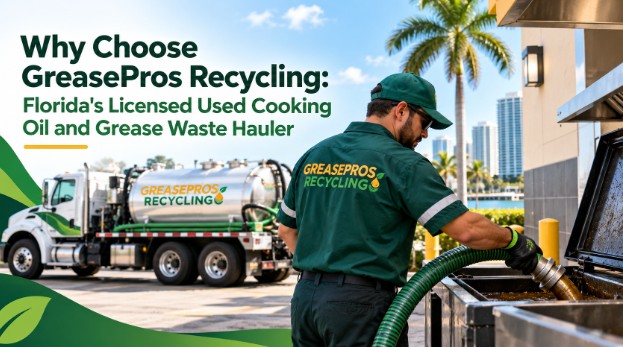
GreasePros Recycling LLC is a Florida used cooking oil and grease waste hauler operating from dispatch bases in West Park and Cape Canaveral, serving commercial kitchens across eight Florida counties.
The company operates under USDOT #4136566 as a Miami-Dade DERM-permitted liquid waste transporter, with more than 20 years of operation.
Every collection produces a signed manifest naming the hauler, the origin kitchen, and the disposal facility. Scheduled used oil pickup covers restaurants, hotels, hospitals, schools, and food manufacturers.
GreasePros Recycling collects, transports, and documents the two grease streams a commercial kitchen produces every day.
Used cooking oil, or yellow grease, is spent fryer oil held in dedicated collection containers. Grease trap waste, or brown grease, is the fatty material captured inside a grease interceptor before wastewater reaches the sewer.
The distinction carries a practical consequence. Florida Statute § 403.0741 defines grease waste as material retained in a grease interceptor or trap, and its definition expressly excludes receptacles designed for collecting used cooking oil.
The state manifest, hauler licensing, and penalty provisions attach to the interceptor stream, while used cooking oil moves under recycling and transport arrangements. A kitchen with fryers and a dish line needs both handled and needs to know which paperwork belongs to which.
Alongside collection, the company provides grease trap cleaning, hood cleaning, commercial drain cleaning, and emergency retrieval.
Service is commercial only; the equipment is built for commercial volumes, and residential oil disposal falls outside it.
If you’re ready to get started, call us now!
Six checks separate a defensible service arrangement from one that fails at inspection, and they apply to any provider under consideration.
| What to verify | Why it matters | Where the answer comes from |
| Interceptor pump-out permit status | Section 24-42.6 lists having a FOG control device cleaned by a person not permitted by the Department among the causes for revoking a FOG operating permit | Miami-Dade’s published list of DERM-approved haulers |
| Current state grease waste hauler license | Chapter 62-705, F.A.C. licenses grease waste haulers; licenses expire April 1 and renew by March 1 each year | The hauler’s current license number, checked against Florida DEP |
| Manifest handling | Section 403.0741 requires signature at the time of service and a completed copy to the originator, county, and municipality within 30 days | A sample manifest, reviewed before service begins |
| Carrier registration | Identifies the carrier moving material off the property | USDOT number, verifiable in federal registration records |
| Downstream destination | Determines where collected material actually goes | Named receiving facility, not a general assurance |
| Emergency coverage terms | Determines response when a container overflows on a Saturday | Written service terms, including area and hours |
The licensing check is the most recently changed. Chapter 62-705 took effect in December 2025 and set an application window that closed in June 2026, so any hauler operating in Florida today should already hold a current license rather than a pending application.
Licenses run on an annual cycle, expiring April 1 with renewal due by March 1, which makes early spring the moment a kitchen should ask to see the renewed number.
GreasePros Recycling answers each of these on request, and current permit documentation sits on the credentials and licensing page.
Miami-Dade publishes its approved hauler list on the county’s fats, oils and grease page, and Florida DEP’s grease waste program governs the licensing framework.
One item kitchens routinely miss: Miami-Dade’s FOG training materials state that waste from cleaning hoods, filters, and exhaust fans cannot go to the sanitary sewer or septic system, and must be collected by a DERM-permitted liquid waste transporter.
Vendor files are easier to build before an inspection than after one — request current credential documentation from GreasePros Recycling and file it with the service agreement.
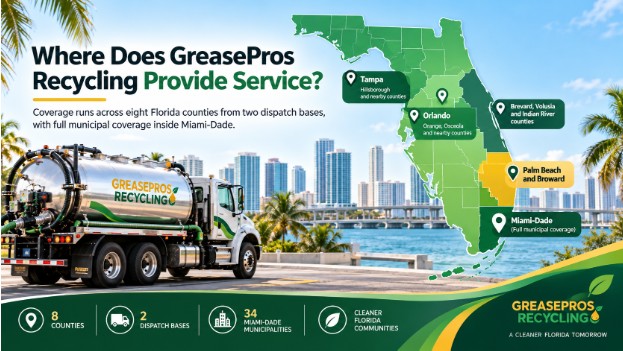
Coverage runs across eight Florida counties from two dispatch bases, with full municipal coverage inside Miami-Dade.
Miami-Dade contains 34 incorporated municipalities, each layering its own certificate of use and local business tax process on top of the county GDO permit.
| Area | Coverage |
| Miami-Dade, north | Aventura, Bal Harbor, Bay Harbor Islands, Biscayne Park, El Portal, Golden Beach, Indian Creek Village, Miami Gardens, Miami Shores, North Bay Village, North Miami, North Miami Beach, Opa-locka, Sunny Isles Beach, Surfside |
| Miami-Dade, central and west | Doral, Hialeah, Hialeah Gardens, Medley, Miami, Miami Beach, Miami Lakes, Miami Springs, Sweetwater, Virginia Gardens, West Miami |
| Miami-Dade, south | Coral Gables, Cutler Bay, Florida City, Homestead, Key Biscayne, Palmetto Bay, Pinecrest, South Miami |
| Broward and Palm Beach | Fort Lauderdale, Pembroke Pines, Weston, Davie, Pompano Beach, Boca Raton, Delray Beach, Jupiter, West Palm Beach, Parkland |
| Central Florida and Gulf Coast | Orlando, Kissimmee, St. Cloud, Tampa, plus Brevard, Volusia, and Indian River county coverage |
Dispatch runs from 2321 SW 57th Terrace in West Park and 166 Center Street, Suite 235 in Cape Canaveral. Local service pages cover Miami, Orlando, and Tampa in detail.
If you’re ready to get started, call us now!
Collected used cooking oil leaves the kitchen as waste and enters the renewable fuel supply chain.
GreasePros Recycling delivers collected oil to Florida DEP-approved processing facilities. At the facility, the oil is filtered to remove food particles and impurities, heated to break down fats, and processed into renewable fuel.
Biodiesel is produced through transesterification, the chemical process that converts cleaned oil into a fuel usable in diesel engines.
The recycling process is documented at each transfer, and clients receive signed documentation showing where their oil went.
That documentation does more than support sustainability reporting. It closes the disposal chain and supports the compliance frameworks the company operates under: Broward County’s Industrial Pretreatment Program, Miami-Dade’s FOG Control Program, and Florida DEP disposal standards.
Oil sitting in a full container is a liability, not an asset—schedule collection with GreasePros Recycling and keep the container ahead of its fill line.
An account bundles equipment, scheduling, documentation, and emergency coverage rather than pricing them separately.
Container security matters more in South Florida than most operators expect, since used cooking oil carries resale value and unsecured containers draw theft.
The secured collection approach addresses theft and storm exposure together, and hurricane season planning covers the pre-storm sequence.
Grease problems escalate on their own schedule, not the kitchen’s — open an account with GreasePros Recycling at (786) 655-7070 and put the service on a documented footing.
What is GreasePros Recycling?
GreasePros Recycling LLC is a Florida used cooking oil and grease waste hauler operating under USDOT #4136566. The company collects and documents used cooking oil and grease trap waste from commercial kitchens across eight Florida counties from two dispatch bases.
How long has GreasePros Recycling been in business?
GreasePros Recycling has more than 20 years of operating experience in used cooking oil recycling, serving restaurants, hotels, hospitals, schools, and food manufacturers across South Florida, Central Florida, and the Gulf Coast from bases in West Park and Cape Canaveral.
What is the difference between used cooking oil and grease trap waste?
Used cooking oil is spent fryer oil held in dedicated containers. Grease trap waste is material captured inside an interceptor. Florida Statute § 403.0741 governs the interceptor stream and expressly excludes used cooking oil receptacles from its definition.
Does GreasePros Recycling serve all of Miami-Dade County?
GreasePros Recycling operates as a DERM-permitted liquid waste transporter covering all 34 incorporated Miami-Dade municipalities, from Aventura and Sunny Isles Beach in the north through Homestead and Florida City in the south.
What should a restaurant verify before hiring a grease hauler?
Verify interceptor pump-out permit status, current state grease waste hauler licensing, manifest handling practice, carrier registration, the named downstream disposal facility, and written emergency coverage terms. Section 24-42.6 places permit exposure on the kitchen itself.
When do Florida grease waste hauler licenses expire?
Grease waste hauler licenses run annually under Chapter 62-705, F.A.C. Each license expires April 1, with renewal applications due by March 1. Kitchens should request the renewed license number each spring rather than relying on a prior year’s paperwork.
What does GreasePros Recycling charge for grease containers?
Containers are included at no charge with an active commercial account. The lineup covers 35-gallon under-counter tanks, 55-gallon drums, 140-gallon wheeled units, and 240-gallon outdoor containers, each delivered, professionally set up, and maintained by the company.
What happens to used cooking oil after GreasePros Recycling collects it?
Collected oil goes to Florida DEP-approved processing facilities, where it is filtered, heated, and processed into renewable fuel, with biodiesel produced through transesterification. Clients receive signed documentation showing the disposal facility that received their oil.
Does GreasePros Recycling offer Spanish-language service?
Bilingual English and Spanish service covers dispatch, field crews, documentation, and emergency communication. South Florida commercial kitchens employ multilingual staff, and container placement and pickup coordination happen with whoever is working the line.
Founded with a vision to revolutionize the used cooking oil recycling industry, GreasePros Recycling has established itself as a trusted and leading provider of sustainable waste management solutions. With over 20 years of experience, our dedicated team brings extensive expertise and a commitment to environmental stewardship.
Quick Links
Contact Information
Get in Touch with GreasePros