Trusted and leading provider of sustainable waste management solutions from 20 years. (786) 655-7070
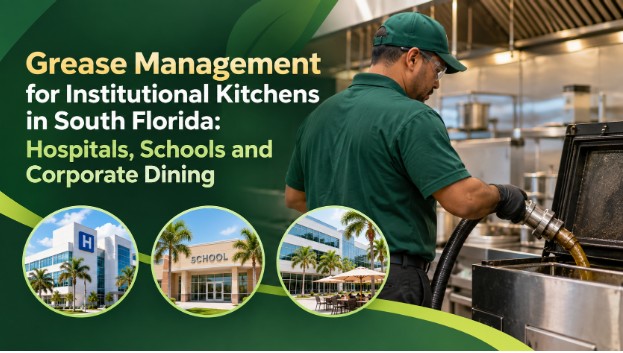
Institutional kitchen grease management covers the collection, documentation, and disposal of used cooking oil and grease trap waste produced inside hospitals, school cafeterias, casino dining outlets, and corporate dining halls.
Institutional kitchens carry different compliance exposure than standalone restaurants because Florida assigns institutional food service to a different regulator, serves populations the state classifies as medically vulnerable, and often runs several outlets through shared grease infrastructure.
GreasePros Recycling LLC, a West Park, Florida, used cooking oil and grease waste hauler, provides scheduled institutional oil pickup statewide.
Missing pump-out records surface first during an inspection, not after — schedule an institutional grease audit with GreasePros Recycling before the next inspection cycle.
Used cooking oil and grease trap waste are two distinct streams with two different regulatory paths, and institutional operators who treat them as one subject miss half their obligations.
Used cooking oil, also called yellow grease, is spent fryer oil collected in dedicated containers and routed to recycling and biodiesel processing.
Grease trap waste, sometimes called brown grease, is the fatty material captured inside a grease interceptor or trap before wastewater enters the sewer.
Florida Statute § 403.0741 defines grease waste as material retained in a grease interceptor or grease trap, and the statute’s definition expressly excludes receptacles designed specifically for collecting used cooking oil or fats and bones.
Manifest, hauler-contract, and penalty provisions therefore attach to the interceptor stream.
A hospital or school kitchen generates both. The fryer feeds a collection container serviced on a volume-driven schedule, and the dish line and floor drains feed an interceptor serviced under county pump-out rules, which the company’s grease trap cleaning page covers in operational detail.
Institutional kitchens combine three conditions that standalone restaurants rarely carry at once: extended service hours, shared drainage across outlets, and a diner population the state treats as medically vulnerable.
A large hospital runs patient meal service, a public cafeteria, a staff dining room, and internal catering from the same building. Those outlets frequently drain into grease interceptors sized during original construction, sometimes years before the current meal census.
Chapter 64E-11, F.A.C. defines a highly susceptible population as people more likely to experience foodborne disease, including immunocompromised patients, institutionalized older adults, and elementary school-age children. That classification appears in the Florida Department of Health’s food hygiene rule.
The U.S. Environmental Protection Agency lists fats, oils, and grease among the materials that create blockages leading to sanitary sewer overflows, and a backup inside a patient care building carries consequences a restaurant does not face.
If you’re ready to get started, call us now!
Florida splits food service oversight by facility type under Section 381.0072, Florida Statutes. The Department of Health inspects institutional kitchens, and the Department of Business and Professional Regulation licenses restaurants and caterers.
That split catches facility directors who inherit vendor relationships built for restaurant accounts. A hauler experienced only with DBPR-licensed restaurants may never have supported an institutional account inspected under the Department of Health’s food hygiene program.
Grease waste obligations sit on a separate track. Section 403.0741 defines an originator to include commercial kitchens, cafeterias, school kitchens, hospitals, prisons, correctional facilities, and care institutions, and directs the hauler to document every removal and disposal on a signed service manifest.
| Institution type | Food safety regulator | Grease waste rule | Local layer in Miami-Dade |
| Hospital and nursing home kitchens | Florida DOH, Chapter 64E-11, F.A.C. | Hauler contract and signed manifest under § 403.0741 | GDO permit and 25% Rule under County Code § 24-42.6 |
| Public and private school cafeterias | Florida DOH, Chapter 64E-11, F.A.C. | Hauler contract and signed manifest under § 403.0741 | GDO permit and 25% Rule under County Code § 24-42.6 |
| Detention and correctional kitchens | Florida DOH, Chapter 64E-11, F.A.C. | Hauler contract and signed manifest under § 403.0741 | GDO permit and 25% Rule under County Code § 24-42.6 |
| Casino and racino dining outlets | Florida DBPR, Division of Hotels and Restaurants | Hauler contract and signed manifest under § 403.0741 | GDO permit and 25% Rule under County Code § 24-42.6 |
| Corporate dining run by a contract caterer | Florida DBPR caterer licensing | Hauler contract and signed manifest under § 403.0741 | GDO permit and 25% Rule under County Code § 24-42.6 |
The Florida Department of Environmental Protection administers hauler licensing and manifest forms through its grease waste program under Chapter 62-705, F.A.C.
Section 403.0741(6) lets local governments adopt stricter rules and lets fiscally constrained and small counties opt out, so the local requirement always controls.
Miami-Dade sits at the strict end: non-residential FOG generators need a Grease Discharge Operating permit, a framework detailed in the Miami-Dade GDO compliance breakdown.
GreasePros Recycling sizes institutional containers against meal census and fryer count rather than dining room seats, because institutions produce oil on a scheduled census curve instead of a walk-in traffic curve.
In the company’s institutional accounts, undersized containers fail at three predictable moments: the start of an academic term, a casino holiday weekend, and a hospital event that adds catering to an existing patient meal load.
GreasePros Recycling supplies free lockable containers in 35-gallon under-counter, 55-gallon drum, 140-gallon wheeled, and 240-gallon outdoor configurations, so each kitchen on a campus can be fitted to its own output.
| Operation profile | Service pattern | Container configuration GreasePros Recycling deploys | Cadence driver |
| School cafeteria, single kitchen | Weekday breakfast and lunch, academic calendar | 140-gallon wheeled unit at the service dock | Term start and testing-week meal spikes |
| District central production kitchen | Daily batch cooking for satellite sites | Multiple 240-gallon outdoor containers | Daily fryer volume, summer program schedule |
| Hospital with public cafeteria | Continuous patient, staff, and visitor service | 240-gallon outdoor container plus under-counter tanks | Bed census and catered events |
| Casino resort with several outlets | 24-hour dining, buffet, and banquet service | Two or more 240-gallon containers at separate docks | Event calendar and weekend occupancy |
| Corporate dining hall | Single weekday lunch peak | 55-gallon drum or 140-gallon wheeled unit | Headcount and hybrid attendance patterns |
Buffet lines and banquet halls generate oil faster than fixed schedules absorb — lock in surge-responsive collection with GreasePros Recycling across every campus kitchen.
If you’re ready to get started, call us now!
Multi-location coordination means one hauler, one account structure, and one documentation trail across every kitchen a district or health system operates, rather than separate vendor relationships negotiated site by site.
Fragmented arrangements produce a pattern GreasePros Recycling encounters when taking over district and health-system accounts:
GreasePros Recycling consolidates institutional accounts under centralized billing across South Florida, Central Florida, and the Gulf Coast, including Broward, Palm Beach, Orlando, and Tampa. Bilingual English and Spanish dispatch and field communication support the multilingual kitchen staff common across institutional food service.
Same-day emergency retrieval matters more for institutions than for restaurants, since hospital kitchens serve patients on a fixed daily schedule and school cafeterias operate around a fixed lunch period.
Coordinated hood cleaning and drain maintenance scheduling compresses back-of-house disruption into a single planned window.
Institutional vendor onboarding runs before service begins, and the file a hauler submits determines how quickly an account can be activated.
For hospital supply chain offices, school district purchasing departments, and casino compliance teams, GreasePros Recycling assembles hauler licensing records under Chapter 62-705, F.A.C., DOT registration, certificates of insurance naming the institution, W-9 and vendor registration forms, and a sample service manifest showing the format the institution receives after each pump-out.
Manifest handling then carries the ongoing record. Section 403.0741 directs the originator and hauler to sign at the time of service, and the hauler to deliver a completed copy to the originator and to the county and municipality within 30 days after disposal.
Both parties retain a copy on-site for one year, and Miami-Dade’s Section 24-42.6 extends on-site retention to three years.
GreasePros Recycling signs manifests at the point of service, delivers copies inside the statutory window, and maintains licensing and credential records formatted for vendor onboarding files.
Operators reviewing broader state obligations can cross-check the Florida used oil disposal rules that apply alongside county requirements.
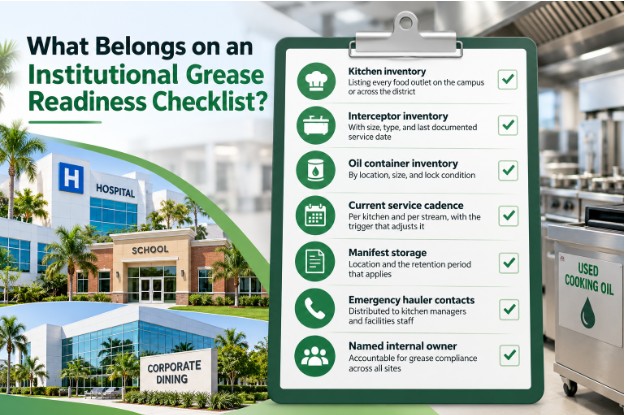
An institutional grease readiness review covers what a facilities team needs on file before an inspection, a storm, or a procurement cycle arrives.
Institutional kitchens need pre-storm grease planning because many operate as shelters, emergency care sites, or continuous-service facilities.
Florida’s hurricane season runs June 1 through November 30. GreasePros Recycling anchors outdoor containers at exposed loading docks, confirms interceptor capacity before a watch is issued, and runs pre-storm collection for accounts on its priority list.
Storm protocols appear in the company’s hurricane season grease planning resource, and secured container options address both storm exposure and oil theft.
Procurement deadlines arrive faster than compliance gaps close — request an institutional service proposal from GreasePros Recycling and document every kitchen on one contract.
Who regulates food service inside Florida hospitals and school cafeterias?
The Florida Department of Health regulates institutional food service under Chapter 64E-11, Florida Administrative Code, covering schools, hospitals, nursing homes, detention facilities, and similar settings. The Department of Business and Professional Regulation regulates restaurants, caterers, and mobile food units instead.
Does Florida Statute § 403.0741 cover used cooking oil containers?
Florida Statute § 403.0741 governs grease waste held in grease interceptors and traps, and its definition expressly excludes receptacles designed for collecting used cooking oil or fats and bones. Institutional kitchens follow a separate recycling stream for used cooking oil collection.
What does Florida law require from a school or hospital kitchen?
Section 403.0741 treats school kitchens and hospitals as originators. An inspecting entity verifies that the originator holds a grease waste hauler contract, that removal and disposal are documented on a service manifest, and that a signed copy stays on-site for one year.
Who pays the fines under Florida Statute § 403.0741?
Section 403.0741(5) directs its administrative fines at haulers rather than originators: up to $100 per missing manifest, up to $250 per uncleaned interceptor, and at least $2,500 for unlawful disposal. Repeat unlawful disposal carries at least $5,000 plus license revocation.
How long must institutional kitchens keep grease service manifests?
Section 403.0741 sets on-site retention at one year for both the originator and the hauler. Miami-Dade County Code § 24-42.6 extends retention to three years inside that county, so institutional operators there follow the longer requirement.
What happens when several kitchens share one grease interceptor?
Shared interceptors accumulate grease from every connected outlet, so a single high-volume kitchen can move the system toward its pump-out threshold. Campus operators benefit from volume-responsive scheduling rather than fixed calendar intervals across connected outlets.
How often must a grease interceptor be pumped out in Miami-Dade County?
Miami-Dade County Code § 24-42.6 sets monthly intervals for hydromechanical interceptors and 60 days for gravity interceptors, extendable to 180 days with a functional monitoring device. The 25% capacity rule overrides any scheduled interval.
Can one hauler service an entire school district or hospital system?
GreasePros Recycling consolidates multi-site institutional accounts under centralized billing, with consistent container standards, pickup scheduling, and manifest formatting across each campus, clinic, or satellite kitchen inside its Florida service area.
What container size fits a hospital cafeteria kitchen?
Hospital cafeterias serving patients, staff, and visitors continuously typically receive a 240-gallon outdoor container, often paired with under-counter tanks inside prep areas. GreasePros Recycling selects sizing from daily meal census and fryer count rather than dining room seating.
Does casino dining follow different grease rules than a hotel restaurant?
Casino dining outlets follow the same statewide grease waste framework as other food service establishments under Florida Statute § 403.0741, and the same county interceptor requirements. Volume and 24-hour service patterns change the pickup schedule, not the obligations.
Founded with a vision to revolutionize the used cooking oil recycling industry, GreasePros Recycling has established itself as a trusted and leading provider of sustainable waste management solutions. With over 20 years of experience, our dedicated team brings extensive expertise and a commitment to environmental stewardship.
Quick Links
Contact Information
Get in Touch with GreasePros