Trusted and leading provider of sustainable waste management solutions from 20 years. (786) 655-7070
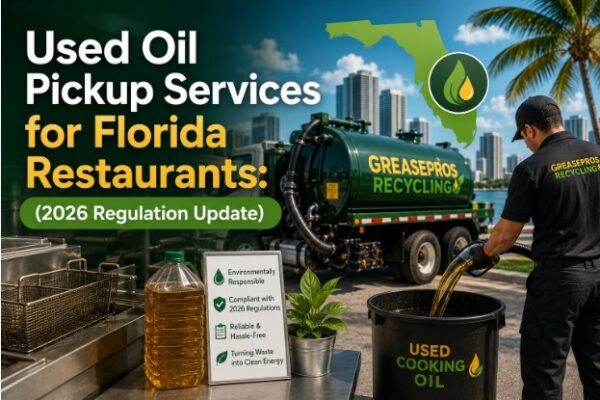
Used oil pickup is the professional collection of spent fryer and cooking oil from Florida restaurants by a state-certified transporter, delivered to a processing facility for recycling into biodiesel and other products.
Florida regulates this through two separate frameworks: Rule 62-710 governs used cooking oil (UCO) transporter certification, while Florida Statute 403.0741 and its newly finalized implementing rule govern grease interceptor waste — a different waste stream with its own hauler licensing and manifest requirements.
County-level FOG programs then layer additional local rules on top of both.
Confusing UCO pickup rules with grease interceptor requirements is one of the most common compliance gaps GreasePros Recycling sees across its Florida service area. Schedule a free pickup to confirm which GreasePros services, containers, and pickup schedule your kitchen needs.
Used cooking oil pickup is governed by Florida Administrative Code Rule 62-710, the state’s used oil transporter certification program, which prohibits generators from using a transporter that isn’t certified or registered with the state.
Florida Statute 403.767 requires any person transporting more than 500 gallons of used oil annually over public highways to hold that certification.
This framework traces back to Florida’s Used Oil Recycling Program, established in 1984 under sections 403.75–403.769 of the Florida Statutes — a program the Florida Department of Environmental Protection (DEP) describes as one of the most successful in the country.
The documentation restaurants encounter for UCO pickup is the hauler’s own collection manifest — not the statutory grease waste manifest, which is a separate requirement covered below.
Certified transporters like GreasePros Recycling document collection date, volume, and destination facility as standard practice, but this UCO manifest isn’t the same legal instrument as the grease waste service manifest required under Statute 403.0741.
For penalty exposure, Florida DEP’s own Guidelines for Characterizing Used Oil Violations confirm that administrative penalties for used oil violations are calculated under Florida Statute 403.121 and cannot exceed $50,000 per assessment. This is a separate and distinct penalty structure from the grease waste fine schedule discussed next.
If you’re ready to get started, call us now!
Grease interceptor waste — the FOG and solids that accumulate in a plumbed grease trap — falls under a different framework than UCO. Florida Statute 403.0741, created by 2022’s Senate Bill 1110, requires food service establishments to use a licensed grease waste hauler for interceptor cleanings and to document each collection with a signed service manifest.
The statute explicitly excludes dedicated used-cooking-oil receptacles from its “grease interceptor or grease trap” definition, which is why UCO pickup and grease trap cleaning require two separate certifications rather than a single combined rule.
The rule implementing this statute, Chapter 62-705, F.A.C. — Grease Waste Removal and Disposal, took effect December 7, 2025, along with the associated Grease Waste Hauler License application and Grease Waste Service Manifest forms.
This finalizes the administrative framework Florida DEP had been developing since 2023, so restaurants and haulers now operate under a completed rule rather than a proposed one.
Florida Statute 403.0741 Grease Waste Fine Schedule
| Violation | Fine | Additional Penalty |
| Failure to provide or retain a service manifest | Up to $100 per instance | None specified |
| Failure to clean a grease interceptor or grease trap on schedule | Up to $250 per instance | None specified |
| Unlawful disposal of grease waste (first offense) | At least $2,500 | Hauler license suspension of at least 30 days |
| Unlawful disposal of grease waste (second or subsequent offense) | At least $5,000 | Hauler license revocation of at least 12 months |
These four tiers apply specifically to grease interceptor waste under Statute 403.0741 — not to used cooking oil pickup, which carries the separate 403.121-based penalty structure described above.
Local county programs, such as Miami-Dade’s GDO portal enforcement, can layer additional administrative fees on top of this state schedule for missed reporting deadlines.
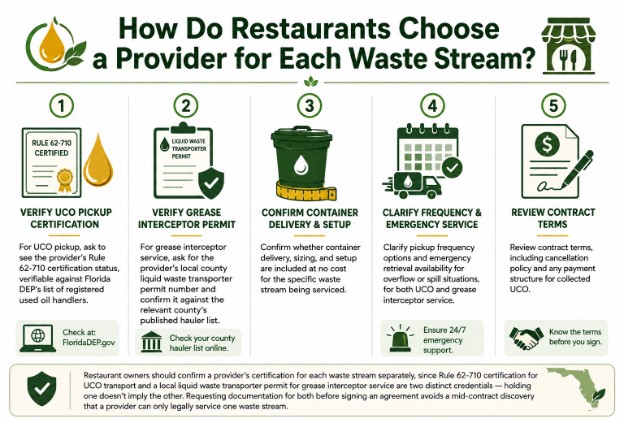
A used oil pickup begins when a restaurant partners with a certified transporter that installs a sealed, dedicated storage container on-site. Kitchen staff pours cooled fryer oil into that container between visits, keeping it separate from any grease interceptor or drain line.
On the scheduled or on-call pickup date, a technician transfers the oil from the container into a tanker vehicle and documents the collection with a manifest recording the volume, date, and destination facility.
The hauler then transports the oil to a Florida DEP-permitted processing facility, where it’s filtered and converted into biodiesel and other recycled products. Collection frequency typically runs weekly, biweekly, or monthly depending on a kitchen’s fryer volume.
A few practical habits help kitchens stay ahead of both waste streams:
Florida’s statewide rules set the baseline for both waste streams, but county and city FOG (fats, oils, and grease) programs add local permit, inspection, and documentation requirements that vary significantly across the state.
The counties below illustrate how local programs typically layer on top of the statewide rules — they aren’t an exhaustive list of requirements for every Florida county.
Florida County FOG Program Examples
| County | Local Program | Key Requirement | Administering Agency |
| Miami-Dade | Grease Discharge Operating (GDO) Permit, Code § 24-42.6 | Annual permit; pump-out before the 25% Rule threshold; DERM-permitted hauler required | DERM (Dept. of Regulatory and Economic Resources) |
| Broward | Industrial Pretreatment / FOG program under the county’s Sewer Use Ordinance | Grease interceptor required for FOG-generating facilities; licensed hauler for grease trap waste removal | Broward County Water and Wastewater Services |
| Orange (Orlando) | Oil & Grease Prevention Program, Chapter 37 Article XX, Orange County Code | County-approved pretreatment device; interceptor pumped and cleaned at least every 90 days | Orange County Utilities |
Restaurant owners in other Florida counties should confirm with their local utility or environmental health department whether a comparable county-level FOG program applies, since SB 1110 authorizes — but does not require — local governments to adopt additional grease waste rules.
If you’re ready to get started, call us now!
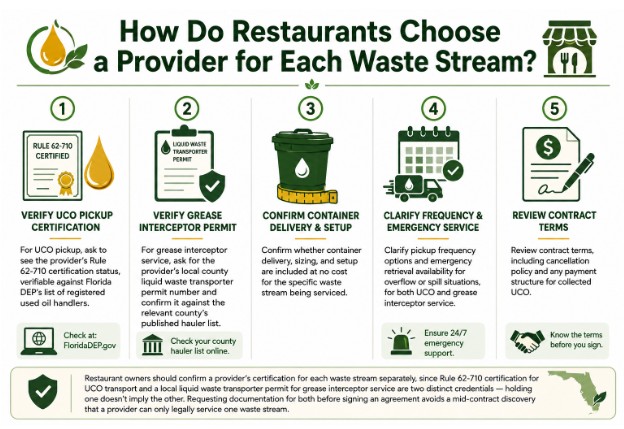
Restaurant owners should confirm a provider’s certification for each waste stream separately, since Rule 62-710 certification for UCO transport and a local liquid waste transporter permit for grease interceptor service are two distinct credentials — holding one doesn’t imply the other.
Requesting documentation for both before signing an agreement avoids a mid-contract discovery that a provider can only legally service one waste stream.
GreasePros Recycling LLC provides scheduled used oil pickup across Florida, from Miami-Dade to Central Florida and the Tampa Bay area.
The company documents its Rule 62-710 certification directly on its credentials and licensing page, along with the manifest fields it issues after every collection.
For Miami-Dade restaurants managing both waste streams, GreasePros also holds the local liquid waste transporter permit required for grease interceptor service — see Grease Trap Cleaning vs. Used Cooking Oil Pickup for how the two services and their separate certifications work together.
Restaurants generating unexpected overflow in either waste stream can also request emergency retrieval outside a scheduled pickup window.
What is a used oil pickup service? A used oil pickup service is a Rule 62-710-certified transporter that collects spent fryer and cooking oil from a restaurant’s dedicated storage container and delivers it to a licensed processing facility. This differs from grease trap cleaning, which removes wastewater-based FOG from a plumbed interceptor under a separate certification.
How often should Florida restaurants schedule oil pickups? Florida restaurants typically schedule weekly, biweekly, or monthly pickups depending on fryer oil volume. High-volume kitchens serving fried foods generally need more frequent collection, and requesting service before the container reaches capacity helps avoid unscheduled emergency calls.
Is it legal to pour used cooking oil down a drain in Florida? No. Local FOG ordinances, such as Miami-Dade’s County Code § 24-42.6, prohibit discharging FOG or food waste into sewers or stormwater systems. Improper disposal can also expose a restaurant to penalties under Florida’s used oil and grease waste statutes, depending on which waste stream is involved.
What is the difference between a UCO manifest and a grease waste manifest? A UCO manifest is the hauler’s own collection documentation for used cooking oil pickup, while a grease waste service manifest is a specific legal instrument required under Florida Statute 403.0741 for grease interceptor cleanings. Restaurants managing both waste streams should retain both documents separately.
How much do used oil pickup services cost? Most Florida used oil pickup services, including GreasePros Recycling, provide free containers and free scheduled pickups for qualifying restaurant accounts. Some haulers may also pay for collected oil depending on volume and current market pricing, so restaurants should confirm terms directly.
What happens to used cooking oil after pickup? After pickup, used cooking oil is transported to a Florida DEP-permitted processing facility, where it’s filtered and converted into biodiesel and other recycled products through transesterification and related refining processes that remove water, food particles, and other contaminants.
What are the fines for improper grease waste disposal in Florida? Florida Statute 403.0741 sets fines from $100 for a missing service manifest up to at least $2,500 for a first unlawful disposal offense and at least $5,000 plus license revocation for repeat offenses. This schedule applies to grease interceptor waste specifically, not used cooking oil.
What penalties apply to used cooking oil violations in Florida? Used oil violations, including improper UCO disposal, are calculated under Florida Statute 403.121 rather than the grease waste fine schedule. Florida DEP guidance confirms these administrative penalties cannot exceed $50,000 per assessment.
Do Florida county requirements differ from the statewide rules? Yes. Statewide rules under Rule 62-710 and Statute 403.0741 set the baseline for each waste stream, but counties including Miami-Dade, Broward, and Orange administer their own FOG programs with additional permits, inspection schedules, and documentation requirements.
Can a used oil pickup service also handle grease trap cleaning? Yes, provided the company holds both the Rule 62-710 certification for used cooking oil transport and the applicable local liquid waste transporter permit for grease interceptor service. These are separate credentials under separate rules, not a single combined certification covering both waste streams.
What size containers do restaurants receive for used oil storage? Restaurants typically receive 55-gallon drums, 140-gallon or 240-gallon outdoor containers, or under-counter tanks, sized to the kitchen’s fryer oil volume. GreasePros Recycling provides and maintains these containers at no additional cost for active accounts.
Two regulated waste streams, two sets of rules, and a grease waste framework that just became final in December 2025 — staying current means knowing which rule applies to which container. Contact GreasePros Recycling to schedule a free container and first pickup.
Founded with a vision to revolutionize the used cooking oil recycling industry, GreasePros Recycling has established itself as a trusted and leading provider of sustainable waste management solutions. With over 20 years of experience, our dedicated team brings extensive expertise and a commitment to environmental stewardship.
Quick Links
Contact Information
Get in Touch with GreasePros