Trusted and leading provider of sustainable waste management solutions from 20 years. (786) 655-7070
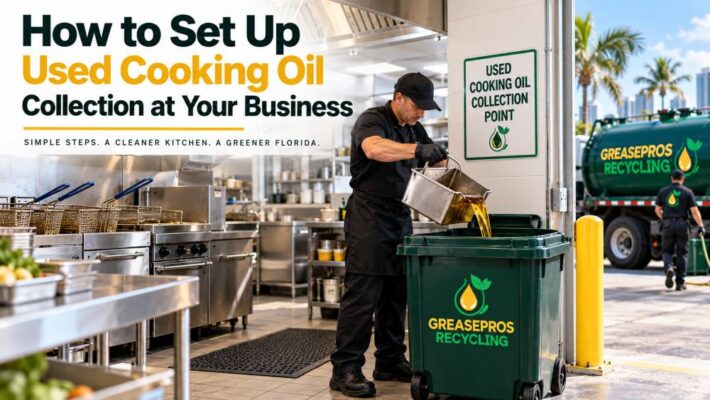
A working used cooking oil collection system needs four things: a sealed container sized to output, a spill-safe way to move oil into it, a fixed place for it to live, and a scheduled pickup.
Most Florida kitchens already have the oil problem; they just lack a station designed around it. GreasePros Recycling LLC supplies the container and runs the route with scheduled used-oil pickup.
Kitchens hauling drums by hand risk burns and back injuries every shift. GreasePros Recycling supplies containers and runs the route across Florida — set up collection.
A collection station is the fixed point where used oil lives between the fryer and the truck. Four components make it work, and a missing one shows up as a spill, an overflow, or a rejected load.
| Component | Function | What goes wrong without it |
| Sealed container | Holds oil between collections | Open drums take on rain, debris, and pests |
| Transfer device | Moves oil from fryer to container | Hand-carried buckets cause burns and floor spills |
| Spill containment | Catches drips and leaks under the container | Oil reaches the pad, then the nearest drain |
| Absorbent and label | Handles spills, identifies contents | Slip hazards persist through the shift |
Container material matters less than the seal and the lid. Provider-supplied drums and tanks arrive with fitted lids, and locking versions exist for sites with active oil theft. Containers belong on a solid, oil-impermeable surface rather than bare soil or gravel, which keeps a small leak from becoming a soil remediation problem.
Sizing follows output between pickups, not available space. A container that fits neatly but fills in four days forces unscheduled retrievals, which is the most common reason a kitchen ends up stacking spare buckets behind the building.
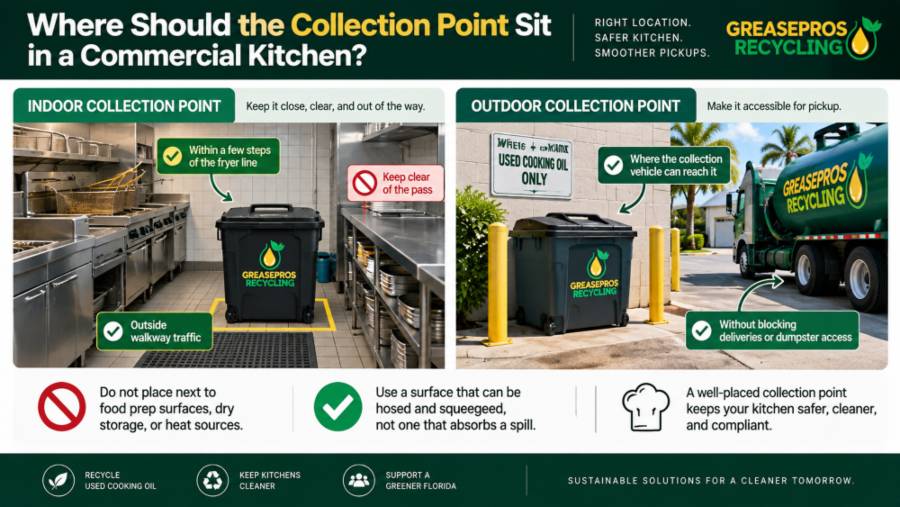
Placement decides whether staff use the station or improvise around it. The working rule is short carry distance indoors and clear truck access outdoors.
Long carry distances are the hidden cost. Every extra meter between fryer and container raises the chance of a drip trail across tile, and the U.S. Occupational Safety and Health Administration notes that restaurant burn injuries occur specifically during straining, moving, and transferring hot oil.
GreasePros Recycling reviews carry routes as part of account setup.
If you’re ready to get started, call us now!
The method should follow fryer count and cover volume. Across GreasePros Recycling’s Florida accounts, four configurations cover nearly every commercial kitchen.
| Method | Fits | How oil moves | Trade-off |
| Indoor lidded caddy | Single fryer, low covers | Drained into caddy, wheeled to container | Manual handling, smallest capacity |
| Fryer oil shuttle | Two to four fryers | Pumped from pot into shuttle unit | Equipment cost, needs storage space |
| Direct-plumbed line | Multi-fryer, fixed layout | Pumped straight to outdoor tank | Installation cost, layout-dependent |
| Bulk outdoor tank | High-volume and multi-site | Pumped from tank by collection truck | Requires pad and clearance for the truck |
Shuttles and plumbed lines remove the hand-carry step entirely, which is where most oil-handling injuries and floor spills originate.
For kitchens weighing the upgrade, the decision usually rests on shift count rather than square footage: a site running fryers through two shifts moves enough oil that manual handling becomes the constraint.
A station sized wrong overflows before the next scheduled stop. GreasePros Recycling matches container capacity to fryer output — request a site review.
Training holds when the routine lives on the closing checklist, not in verbal instruction. Three habits carry most of the value, and each fails predictably when skipped.
Written steps survive shift changes and seasonal hiring in a way that a verbal briefing does not.
Kitchens that post the sequence at the station itself — cool, transfer, close, log — report fewer repeat spills than those relying on onboarding alone. The broader handling protocol appears in the guidance on safe oil handling.
Yes, and it changes the economics on both ends. Daily filtration removes carbon and food particles that accelerate oil breakdown, extending usable fryer life and lowering purchase volume.
A kitchen that filters daily typically changes oil less often than one that doesn’t, which reduces both the cost of new oil and the volume entering the collection container.
Filtration does not remove the need for collection. Oil still degrades past the point of use, and the filtered-out solids still require disposal.
What filtration does is shift the ratio between what the kitchen buys and what it discards, which is the number worth tracking.
Logging collection volumes against oil purchase invoices reveals that ratio directly, and a widening gap usually points to a slipped filtration routine.
If you’re ready to get started, call us now!
The useful questions cover credentials, reliability, equipment, and paperwork. Credentials deserve precision, because requirements differ by waste stream and county rather than following a single statewide certification.
GreasePros Recycling publishes its credentials and licensing for that verification step and provides collection at no charge under its published service terms.
Across the wider market, arrangements differ — some collectors pay a per-gallon rate for clean oil, and others offset service against the value of the load, an economic picture covered in the breakdown of used cooking oil’s value.
They are different materials with different destinations. Fryer oil collected clean from the pot is yellow grease, which the U.S. Department of Energy identifies as a feedstock for biodiesel and renewable diesel production.
Grease trap waste is brown grease: a mix of water, food solids, and fats retained in an interceptor, processed through an entirely different route and carrying its own statutory handling duties under Section 403.0741, Florida Statutes.
Combining them destroys the value of the yellow grease and complicates the trap servicing record. Keeping them apart is why a kitchen needs a dedicated oil container in addition to whatever grease trap cleaning schedule it already runs.
The same logic rules out routing fryer oil to any drain: the U.S. Environmental Protection Agency reports that grease causes 47% of reported sewer blockages, and federal pretreatment rules at 40 CFR 403.5(b)(3) prohibit discharges that obstruct flow, with Florida counties and utilities setting local FOG limits above that floor.
What equipment does a used cooking oil collection station need?
A collection station needs a sealed container sized to output, a transfer device such as a caddy or pump, spill containment beneath the container, nearby absorbent material, and clear labeling. Collection providers supply the container and containment on most service agreements.
Where should the collection container go?
Indoor caddies belong near the fryer line but outside walkway traffic. Outdoor drums and tanks belong on a solid surface within reach of the collection truck, away from food prep doors, and clear of dumpster and delivery routes at the property.
Does a grease trap collect used cooking oil?
No. A grease interceptor captures fats from wash water flowing to the drain and holds brown grease. Fryer oil belongs in a separate container and never enters the trap, because mixing the streams ruins the value of both loads.
How large a container does a kitchen need?
Container size should match output between scheduled collections, with extra headroom. Across GreasePros Recycling’s Florida accounts, single-fryer kitchens typically run an indoor caddy, mid-volume sites a sealed outdoor drum, and high-volume operations a pumped bulk tank sized to demand.
Can filtration reduce how much oil a kitchen throws out?
Yes. Daily filtration removes carbon and food particles that accelerate oil breakdown, extending fryer oil life and lowering purchase volume. Filtration reduces how often you change oil; it does not replace the need for a scheduled collection service.
Who supplies the collection containers?
The collection provider supplies them on most Florida service agreements, including lids, containment, and replacement when a container fouls. Kitchens supplying their own containers take on cleaning and replacement costs that the service arrangement usually absorbs at no charge.
What should staff be trained to do?
Staff need three habits: cool oil fully before moving it, transfer without spilling onto the floor, and close the container lid every time. Written closing-checklist steps hold better than verbal instruction, especially across shift changes and new seasonal hires.
Does collection cost a Florida business money?
GreasePros Recycling provides collection at no charge under its published service terms. Other arrangements across the market vary: some collectors pay a per-gallon rate for clean oil, and others bundle containers and service against the value of the collected load.
How can a business track collection volume?
Collection records from the provider show date, volume, and destination for each pickup. Logging those alongside oil purchase invoices reveals how much oil the kitchen buys versus discards, which is the clearest signal that filtration needs attention at the fryer.
Used cooking oil collection is a design problem before it is a discipline problem. A sealed container sized to actual output, sited within a few steps of the fryer line and within reach of the collection truck, on containment, with a lid that closes — that configuration prevents most spills, overflows, and rejected loads that kitchens blame on staff.
Fryer oil and grease trap waste stay in separate containers because they are different materials with different destinations.
Filtration reduces the volume flowing through the station without removing the need for it. The provider supplies the equipment and the schedule; the kitchen supplies the routine.
Oil piling up in mismatched buckets costs staff time and grade. GreasePros Recycling handles containers, pickup, and records — book Florida collection.
Founded with a vision to revolutionize the used cooking oil recycling industry, GreasePros Recycling has established itself as a trusted and leading provider of sustainable waste management solutions. With over 20 years of experience, our dedicated team brings extensive expertise and a commitment to environmental stewardship.
Quick Links
Contact Information
Get in Touch with GreasePros