Trusted and leading provider of sustainable waste management solutions from 20 years. (786) 655-7070
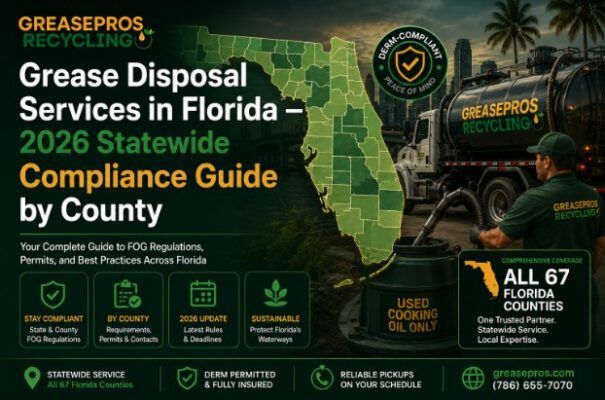
Florida restaurants must dispose of used cooking oil through licensed haulers under Florida Statute § 403.0741 and the Florida DEP Used Oil Management Program (§§ 403.75–403.769), but five major counties — Miami-Dade, Broward, Palm Beach, Orange, and Hillsborough — enforce additional permit, manifest, and penalty requirements that exceed the state baseline.
GreasePros Recycling LLC (DOT #4136566) provides DERM-compliant collection across South Florida and statewide service, with free locked containers, bilingual support in English and Spanish, and hurricane-season protocols.
Three layers of Florida law govern used cooking oil disposal: the FOG hauler licensing statute, the Used Oil Management Program, and Florida Administrative Code rules that set manifest and transport standards.
Florida has no statewide grease interceptor mandate in its environmental code. The interceptor requirement stems from each county’s local sewer ordinance and the Florida Building Code, so enforcement intensity, permit types, and penalty schedules vary by jurisdiction.
Florida’s five highest-volume restaurant counties each enforce FOG compliance through a separate agency with its own permit type, pump-out schedule, manifest portal, and penalty framework — a restaurant that is compliant in Tampa may be non-compliant in Miami-Dade without adjusting its documentation.
| County | Enforcement Agency | Permit Type | Pump-Out Rule | Manifest Requirement | Key Penalty |
| Miami-Dade | DERM (County Code Ch. 24) | Annual GDO permit (expires Dec 31) | 25% Rule + 90-day max | DERM-formatted; upload to WASD portal within 5 days | $250 automatic fee for logs exceeding 90 days |
| Broward | Water & Wastewater Services, (954) 831-0952 | Quarterly compliance; yellow “compliance decal” required near trap | 90-day (quarterly) | Quarterly pump-out manifests; compliance decal verification | $500 fine for unlicensed haulers |
| Palm Beach | Solid Waste Authority (SWA) oversight | Biennial permit | 25% Rule; per-permit schedule | Grease Trap Self-Certification form each January; low-volume variance available (<40 lb/week) | Permit tied to food-service license renewal |
| Orange | OCU FOG Control Program; Orlando Wastewater Division (City Code Ch. 28) | Per-permit basis; annual certificate | 90-day or 25% Rule; enhanced inspections in Disney/resort corridor | Online portal auto-flags missing manifests; 30-day warning before fines | County tests effluent for FOG <100 mg/L |
| Hillsborough | EPC, (813) 627-2600; Tampa Water Dept Pretreatment, (813) 274-8551 | Grease Management Program | 90-day pump-out | City of Tampa approved manifests for all service events | Unannounced inspections; enforcement under Tampa Code Ch. 26 |
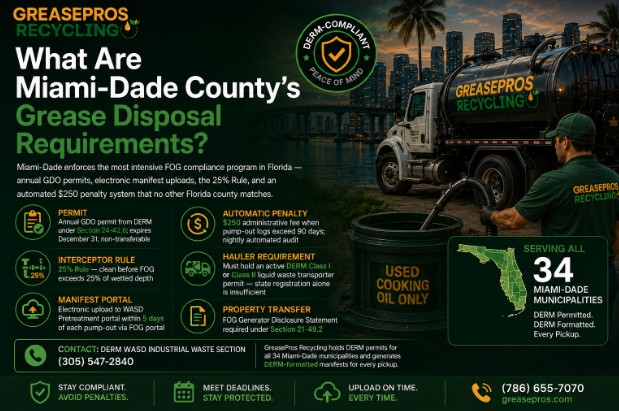
Miami-Dade enforces the most intensive FOG compliance program in Florida — annual GDO permits, electronic manifest uploads, the 25% Rule, and an automated $250 penalty system that no other Florida county matches.
GreasePros Recycling holds DERM permits for all 34 Miami-Dade municipalities and generates DERM-formatted manifests for every pickup.
If you’re ready to get started, call us now!
Broward County requires quarterly grease trap pump-outs and issues a yellow “compliance decal” that must be affixed near the trap — inspectors verify the decal during health reviews.
GreasePros Recycling serves Broward County restaurants from its West Park base — located within the county — with same-day emergency response for spills and compliance emergencies.
Palm Beach County operates a biennial permit system under the Solid Waste Authority’s oversight — the only major Florida county with a two-year permit cycle rather than annual renewal.
GreasePros Recycling provides compliant collection across all Palm Beach County ZIP codes, including Jupiter, West Palm Beach, Boca Raton, and Delray Beach.
Multi-county Florida restaurant operators need a hauler whose manifests match each county’s specific portal and documentation format. GreasePros Recycling generates county-specific compliance documentation for Miami-Dade, Broward, and Palm Beach from a single service relationship. Call (786) 655-7070.
Orange County Utilities (OCU) operates a FOG Control Program with per-permit pump-out schedules, an online auto-flagging manifest portal, and enhanced inspections for restaurants in the Walt Disney World resort corridor.
GreasePros Recycling serves Orlando-area restaurants with manifests formatted for OCU’s online portal requirements.
Hillsborough County’s Environmental Protection Commission (EPC) and the City of Tampa Water Department jointly administer FOG programs in the Tampa Bay area, whose enforcement depends on which utility serves the restaurant’s address.
GreasePros Recycling provides statewide service in Florida, including Tampa Bay area collection, with manifests formatted to meet City of Tampa documentation standards.
GreasePros Recycling provides free used cooking oil collection for Florida restaurants producing 40 or more gallons per month — no setup fees, no monthly charges, and no long-term contracts.
If you’re ready to get started, call us now!
GreasePros Recycling LLC (DOT #4136566) operates from two Florida locations — West Park (Miami-Dade) and Cape Canaveral (Brevard) — providing used cooking oil collection across all five major FOG enforcement counties and statewide.
Florida’s five major restaurant counties each enforce different permits, portals, and penalty schedules — one missed manifest can cost $250–$500 depending on jurisdiction.
GreasePros Recycling generates county-specific compliant documentation from a single hauler relationship across all five regions. Call (786) 655-7070 or request service online.
Does Florida have a single statewide grease interceptor mandate? Florida has no statewide grease interceptor mandate in its environmental code. The requirement to install a grease interceptor is set by each county’s local sewer ordinance and the Florida Building Code Plumbing Volume, which references the ASME A112.14.3 and PDI G-101 interceptor standards.
What is Florida Statute § 403.0741, and how does it affect restaurants?
Florida Statute § 403.0741 requires all food service establishments to use licensed haulers for FOG transport and maintain signed service manifests for every collection event. County-level FOG ordinances in Miami-Dade, Broward, Palm Beach, Orange, and Hillsborough add additional permit, portal, and penalty requirements above this state baseline.
Which Florida county has the strictest enforcement of grease disposal?
Miami-Dade County enforces the most intensive FOG compliance program in Florida through DERM — annual GDO permits, the 25% Rule, electronic manifest uploads within 5 days, an automated nightly audit system, and a $250 automatic administrative fee for pump-out logs exceeding 90 days.
What is the 25% Rule for grease traps in Florida?
The 25% Rule requires food service establishments to clean grease interceptors before FOG accumulation exceeds 25% of the wetted depth. Miami-Dade, Palm Beach, and Orange counties explicitly enforce this rule — Broward and Hillsborough use a 90-day quarterly pump-out standard as the primary compliance trigger.
How much does it cost to not comply with Florida grease disposal laws?
Non-compliance penalties vary by county: Miami-Dade charges an automatic $250 fee per missed manifest cycle; Broward imposes $500 fines for unlicensed haulers; and statewide penalties under Florida Administrative Code Chapter 62-705 range from $100 to $5,000 per offense, depending on violation severity and repeat history.
Do Florida restaurants earn money from used cooking oil?
Florida restaurants earn $0.15–$0.55 per gallon from licensed haulers, depending on oil quality, monthly volume, and proximity to biodiesel processing facilities. Miami-Dade kitchens average $0.40 per gallon due to South Florida’s dense network of certified biodiesel processors.
What is the difference between Florida DEP registration and county-level FOG permits?
Florida DEP registration under §§ 403.75–403.769 covers statewide hauler licensing and used oil transport standards. County-level FOG permits — such as Miami-Dade’s GDO permit or Palm Beach’s biennial permit — add local compliance requirements, including electronic portal reporting, specific manifest formats, and jurisdiction-specific penalty schedules.
Does GreasePros Recycling serve all five major Florida FOG counties?
GreasePros Recycling operates from two Florida bases — West Park in Miami-Dade and Cape Canaveral in Brevard — serving Miami-Dade, Broward, Palm Beach, Orange, Hillsborough, and all surrounding Florida counties with manifests formatted for each county’s specific compliance portal and documentation requirements.
What happens to used cooking oil after collection in Florida?
Licensed haulers transport the collected UCO to certified Florida processing facilities, where it is converted to ASTM D6751-grade biodiesel through transesterification, yielding 90–97% fuel recovery per gallon. Glycerin byproduct sells for soap and pharmaceutical manufacturing, and finished biodiesel is distributed as B20 blends for commercial fleets throughout the Southeast.
Is Florida Statute § 403.7225 related to restaurant grease disposal?
Florida Statute § 403.7225 addresses local hazardous waste management assessments for small quantity generators — it does not govern used cooking oil or FOG disposal for food service establishments. The relevant restaurant grease statutes are § 403.0741 for FOG hauler licensing and manifests, and §§ 403.75–403.769 for the broader Used Oil Management Program administered by the Florida DEP.
Founded with a vision to revolutionize the used cooking oil recycling industry, GreasePros Recycling has established itself as a trusted and leading provider of sustainable waste management solutions. With over 20 years of experience, our dedicated team brings extensive expertise and a commitment to environmental stewardship.
Quick Links
Contact Information
Get in Touch with GreasePros