Trusted and leading provider of sustainable waste management solutions from 20 years. (786) 655-7070
Florida used oil disposal regulations are the state rules in sections 403.75 through 403.769, Florida Statutes, and Chapter 62-710, Florida Administrative Code, where “used oil” is a legal term limited to oil refined from crude or synthetic sources.
Restaurant fryer oil falls outside that term. Grease trap waste follows a separate state law, and drains and county permits follow federal pretreatment rules and local FOG programs.
A restaurant meets each layer by first naming its waste stream, then hiring the right service, such as used cooking oil pickup for fryer oil.
Florida’s used oil rules do not apply to restaurant cooking oil because “used oil” is a defined legal term, not a general term for discarded oil.
Section 403.75(7), Florida Statutes, limits it to oil refined from crude or synthetic oil, and the Florida DEP used oil brochure states that the term excludes products derived from vegetable or animal fats.
The federal definition points the same way.
The U.S. Environmental Protection Agency’s used oil guidance for businesses sets three tests for used oil: refined from crude or synthetic material, used as a lubricant or similar fluid, and contaminated through that use. Fryer oil fails the first test.
Cooking oil still has rules around it. Drains, county permits, and grease trap paperwork each carry requirements, and household cooking oil disposal varies from one Florida county to the next.
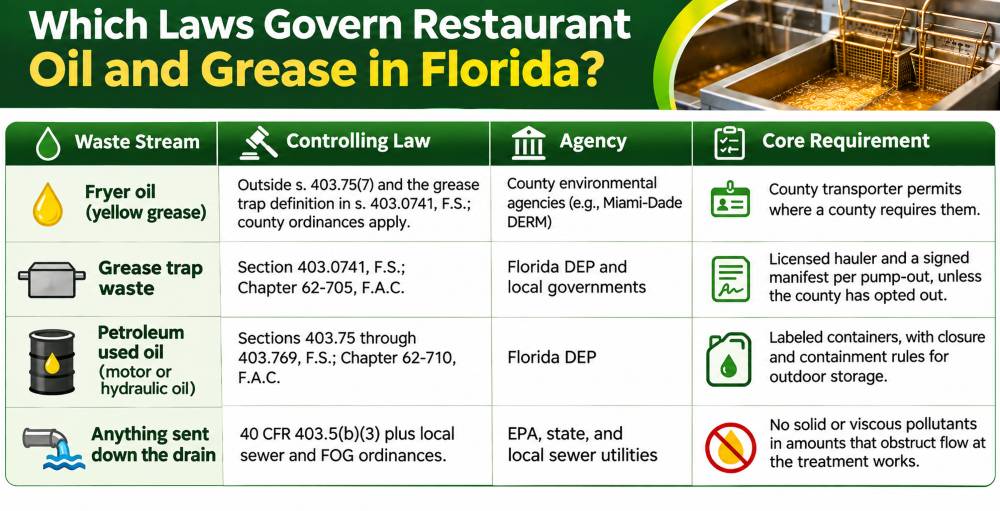
Four sets of rules govern the oil and grease a Florida restaurant produces, each targeting a different waste stream or discharge point. County rules and sewer utilities add local layers on top of this baseline.
| Waste Stream | Controlling Law | Agency | Core Requirement |
| Fryer oil (yellow grease) | Outside s. 403.75(7) and the grease trap definition in s. 403.0741, F.S.; county ordinances apply | County environmental agencies such as Miami-Dade DERM | County transporter permits where a county requires them |
| Grease trap waste | Section 403.0741, F.S.; Chapter 62-705, F.A.C. | Florida DEP and local governments | Licensed hauler and a signed manifest per pump-out, unless the county has opted out |
| Petroleum used oil (motor or hydraulic oil) | Sections 403.75 through 403.769, F.S.; Chapter 62-710, F.A.C. | Florida DEP | Labeled containers, with closure and containment rules for outdoor storage |
| Anything sent down the drain | 40 CFR 403.5(b)(3) plus local sewer and FOG ordinances | EPA, state, and local sewer utilities | No solid or viscous pollutants in amounts that obstruct flow at the treatment works |
A normal service week shows the split. A collector empties the fryer oil container on schedule, while a licensed grease waste hauler pumps the interceptor, signs the state manifest with the manager, and returns the completed copy after disposal.
Day-to-day fryer oil disposal practices such as cooling, storage, and collection intervals come from kitchen safety and collector standards rather than these statutes.
If you’re ready to get started, call us now!
Florida’s grease waste law requires restaurants to use a licensed hauler for grease trap pump-outs and to keep the completed manifest for every job. Senate Bill 1110 (2022) created section 403.0741, Florida Statutes, and DEP carries it out through Chapter 62-705, Florida Administrative Code.
Section 403.0741 defines a restaurant as an originator: a food service establishment that serves food or drinks to the public, including hotels, schools, and hospitals.
Grease waste is the fatty material held in a trap or interceptor, and the statute’s trap definition excludes containers built to collect used cooking oil, fats, and bones.
The state manifest, DEP form 62-705.300(3), records who removed the grease, its origin, and its destination.
The Florida DEP grease waste fact sheet treats a restaurant as a self-cleaner only when its grease trap storage capacity is 55 gallons or less, and it removes and transports its own grease waste. A self-cleaner follows every hauler rule except licensing and keeps signed manifests.
New haulers apply 30 days before starting work, licenses expire April 1, and renewals are due by March 1 each year. Trap pump-outs run as a separate service from fryer oil, through grease trap cleaning.
The statute’s fines fall on the hauler. A hauler faces up to $100 for each manifest it fails to provide or keep, up to $250 for each trap it fails to clean, and at least $2,500 plus a license suspension of at least 30 days for an unlawful disposal.
A repeat unlawful disposal brings at least $5,000 and a license revocation of at least 12 months.
Local governments can adopt stricter grease rules, while fiscally constrained counties and small counties may opt out of the section entirely.
Florida’s used oil rules apply when a business holds petroleum oil, such as motor oil or hydraulic fluid. Florida DEP’s generator brochure summarizes the storage standards in Chapter 62-710.
Households sit outside these generator standards under 40 CFR 279.20(a)(1).
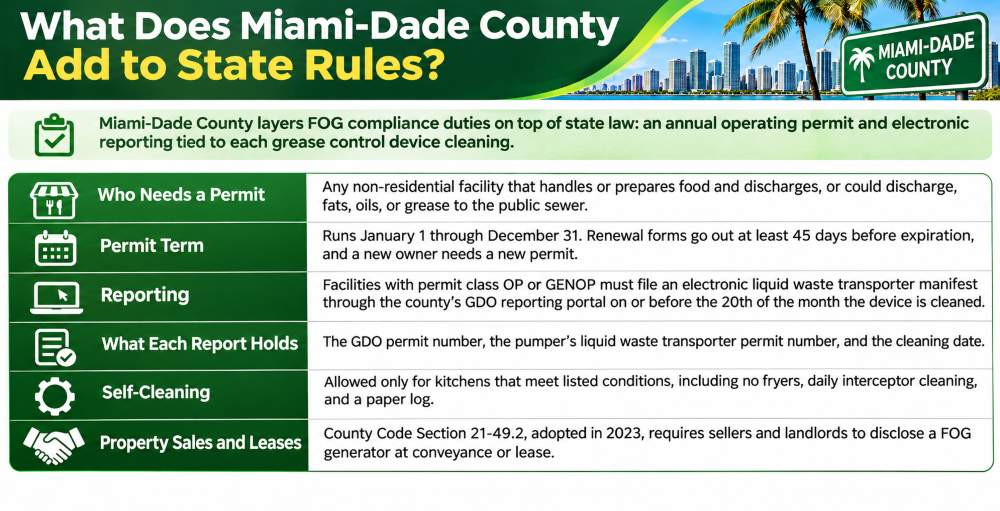
Miami-Dade County layers Miami-Dade FOG compliance duties on top of state law: an annual operating permit and electronic reporting tied to each grease control device cleaning.
Under a federal court order involving the U.S. Environmental Protection Agency, the county must cut the grease entering its sewers.
Fryer oil runs on its own paper trail. GreasePros Recycling leaves a signed collection record at every pickup, so schedule fryer oil collection today.
A Florida restaurant’s compliance checklist should separate legal duties from good practice and name the responsible party for each. County and sewer utility rules can be stricter or, in opt-out counties, narrower, so each restaurant should confirm the list with its county and utility.
| Task | Type | Applies To | Timing |
| Keep grease out of drains in amounts that obstruct sewer flow | Federal and local law | All food service establishments | Ongoing |
| Use a DEP-licensed hauler for trap pump-outs | State law (s. 403.0741) | Originators in counties that have not opted out | Each pump-out |
| Sign the manifest at pump-out and keep the completed copy | State law (s. 403.0741) | Originator and hauler | One year per completed manifest |
| Confirm the completed manifest arrived after disposal | Good practice | Originator | Within 30 days of disposal |
| Renew the FOG operating permit | County law | Miami-Dade food facilities | Calendar-year term |
| File the electronic manifest for each device cleaning | County law | Miami-Dade permit classes OP and GENOP | By the 20th of the cleaning month |
| Label petroleum oil containers “Used Oil” | State rule (62-710.401(6)) | Businesses holding motor or hydraulic oil | Ongoing |
| Check a collector’s credentials before signing | Due diligence | Restaurants hiring any collector | Before signing |
Credential checks differ by service. A fryer oil collector should show a USDOT record in the FMCSA SAFER database and any county transporter permit, and a trap hauler also needs a DEP grease waste hauler license. GreasePros Recycling LLC lists its USDOT number and Miami-Dade DERM permit on its credentials and licensing page, and its fryer oil collection record shows the kitchen, disposal facility permit number, date, and gallons collected.
Florida’s grease rules changed in four steps between 2022 and 2026. Senate Bill 1110 created section 403.0741 in 2022, DEP’s Chapter 62-705 took effect in December 2025, and the licensing deadlines fall in 2026.
Section 403.0741 text holds these provisions, and the county-by-county disposal rules cover Broward, Palm Beach, Orange, and Hillsborough.
No. Section 403.75(7), Florida Statutes, limits used oil to oil refined from crude or synthetic oil, and section 403.0741 excludes used cooking oil containers from its grease trap definition. Fryer oil collection instead follows county rules, such as Miami-Dade transporter permits.
A Florida restaurant keeps the completed manifest, signed by the restaurant, the hauler, and the disposal facility operator. The hauler sends it within 30 days of disposal, and the restaurant keeps it on-site for one year. The copy signed at pump-out is the interim record.
Section 403.0741, Florida Statutes, fines haulers up to $100 per missing manifest and up to $250 per uncleaned trap. An unlawful disposal carries at least $2,500 and a 30-day license suspension; a repeat violation carries at least $5,000 and a 12-month revocation.
Only with a small trap. Florida DEP treats a restaurant as a self-cleaner when its grease trap storage capacity is 55 gallons or less, and it hauls its own waste. Self-cleaners follow hauler rules except licensing, and Miami-Dade adds stricter conditions.
Miami-Dade facilities with GDO permit class OP or GENOP file an electronic liquid waste transporter manifest on or before the 20th of the month the grease control device is cleaned. Each report includes the GDO permit number, pumper permit number, and cleaning date.
A Miami-Dade FOG Discharge Control Operating Permit runs from January 1 through December 31 and renews every year. The county sends renewal forms at least 45 days before expiration, and the permit does not transfer to a new owner after a sale.
Yes. The federal pretreatment rule at 40 CFR 403.5(b)(3) prohibits discharging solid or viscous pollutants in amounts that obstruct flow at a public treatment works and cause interference. The rule applies to every user, and Florida counties and cities add their own FOG ordinances.
Florida DEP’s brochure lists a “Used Oil” label on every tank and container under Rule 62-710.401(6). Outdoor containers stay closed or covered and either have double walls or sit on an oil-impermeable surface with containment for 110% of the largest container.
Florida used oil disposal regulations govern petroleum oil, not restaurant fryer oil.
Grease trap waste falls under section 403.0741 and Chapter 62-705, which require a licensed hauler, a manifest signed at pump-out and completed after disposal, and one year of on-site records, unless the county has opted out.
Federal pretreatment rules and local ordinances bar grease discharges that obstruct sewers, and Miami-Dade adds an annual permit and per-cleaning reporting.
A restaurant that sorts its waste streams correctly needs two services: fryer oil collection and grease trap pumping.
Fryer oil in the wrong place means clogs and fines. GreasePros Recycling collects kitchen fryer oil on schedule, so book fryer oil pickup.
Founded with a vision to revolutionize the used cooking oil recycling industry, GreasePros Recycling has established itself as a trusted and leading provider of sustainable waste management solutions. With over 20 years of experience, our dedicated team brings extensive expertise and a commitment to environmental stewardship.
Quick Links
Contact Information
Get in Touch with GreasePros