Trusted and leading provider of sustainable waste management solutions from 20 years. (786) 655-7070

Used cooking oil becomes Florida biodiesel through four linked stages: licensed collection from commercial kitchens, transport, transesterification processing at a Florida Department of Environmental Protection (DEP)-permitted facility, and blending into diesel fuel sold across the state.
Restaurants generate the used cooking oil that feeds this supply chain, and oil collected by a certified transporter and processed at a permitted facility displaces petroleum diesel with a lower-emission alternative.
Restaurant owners who route their oil through a licensed hauler turn a disposal cost into a documented compliance record backed by manifests.
Overflowing grease containers pose a compliance risk, not just a mess. GreasePros Recycling’s free lockable containers and scheduled pickup move oil safely into Florida’s biodiesel supply chain.
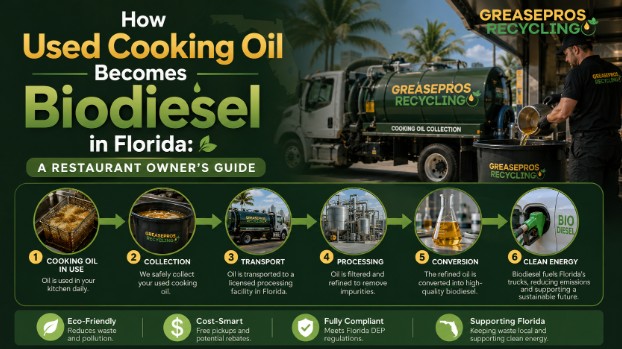
Used cooking oil (UCO) is fryer and cooking oil that food service establishments can no longer use for food preparation because repeated heating has degraded its quality. Florida’s UCO-to-biodiesel chain runs through four stages: collection, transport, processing, and distribution.
Kitchen staff pours cooled fryer oil into a sealed storage container supplied by a licensed hauler.
A certified transporter empties that container on a scheduled or on-call basis and issues a signed manifest documenting the collection. The hauler delivers the oil to a Florida DEP-permitted processing facility, where it never touches a landfill or storm drain.
At the processing facility, technicians filter the oil to remove food particles and water, then subject it to transesterification.
Transesterification is the chemical reaction that combines filtered oil with an alcohol (typically methanol) and a catalyst to split triglyceride molecules into methyl esters — biodiesel — and a glycerin byproduct.
The finished biodiesel is blended with petroleum diesel at ratios ranging from B5 to B100 before distribution to fuel terminals, fleets, and retail pumps.
From Fryer to Fuel: Florida’s Used Cooking Oil Supply Chain
| Stage | What Happens | Who Handles It |
| Collection | Kitchen staff store cooled UCO in a sealed, lockable container | Restaurant staff |
| Transport | Certified hauler empties containers and issues a signed manifest | State-certified transporter |
| Processing | Oil is filtered, then converted via transesterification | DEP-permitted processing facility |
| Distribution | Finished biodiesel is blended and shipped to terminals and fleets | Biodiesel producer/distributor |
Demand for Florida’s used cooking oil is driven by the growing biodiesel market. Biodiesel is a renewable diesel substitute made from feedstocks such as used cooking oil, animal fats, and virgin vegetable oils, and is blended into or used in place of petroleum diesel.
National biodiesel production has been in the billions of gallons annually for over a decade, and the U.S. Energy Information Administration tracks production, exports, and consumption trends, showing sustained demand for waste-grease feedstocks.
That demand exists because of the federal Renewable Fuel Standard (RFS). Under the RFS, obligated petroleum refiners and importers must blend a set volume of renewable fuel into the fuel supply each year or purchase compliance credits called Renewable Identification Numbers, or RINs.
A gallon of biodiesel generates 1.5 RINs, which contributes to the market price processors are willing to pay for feedstock — including South Florida restaurant fryer oil.
Grease recycling plays a direct role in that market: recycled grease functions as a lower-cost, eco-friendly feedstock for biodiesel industry producers who would otherwise rely on virgin vegetable oils.
If you’re ready to get started, call us now!
Biodiesel and renewable diesel made from used cooking oil, tallow, and distillers’ corn oil achieve greenhouse gas reductions of 79% to 86% compared with petroleum diesel, so a restaurant’s recycled fryer oil feeds a measurably cleaner fuel pathway than the diesel it displaces.
This 79%–86% reduction range comes from a peer-reviewed life-cycle emissions analysis covering both biodiesel and renewable diesel production pathways across multiple feedstocks; the same analysis notes biodiesel production is less energy-intensive than the renewable diesel route for a given feedstock.
Under the federal Renewable Fuel Standard, any fuel classified as biomass-based diesel — a category that includes both biodiesel and renewable diesel — must independently demonstrate at least a 50% lifecycle greenhouse gas reduction compared to the 2005 petroleum baseline before it can generate RINs.
Waste-grease-derived fuel clears that threshold with room to spare, which is why UCO remains an attractive feedstock for processors chasing RFS compliance credits.
Lifecycle Greenhouse Gas Emissions Reduction vs. Petroleum Diesel
| Feedstock | GHG Reduction vs. Petroleum Diesel | Source |
| Soybean, canola, or carinata oil (biodiesel/renewable diesel) | 40%–69% | Peer-reviewed life-cycle analysis (PMC) |
| Used cooking oil, tallow, distillers corn oil (biodiesel/renewable diesel) | 79%–86% | Peer-reviewed life-cycle analysis (PMC) |
| EPA minimum threshold for biomass-based diesel | 50% (minimum required) | U.S. EPA, Renewable Fuel Standard |
So-called “waste grease” has a lower carbon footprint than crop-based feedstocks because it requires no new agricultural land or virgin oil production, so restaurants that recycle fryer oil are feeding the highest-reduction segment of the biodiesel and renewable diesel supply chain.
Restaurants do not collect RIN credits directly — those credits are generated and traded by registered fuel producers and obligated parties further down the supply chain, not by the kitchens that generate the raw oil. What restaurant owners get is the downstream effect of that RIN market: because processors can get paid for the biodiesel and RINs their facilities generate, used cooking oil carries resale value rather than being a pure disposal cost, though RIN pricing is one of several factors — alongside diesel demand and regional processing capacity — that determine that value.
That resale value is one reason licensed haulers can offer free containers, scheduled pickup, and — depending on volume and current UCO market pricing — payment or reduced service costs to higher-volume kitchens.
Florida’s current UCO market value shifts over time, so restaurant owners should confirm current terms directly with their certified hauler rather than assuming a fixed rate applies statewide.
GreasePros Recycling LLC, a Florida DEP-certified used cooking oil transporter headquartered in West Park, Florida, operates as the collection link between commercial kitchens and DEP-permitted biodiesel processing facilities.
The company operates USDOT #4136566-registered liquid tanker trucks and issues a signed manifest that documents the hauler identity, kitchen origin, disposal facility permit number, and gallons collected after each pickup, so kitchens can maintain a documented compliance record without extra paperwork.
Gaps in the chain of custody expose a kitchen to compliance risks, which is why GreasePros serves as the licensed collection point, keeping the chain intact from fryer to processor rather than operating its own transesterification plant.
Restaurants, hotels, hospitals, and franchise kitchens across South and Central Florida use this collection layer to move oil into the biodiesel supply.
Beyond scheduled pickups, the company provides emergency retrieval for overflow, spill, or storm-related situations, so kitchens generating unusually high volumes of used cooking oil during a rush or storm event can still comply with Florida’s used cooking oil disposal requirements.
If you’re ready to get started, call us now!
Florida regulates used cooking oil collection through two separate frameworks. Florida Administrative Code Rule 62-710, administered by the Florida DEP, establishes a statewide certification program for used oil transporters and prohibits generators from using a transporter that isn’t certified or registered with the state — GreasePros Recycling holds this certification, as documented on its own credentials and licensing page.
Separately, Florida Statute 403.0741, created by 2022’s Senate Bill 1110, requires food service establishments to use a licensed grease waste hauler and to sign and retain a service manifest documenting each collection; Florida DEP’s own guidance confirms the completed manifest must be retained on-site by both the originator and the hauler for one year.
The same legislation authorizes the Florida DEP to periodically inspect service manifests and permits local governments to adopt additional grease waste requirements in addition to the state framework.
Florida Statute 403.751 separately prohibits the collection, transportation, storage, or disposal of used oil in any manner that endangers public health, and bars the discharge of used oil into sewers, drains, or waterways.
Local ordinances can add further requirements on top of the state framework — Miami-Dade County’s Fats, Oils, and Grease program, for example, layers county-level manifest and permitting rules onto the statewide DEP requirements.
Restaurant owners in other Florida counties should confirm whether a comparable local ordinance applies to their business, since SB 1110 leaves room for county-level variation rather than imposing one uniform local rule statewide.
Florida DEP periodically inspects service manifests as part of its grease waste compliance program. GreasePros Recycling’s documented pickup service automatically records every collection, without extra paperwork for kitchen staff.
How does used cooking oil become biodiesel? Processing facilities filter used cooking oil to remove food particles, then process it through transesterification, a chemical reaction that combines the oil with methanol and a catalyst. The reaction splits the oil into biodiesel (methyl esters) and a glycerin byproduct, which processors sell separately.
Is used cooking oil recycling required by law in Florida? Yes. Florida Statute 403.0741 requires food service establishments to use a licensed grease waste hauler and document each collection with a signed service manifest. Separately, Florida Statute 403.751 prohibits improper disposal of used oil into sewers, drains, or waterways.
Can restaurants sell their used cooking oil in Florida? Some licensed haulers pay for used cooking oil depending on volume and current market pricing, since RIN-driven demand gives UCO resale value. Terms vary by hauler and fluctuate with biodiesel market conditions, so restaurants should confirm current pricing directly.
What is transesterification? Transesterification is the chemical process that converts filtered used cooking oil into biodiesel. An alcohol, typically methanol, reacts with the oil in the presence of a catalyst, separating it into methyl esters, which make up biodiesel, and a glycerin byproduct.
How much does biodiesel reduce carbon emissions compared to diesel? Biodiesel and renewable diesel made from used cooking oil and other waste greases cut lifecycle greenhouse gas emissions by 79% to 86% compared with petroleum diesel, based on a published, peer-reviewed life-cycle analysis. Crop-based feedstocks achieve lower reductions, ranging from 40% to 69%.
Who is allowed to collect used cooking oil in Florida? Florida Administrative Code Rule 62-710 prohibits generators from using a transporter that isn’t certified or registered with the state to handle used oil. Florida Statute 403.0741 separately requires food service establishments to use a licensed hauler for grease waste collection and to document it.
What happens if a Florida restaurant uses an unlicensed grease hauler? Florida Statute 403.751 prohibits any person from disposing of used oil in a manner that endangers public health, and Rule 62-710 bars generators from using an uncertified transporter. Restaurants should confirm hauler certification before signing a service agreement to avoid this compliance risk.
How long do Florida restaurants have to keep used cooking oil manifests? Florida Statute 403.0741 and Florida DEP’s grease waste manifest guidance require both the originator and the hauler to retain a signed, completed service manifest on-site for one year from the date of disposal. The hauler must also provide the originator a copy within 30 days.
What is a RIN credit, and does it benefit restaurants directly? A RIN, or Renewable Identification Number, is a compliance credit generated when biodiesel enters the fuel supply, with market value that fluctuates over time. Restaurants don’t receive RINs directly, but RIN value is one factor that makes fuel producers willing to pay for used cooking oil feedstock.
Does GreasePros Recycling turn collected oil into biodiesel itself? No. GreasePros Recycling operates as the licensed collection and transport link, moving oil from commercial kitchens to Florida DEP-permitted processing facilities that perform the actual transesterification into biodiesel. GreasePros issues a signed manifest documenting each collection but does not process the oil itself.
Every gallon of properly documented used cooking oil is one less compliance risk sitting behind the kitchen. Schedule a free container and pickup with GreasePros Recycling before the next inspection cycle.
Founded with a vision to revolutionize the used cooking oil recycling industry, GreasePros Recycling has established itself as a trusted and leading provider of sustainable waste management solutions. With over 20 years of experience, our dedicated team brings extensive expertise and a commitment to environmental stewardship.
Quick Links
Contact Information
Get in Touch with GreasePros