Trusted and leading provider of sustainable waste management solutions from 20 years. (786) 655-7070

Used cooking oil recycling in Titusville means scheduled collection of spent fryer oil from a sealed container supplied to the kitchen.
GreasePros Recycling LLC, a licensed used cooking oil hauler serving Titusville, Florida, provides scheduled oil collection across north Brevard County.
Brown grease captured in a plumbed interceptor is a separate service under the City of Titusville’s own permit program.
A site assessment counts fryers and sizes the container; pricing follows it. Titusville operators can book that assessment with GreasePros Recycling.
GreasePros Recycling provides scheduled fryer oil collection, container delivery, hood cleaning, and emergency retrieval for restaurants, cafeterias, hotels, schools, and commercial kitchens across Titusville and north Brevard County.
GreasePros Recycling supplies 55-gallon, 140-gallon, and 240-gallon containers at no extra charge and maintains them, with weekly, biweekly, or monthly collection and on-call pickup between scheduled visits. Hood cleaning covers hoods, filters, ducts, and fans.
Interceptor pumping is a separate service under separate licensing and is not what this page describes.
The services above concern fryer oil and kitchen exhaust only. Titusville sits on the Space Coast route run from the Cape Canaveral dispatch base at 166 Center St., Suite 235, which also serves Cocoa, Melbourne, Palm Bay, and Viera.
Transporter credentials appear on the credentials and licensing page, and emergency response for overflows, spills, and container damage runs 24/7 through emergency retrieval at (786) 655-7070.
The city does, through its own staff rather than the county. Titusville’s Industrial Pretreatment Program administers a brown grease interceptor permit program covering more than 160 permits across the city’s food service and FOG-discharging businesses.
Two program staff run it, both holding FIPA FOG Management certification and completing annual continuing education. A Titusville operator with a question about interceptor sizing, permit status, or an inspection finding deals with a small specialized local team rather than a county call center.
Determining which authority applies is simpler than it looks: the water and sewer bill names the utility.
An account billed by the City of Titusville points to the city system and its permit program. An account billed by Brevard County Utility Services points to the county framework instead, which is structured quite differently.
The program reports diverting 60,000 gallons of brown grease from the sewer system to recycling outlets such as rendering plants and fuel-energy cogeneration facilities.
Documentation is the core obligation. The permit program requires FOG dischargers to maintain their interceptors and submit written evidence that a licensed contractor pumps accumulated grease on a regular schedule.
The program page states that requirement without publishing a fixed interval or sizing standard, which does not mean no schedule applies to a given site — permit conditions and device sizing are settled directly with Industrial Pretreatment staff.
The program requires the contractor to be licensed and requires written proof to be submitted, making contractor selection part of the compliance picture rather than a purely commercial decision.
Separately, Florida Statute 403.0741 governs grease waste from a plumbed interceptor, requiring a signed service manifest retained on site for a year by both the originator and the hauler, and Florida DEP licenses grease waste haulers under Chapter 62-705. Both obligations attach to the interceptor stream. Neither attaches to fryer oil.
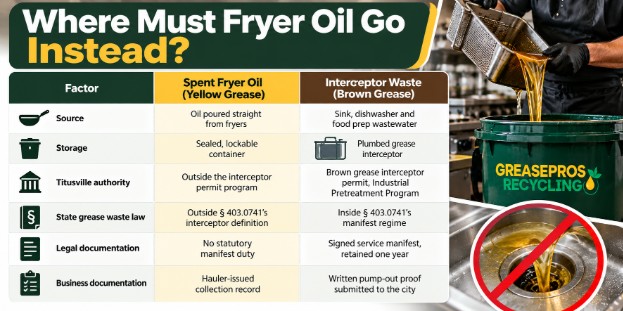
Into a sealed container collected on its own schedule, never into the interceptor or a drain. The two streams carry different obligations and different destinations.
| Factor | Spent Fryer Oil (Yellow Grease) | Interceptor Waste (Brown Grease) |
| Source | Oil poured straight from fryers | Sink, dishwasher, and food prep wastewater |
| Storage | Sealed, lockable container | Plumbed grease interceptor |
| Titusville authority | Outside the interceptor permit program | Brown grease interceptor permit, Industrial Pretreatment Program |
| State grease waste law | Outside § 403.0741’s interceptor definition | Inside § 403.0741’s manifest regime |
| Legal documentation | No statutory manifest duty | Signed service manifest, retained one year |
| Business documentation | Hauler-issued collection record | Written pump-out proof submitted to the city |
Cooking oil contributes to deposits and blockages in wastewater lines, and routing it into an interceptor adds volume the unit was never sized to receive, which brings the next pump-out forward and complicates the written record the city expects.
Pump-out work and fryer oil pickup call for different trucks, schedules, and records.
Collection frequency moves with output rather than staying fixed all year. Titusville kitchens can set up oil collection through GreasePros Recycling.
If you’re ready to get started, call us now!
Service starts with a free site assessment, and container sizing and pricing follow from what it finds, because output is hard to estimate reliably from memory.
The assessment captures four inputs: the number of fryers in active use, each fryer’s oil capacity, how often the oil is changed, and which days carry peak volume.
A kitchen running three fryers at roughly 50 pounds each, changed twice weekly, produces a very different weekly figure from one running the same three fryers changed once every two weeks — which is why business type alone predicts output poorly.
Those figures set the opening container size and collection frequency, and onboarding typically completes within a week of first contact.
The opening schedule is a starting position. Driver fill logs over the first weeks show actual rates, and frequency adjusts up or down based on that data.
Each collection records the volume removed and the service date, which sits in the kitchen’s own file. The service process page covers what a visit involves.
Container size follows measured output. The figures below are illustrative starting points by business type and will be confirmed or revised during the assessment.
| Business Type (Illustrative Starting Points) | Opening Container | Opening Frequency |
| Restaurant or café | 55-gallon drum | Monthly |
| Hotel or lodging | 140-gallon container | Biweekly |
| School or institutional cafeteria | 240-gallon container | Biweekly or weekly |
| Catering or food processing operation | 240-gallon container or multiple units | Weekly or on-demand |
Oil condition between pickups affects a collected load’s value, since water and food debris must be removed before processing. A sealed lockable container guards against contamination and theft.
Collected oil goes to DEP-approved processing facilities that refine it into biodiesel and sustainable aviation fuel, a route covered in the biodiesel explainer.
Brevard County’s collection system follows a more prescriptive regime than the city’s, with fixed intervals and numeric failure thresholds written into the code.
Brevard County Code sections 110-70 through 110-73 require a fats, oils, and grease discharge certificate valid for twelve months, complete interceptor pump-outs no more than 90 days apart, and trap cleaning no more than 30 days apart.
Section 110-72 treats a device as non-compliant once the grease layer exceeds six inches, the solids layer exceeds eight inches, or both together exceed a quarter of the water column.
The same section sets a minimum removal efficiency of 80 percent for animal fats and vegetable oils and bars fryers from connecting to an interceptor at all.
Operators running sites inside and outside the city need to schedule each address with the authority that governs it, as do groups with locations in Cocoa or Melbourne, where the governing body differs again. GreasePros Recycling brings two decades of operating history to each route.
Fryer oil collection and interceptor pumping are separate services with separate paperwork. Titusville restaurants can arrange oil collection with GreasePros Recycling.
Who regulates grease interceptors for Titusville restaurants?
The City of Titusville runs its own Industrial Pretreatment Program, which administers a brown grease interceptor permit program covering more than 160 permits. Businesses on the county collection system follow Brevard County Code instead. The serving wastewater utility determines which applies.
How does a Titusville kitchen confirm which authority governs it?
The water and sewer bill identifies the utility. An account billed by the City of Titusville indicates the city system and its permit program; an account billed by Brevard County Utility Services indicates the county framework and its fixed intervals.
What does a Titusville grease interceptor permit require?
Permit holders must maintain the interceptor and submit written evidence that a licensed contractor regularly pumps accumulated grease. The program page states the requirement but does not publish a fixed interval, so operators confirm their schedule directly with Industrial Pretreatment staff.
Does Florida’s grease waste manifest law apply to used cooking oil?
No. Florida Statute 403.0741 defines a grease interceptor or trap as a wastewater device, and that definition does not include containers built to collect used cooking oil. The manifest obligation attaches to interceptor waste, not containerized fryer oil.
Does Florida’s used oil transporter certification cover fryer oil?
Florida Statute 403.75 defines used oil as oil refined from crude or synthetic oil that has become contaminated through use. Spent cooking oil doesn’t match that description, so the used oil certification framework applies to a different material.
Can fryer oil be poured into a Titusville drain or interceptor?
No. Cooking oil contributes to deposits and blockages in wastewater lines, and routing it into an interceptor adds volume the unit was not sized to receive. Spent oil belongs in a sealed container emptied on its own collection schedule.
How often must an interceptor be pumped outside Titusville city limits?
Brevard County Code requires interceptor pump-outs no more than 90 days apart and trap cleaning no more than 30 days apart for facilities on the county system, along with numeric grease and solids depth limits that define non-compliance.
What does a kitchen receive after a fryer oil pickup?
Each collection produces a record documenting the volume removed and the service date. That record sits in the kitchen’s own file as its account history, separate from any interceptor paperwork the city permit program requires of permit holders.
How does GreasePros Recycling decide container size?
A site assessment records fryer count, oil capacity per fryer, change frequency, and peak days, producing weekly and monthly gallon estimates. Driver fill logs then confirm or revise that opening schedule during the first weeks of service at that site.
Founded with a vision to revolutionize the used cooking oil recycling industry, GreasePros Recycling has established itself as a trusted and leading provider of sustainable waste management solutions. With over 20 years of experience, our dedicated team brings extensive expertise and a commitment to environmental stewardship.
Quick Links
Contact Information
Get in Touch with GreasePros