Trusted and leading provider of sustainable waste management solutions from 20 years. (786) 655-7070
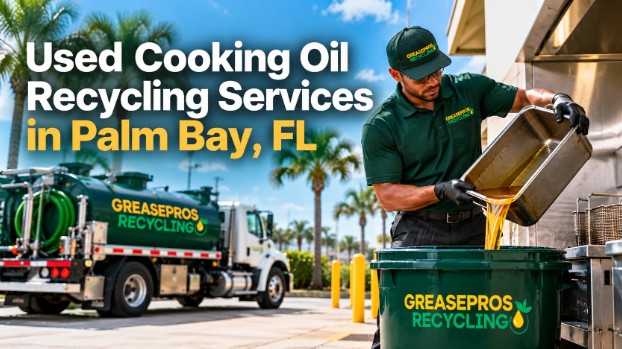
Used cooking oil recycling in Palm Bay covers collecting spent fryer oil from a sealed container and delivering it to a permitted processing facility.
That stream is separate from grease interceptor waste, which moves through plumbing and follows separate local rules.
GreasePros Recycling LLC, a licensed used cooking oil transporter serving Palm Bay, Florida, provides used cooking oil collection across Brevard County.
A service assessment starts with a fryer count, not a contract. Palm Bay operators can book that visit with GreasePros Recycling.
GreasePros Recycling provides scheduled oil collection, container delivery, hood cleaning, and emergency retrieval for restaurants, hotels, schools, hospitals, food processing plants, and catering companies across Palm Bay and Brevard County.
Containers are provided free in 55-gallon, 140-gallon, and 240-gallon sizes and maintained at no extra charge, with weekly, biweekly, or monthly collection and on-call pickup available between visits.
Hood cleaning is a separate service covering hoods, filters, ducts, and fans, and is separate again from grease interceptor work.
Oil transport and interceptor service require separate authorizations, and holding one does not establish the other.
The company publishes its transporter credentials on its credentials and licensing page. Emergency response for overflows, spills, and container damage runs 24/7 on (786) 655-7070 through emergency retrieval.
Service begins with a fryer inventory rather than a quote, because container sizing depends on output a kitchen can rarely estimate accurately from memory.
The assessment records four inputs: how many fryers are in active use, each fryer’s oil capacity, how often the oil gets changed, and which days carry peak volume. Those figures produce weekly and monthly gallon estimates, which set the opening container size and collection frequency.
The opening schedule is a starting position, not a fixed arrangement. Driver volume logs over the first few weeks of service show actual fill rates, and the frequency adjusts based on that measured data rather than the original estimate.
Seasonal operations and academic-term kitchens usually need at least one adjustment in the first year. The service process page covers what each visit involves.
Used cooking oil sits outside both Florida frameworks that regulate waste oils: the used oil rules written for petroleum products and the grease waste rules written for interceptors. That position shapes which credentials matter and which records a kitchen keeps.
Florida Statute 403.767 sets certification for transporters of used oil, and Section 403.75 defines that term as oil refined from crude or synthetic stock and contaminated through use. Fryer oil starts as vegetable or animal fat, so neither provision reaches it.
Florida DEP’s used oil rules under Florida Administrative Code Chapter 62-710 apply the same definition, so they govern petroleum-based oils rather than kitchen fryer oil.
A restaurant’s practical step is to confirm what a hauler is licensed to carry, where the oil goes after pickup, and what record each collection produces, before signing rather than after an issue arises.
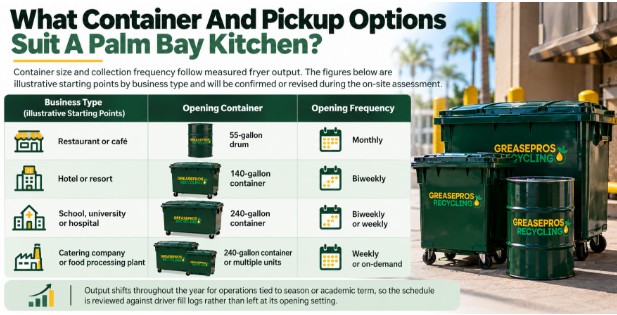
Container size and collection frequency follow measured fryer output. The figures below are illustrative starting points by business type and will be confirmed or revised during the on-site assessment.
| Business Type (Illustrative Starting Points) | Opening Container | Opening Frequency |
| Restaurant or café | 55-gallon drum | Monthly |
| Hotel or resort | 140-gallon container | Biweekly |
| School, university or hospital | 240-gallon container | Biweekly or weekly |
| Catering company or food processing plant | 240-gallon container or multiple units | Weekly or on-demand |
Output shifts throughout the year for operations tied to season or academic term, so the schedule is reviewed against driver fill logs rather than left at its opening setting.
Container sizing changes as a kitchen’s output changes through the year. Palm Bay managers can adjust a collection schedule through GreasePros Recycling.
Commercial oil processing generally runs collected volume through three stages before it enters a product stream: filtering, separation, and refining. These are standard industry stages, not a description of any single facility’s arrangement.
Filtering takes out food particles and suspended solids carried over during pouring. Separation draws off water and other impurities, which build up in any container exposed to rain, condensation, or wash-down. Refining then brings the remaining oil to the specification the receiving product requires.
Oil condition drives a collected load’s value, so storage between pickups matters more than most kitchens expect.
Water intrusion and debris both reduce that value, and an unsecured container invites both. A sealed, lockable container guards against contamination and against theft.
Biodiesel is one of the established product streams for recovered cooking oil, and operators who want more than the logistics can find the conversion chemistry documented separately.
GreasePros Recycling routes collected Palm Bay oil to permitted processing facilities, and the collection record issued at each pickup documents the volume leaving the kitchen.
Interceptor waste falls under local authority and a separate statute; oil collection falls outside both the grease waste statute and the used oil rules. A kitchen running fryers and a dishwasher generates both, and the table separates legal obligation from ordinary business practice.
| Factor | Used Cooking Oil | Grease Interceptor Waste |
| Source | Oil poured straight from fryers | Sink, dishwasher and food prep wastewater |
| Storage | Sealed, lockable container | Plumbed interceptor |
| State framework | Outside the § 403.75 used oil definition | Grease waste provisions of § 403.0741 |
| Statutory position | Outside that statute’s interceptor definition | Inside the statutory manifest regime |
| Local authority | Not governed by local FOG policy | Palm Bay FOG program, or Brevard County Code by address |
| Documentation (legal obligation) | None under § 403.0741 | Signed statutory service manifest, retained one year |
| Documentation (business practice) | Hauler-issued collection record | Hauler invoice and service history |
The City of Palm Bay operates a commercial fats, oil, and grease program run by a Utilities FOG Inspector, covering businesses on the city sanitary sewer.
Facilities discharging into the county-owned system instead answer to Brevard County Code sections 110-70 through 110-73, which require interceptor pump-outs no more than 90 days apart, trap cleaning no more than 30 days apart, and depth-based limits past which a device counts as non-compliant.
For interceptor waste, Section 403.0741 requires a signed manifest kept on site for a year, and Florida DEP licenses grease waste haulers under Chapter 62-705. Grease trap service and oil pickup run on separate equipment, separate schedules, and separate records.
Price matters, but it is the easiest variable to compare and the one that reveals the least about whether a provider is authorized for the work. Five checks fill the gap.
Groups running sites in Palm Bay and Melbourne or Merritt Island can hold one account while each address keeps its own records, which matters where the governing local authority differs between locations. The service model draws on more than 20 years in the business.
Two waste streams produce two record sets, and one account can carry both. Palm Bay restaurants can arrange collection with GreasePros Recycling.
Does a Palm Bay restaurant need its own used oil certification?
No. Florida’s used oil certification under Statute 403.767 covers transporters of petroleum-based used oil, and Statute 403.75 defines used oil in terms that exclude fryer oil. The useful check before signing is what a hauler is licensed for and where collected oil goes.
Can used cooking oil go down a Palm Bay drain?
No. Oil poured into a sink hardens inside plumbing and adds volume to a grease interceptor that was never sized to receive it. Spent oil belongs in a sealed container collected separately. Hot water changes nothing about either outcome.
Who regulates grease interceptors for Palm Bay restaurants?
The City of Palm Bay runs a commercial fats, oil, and grease program through a Utilities FOG Inspector for businesses on the city sewer. Facilities connected to the county system follow Brevard County Code instead. The serving utility decides, not the mailing address.
Does the state manifest law cover used cooking oil?
No. Florida Statute 403.0741 governs waste captured in a plumbed interceptor or trap, and its definition does not extend to containers made for holding used cooking oil. Under that statute, oil collection generates hauler records instead of statutory manifests.
How often must a Brevard County grease interceptor be pumped out?
Brevard County Code requires complete interceptor pump-outs no more than 90 days apart, and trap cleaning no more than 30 days apart. The county also treats an interceptor as non-compliant once accumulated grease and solids pass defined depth limits set in the code.
What happens to oil collected from Palm Bay kitchens?
Commercial processing generally filters collected oil, separates water and solids, and refines it before it enters a product stream such as biodiesel. GreasePros Recycling routes collected Palm Bay oil to permitted processing facilities in Florida for processing.
Does water in the container affect the oil’s value?
Water and food debris both reduce the value of a collected load, since processing must remove them before refining. A sealed container kept clear of rain, condensation, and wash-down protects oil quality between scheduled pickups.
What container sizes does GreasePros Recycling provide in Palm Bay?
GreasePros Recycling provides free lockable containers in 55-gallon, 140-gallon, and 240-gallon sizes, delivered and maintained at no extra charge. Sizing follows an on-site assessment of actual fryer output rather than a figure assigned by business category. Schedules adjust as output changes.
Does GreasePros Recycling offer emergency pickup in Palm Bay?
GreasePros Recycling provides 24/7 emergency retrieval for overflows, spills, and container damage across Palm Bay and Brevard County, reachable at (786) 655-7070. Scheduled collection and emergency response run through one account and one service history. Records stay in a single file.
Founded with a vision to revolutionize the used cooking oil recycling industry, GreasePros Recycling has established itself as a trusted and leading provider of sustainable waste management solutions. With over 20 years of experience, our dedicated team brings extensive expertise and a commitment to environmental stewardship.
Quick Links
Contact Information
Get in Touch with GreasePros