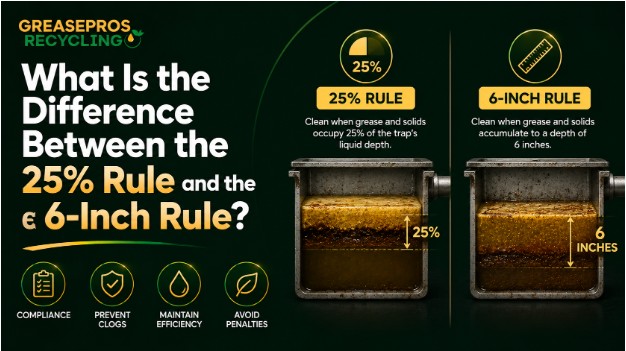
The 25% rule requires grease trap pump-out once combined fats, oils, grease, and solids reach 25% of the trap’s total capacity. The 6-inch rule triggers mandatory cleaning when the floating grease layer reaches 6 inches deep — regardless of trap size.
Some Florida counties enforce one standard, some enforce both, and the stricter threshold always applies when both are in effect. Knowing which rule your local FOG program enforces determines when your kitchen must schedule its next pump-out.
Key Takeaways
- The 25% rule measures total FOG and solids accumulation as a percentage of trap capacity — once the combined layers hit one quarter, cleaning is mandatory.
- The 6-inch rule sets a fixed depth limit for the floating grease layer in an interceptor, regardless of tank size.
- When both rules apply, the threshold reached first triggers the pump-out requirement.
- A licensed hauler must measure and document levels at each service visit to maintain FOG compliance.
GreasePros Recycling measures and documents grease levels on every pump-out across all Florida service areas — request a free quote to stay ahead of both thresholds.
How Does the 25% Rule Work?
The 25% rule is the most widely applied grease trap compliance standard across Florida municipalities. It measures the combined volume of two layers inside the trap: the floating FOG layer on top and the settled solids layer on the bottom. When these two layers together occupy 25% or more of the trap’s total capacity, the trap must be pumped regardless of where it falls on the scheduled cleaning calendar.
A 1,000-gallon interceptor triggers the 25% rule when accumulated grease and solids reach 250 gallons combined. A 50-gallon under-sink trap hits the threshold at just 12.5 gallons.
The percentage-based approach scales to any trap size, which is why most county FOG ordinances use it as the primary enforcement standard.
During routine inspections, FOG program officers measure both layers using a sampling pole or dipstick and calculate the combined percentage.
A licensed hauler performing a scheduled pump-out records these measurements on the service manifest — documentation that proves the trap was cleaned before exceeding the threshold.
How Does the 6-Inch Rule Differ?
The 6-inch rule applies a fixed depth measurement rather than a percentage calculation. It limits the floating grease layer — the FOG cap sitting on the water inside the trap — to a maximum depth of 6 inches. Once the grease layer exceeds six inches, cleaning is mandatory regardless of how much total capacity remains in the trap.
This rule exists because large interceptors can technically remain below 25% capacity while accumulating a thick grease cap that restricts flow and increases the risk of FOG passing into the sewer line.
A 2,000-gallon interceptor with a 10-inch grease cap might still fall under 25% total accumulation, but that concentrated surface layer can release grease downstream during high-flow periods — exactly the outcome FOG ordinances are designed to prevent.
The 6-inch rule functions as a safety net that catches situations the percentage-based rule misses, particularly in large-volume traps serving high-output kitchens.
How Do the Two Rules Compare Side by Side?
| Factor |
25% Rule |
6-Inch Rule |
| What it measures |
Combined FOG + solids as % of total capacity |
Depth of the floating grease layer only |
| Trigger point |
25% of the trap volume is occupied |
Grease layer exceeds 6 inches deep |
| Scales with trap size |
Yes — larger traps allow more volume |
No — 6 inches applies to all sizes |
| Best suited for |
Small to mid-size traps |
Large interceptors with high FOG output |
| Measurement method |
Dipstick reading of both layers + capacity calculation |
Dipstick reading of the top grease layer only |
| Common in |
Most Florida county FOG ordinances |
Select counties as a supplemental standard |
When a jurisdiction enforces both rules simultaneously, the first threshold reached triggers the mandatory pump-out. A restaurant cannot argue that its trap is still under 25% if the grease layer already exceeds six inches — and vice versa.
GreasePros Recycling documents both measurements on every service manifest — schedule your next pump-out with records that satisfy either standard.
Which Florida Counties Enforce Each Rule?
FOG enforcement standards vary by municipality and county utility department. Most Florida counties, including Miami-Dade, Broward, and Palm Beach, reference the 25% rule as the baseline compliance standard in their local FOG ordinances.
The 6-inch rule serves as a supplemental or alternative standard in jurisdictions with a high concentration of large commercial interceptors.
Restaurants operating across multiple Florida counties — particularly franchise operations with locations in different jurisdictions — should confirm which standard applies at each site by checking the local utility or environmental services department’s FOG program requirements.
Assuming one county’s rule applies everywhere is a common compliance mistake that leads to violations at locations governed by the stricter threshold.
How Do These Rules Affect Cleaning Variance Applications?
Both rules directly determine whether a kitchen qualifies for a grease trap cleaning variance. A variance application requires documented proof that the accumulation stays below the applicable threshold across multiple consecutive pump-out cycles.
Under the 25% rule, every inspection during the review period must show combined FOG and solids below 25% of capacity at the proposed extended interval. Under the 6-inch rule, every inspection must confirm the grease layer remains under six inches.
If the jurisdiction enforces both standards, the variance application must demonstrate compliance with the stricter standard for that specific trap size and kitchen output.
Failing either threshold during a single inspection resets the variance review and can result in reversion to the original mandatory schedule — or denial of the application entirely.
Frequently Asked Questions
Can a restaurant be in compliance with the 25% rule but violate the 6-inch rule?
Yes. A large interceptor can hold a substantial volume of FOG in a thick surface layer while remaining at or below 25% of total capacity. If the local FOG ordinance enforces the 6-inch rule, that thick grease cap triggers mandatory cleaning even though the percentage threshold has not been reached.
How does a hauler measure grease depth during a pump-out?
The hauler inserts a sampling dipstick or probe into the trap before pumping begins. The grease layer depth and solids layer depth are measured separately and recorded on the service manifest, along with the trap’s total capacity, for percentage calculation.
Does the 6-inch rule apply to small under-sink grease traps?
The 6-inch rule primarily targets larger outdoor interceptors. Most small under-sink traps — typically 20 to 50 gallons — would exceed the 25% rule well before accumulating a six-inch grease layer due to their limited depth. The 25% rule is generally the binding standard for smaller traps.
What happens if a restaurant exceeds both thresholds simultaneously?
The violation is recorded once, but exceeding both thresholds signals severe neglect that may trigger escalated enforcement. Local FOG programs can impose increased cleaning frequency, more frequent inspections, and fines under the applicable county ordinance.
Does GreasePros Recycling document both measurements on service manifests?
Yes. GreasePros Recycling records grease layer depth and combined accumulation percentage on every pump-out manifest across all Florida service areas. These records satisfy documentation requirements under both the 25% rule and the 6-inch rule.
How often should a restaurant check grease levels between scheduled pump-outs?
Kitchen managers should visually inspect accessible traps weekly using a dipstick or sampling tool. Tracking the grease layer depth between professional visits helps determine whether the current pump-out schedule is adequate or if an emergency retrieval may be needed before the next scheduled service.
Can a restaurant request more frequent cleaning to avoid threshold violations?
Yes. Restaurants can schedule pump-outs more frequently than the minimum required interval. High-volume kitchens that approach thresholds quickly between cleanings often benefit from switching to a shorter cycle rather than risking a violation during a FOG inspection.
Which rule is harder to comply with for high-volume restaurants?
The 6-inch rule is typically more restrictive for high-volume operations using large interceptors. These kitchens quickly form thick grease caps, even though the overall trap percentage remains low. The fixed six-inch limit does not scale with trap size, so larger traps offer no additional cushion under this standard.
Stay ahead of both compliance thresholds with documented grease-level measurements at every service visit — GreasePros Recycling keeps your kitchen inspection-ready. Get your free service quote today.