Trusted and leading provider of sustainable waste management solutions from 20 years. (786) 655-7070
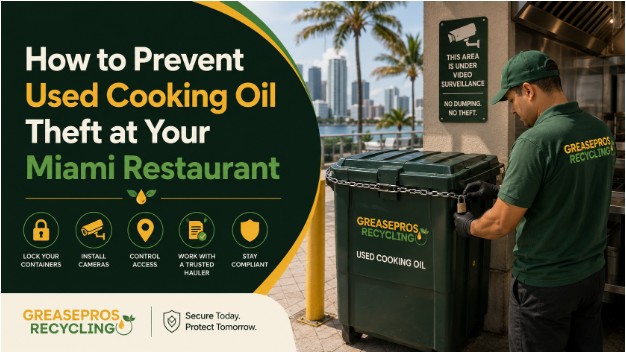
Miami restaurants prevent used cooking oil theft by combining locked containers with cast locking mechanisms, security cameras positioned on the storage area, and a licensed hauler that documents every gallon collected on signed manifests.
GreasePros Recycling LLC, a licensed South Florida used cooking oil hauler with over 20 years of operation and DERM permits across all 34 Miami-Dade municipalities, provides free lockable hurricane-rated containers that eliminate theft for 97% of Miami-Dade clients by removing the physical access point thieves rely on.
Every gallon stolen is revenue lost and a compliance gap created — schedule a free container assessment with GreasePros Recycling and eliminate the access point thieves need.
Theft of used cooking oil in Miami follows a consistent operational pattern. Thieves arrive between 1 AM and 4 AM in unmarked panel vans or box trucks equipped with gas-powered pumps and industrial hoses.
The crew — typically two people — backs the vehicle against the restaurant’s outdoor grease container, attaches the hose, and siphons the contents in under 10 minutes.
The entire operation targets the same vulnerability every time: an unsecured outdoor container with a standard lid that can be opened without tools.
Organized theft crews scout restaurant clusters using map applications, identifying dense dining corridors near major roads that provide quick access and escape routes.
Miami’s Brickell corridor, the Wynwood restaurant district, and the Calle Ocho strip in Little Havana all fit that profile — high concentrations of kitchens with rear-access parking lots and minimal overnight lighting.
Some crews impersonate legitimate haulers by wearing reflective vests and arriving in loosely branded vehicles during off-hours, representing themselves as service personnel from the restaurant’s collection company.
A restaurant may not realize oil has been stolen for days or even weeks if the kitchen staff does not check container levels between scheduled pickups.
Used cooking oil is a liquid without a serial number, and an emptied container looks the same as a container that was recently serviced.
The theft becomes apparent only when the legitimate hauler — such as GreasePros Recycling — arrives for a scheduled pickup and finds a container that should be nearly full sitting empty.
In December 2025, federal prosecutors charged 13 defendants in a 10-state UCO theft ring that laundered proceeds through a network of warehouses, demonstrating that Miami-area restaurants face both local opportunists and organized interstate operations.
If you’re ready to get started, call us now!
Used cooking oil is a feedstock for biodiesel production, sustainable aviation fuel, animal feed, and industrial lubricants. That demand drives the value that makes theft profitable.
| Value Point | Price Range | Context |
| Restaurant-level rebate | $0.15–$0.55 per gallon | Price GreasePros Recycling and other licensed haulers pay Miami restaurants for quality UCO |
| Black-market resale | $1.00–$2.00 per gallon | Price unlicensed buyers pay thieves — no manifests, no taxes, no DEP oversight |
| Single 300-gallon container | $600+ to thieves | One nighttime siphoning run yields enough to cross Florida’s $750 grand theft felony threshold |
| Average monthly restaurant loss | $250 per month | Estimated cost of recurring theft for unsecured Miami restaurants |
| National annual theft losses | $300–$500 million | NARA’s October 2025 updated estimate, replacing the outdated $75 million figure from 1980 |
The Renewable Fuel Standard program, established under the United States Clean Air Act, requires that renewable fuel replace a portion of fossil fuels used for transportation and heating, which has substantially increased institutional demand for biodiesel feedstock.
That demand makes UCO one of the few waste products that appreciate in value — and the higher the value climbs, the more organized the theft operations become.
Locked containers eliminate the physical access point that every UCO theft depends on. A thief with a gas-powered pump and a hose cannot siphon oil from a container that requires a keyed or cast locking mechanism to open.
GreasePros Recycling provides free lockable hurricane-rated containers with cast locking mechanisms in 55-gallon, 140-gallon, and 240-gallon sizes across all 34 Miami-Dade municipalities.
The most effective theft prevention programs layer multiple deterrents rather than relying on a single barrier. Miami restaurants that combine GreasePros Recycling’s locked containers with complementary security measures achieve the highest protection:
A Broward County pilot program pairing police patrols with recycler data in high-theft zones halved UCO theft incidents within six months of deployment.
GreasePros Recycling coordinates with Miami-Dade law enforcement on reporting theft patterns and provides container placement assessments that account for both service access and theft deterrence at each restaurant location.
If you’re ready to get started, call us now!
Stolen oil creates a compliance gap that DERM can penalize even when the restaurant is the victim. Miami-Dade County Code § 24-42.6 requires that manifests be prepared for every gallon of used cooking oil removed from the property by a DERM-permitted hauler.
Oil removed by a thief produces no manifest — and the missing volume appears in the electronic FOG portal as an unexplained gap between reported production and documented disposal.
Restaurants that maintain accurate pickup records showing consistent container volumes before a theft can demonstrate to DERM inspectors that the gap resulted from criminal activity rather than unreported disposal or illegal dumping.
GreasePros Recycling provides timestamped manifests recording gallon counts, container condition, and pickup dates for every scheduled collection, creating a documented baseline that makes volume discrepancies caused by theft immediately identifiable.
Florida’s Civil Theft Statute under § 772.11 allows restaurants to sue convicted oil thieves for three times the stolen oil’s value plus reasonable attorneys’ fees.
Hauler manifests showing the restaurant’s average monthly oil volume establish the baseline value courts require to calculate treble damages.
A restaurant producing 200 gallons per month at $0.40 per gallon loses $80 in rebate revenue per theft incident — but the civil judgment with treble damages, tank repairs, and legal fees can exceed $5,000 per event when the manifest record supports the claim.
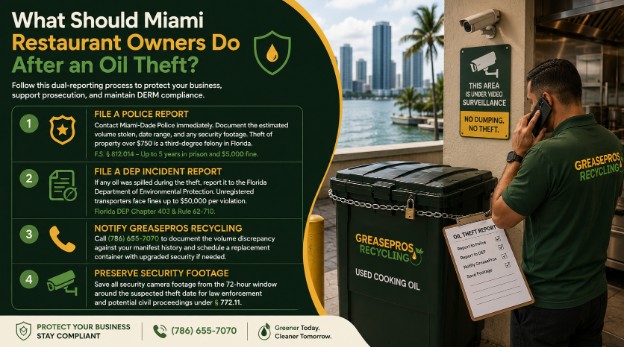
Restaurants that discover a theft should follow a dual-reporting process to maximize both criminal penalties against the thief and the restaurant’s own compliance protection with DERM.
Restaurants that complete both the police report and the DEP filing create dual enforcement exposure for the thief while protecting their own FOG compliance record with DERM.
GreasePros Recycling’s manifest history provides the volume baseline that both law enforcement and DERM inspectors require to distinguish theft-related gaps from disposal violations.
Stop losing revenue to oil thieves — call GreasePros Recycling at (786) 655-7070 for a free locked container and eliminate the access point that makes your restaurant a target.
How much does used cooking oil theft cost Miami restaurants each year?
Industry estimates place Miami restaurant oil theft losses at approximately $2.4 million annually. The National Renderers Association updated the nationwide UCO theft estimate in October 2025 to $300–$500 million, replacing the outdated $75 million figure from 1980.
What makes used cooking oil valuable enough to steal?
Used cooking oil serves as a feedstock for biodiesel production, sustainable aviation fuel, animal feed, and industrial lubricants. UCO trades at $0.15 to $0.55 per gallon at the restaurant level and up to $2.00 per gallon at biodiesel refineries on the black market.
Is stealing used cooking oil a felony in Florida?
Florida Statute § 812.014 classifies theft of property valued above $750 as grand theft, which is a third-degree felony carrying up to 5 years in prison and a $5,000 fine. A single 300-gallon container of UCO can exceed that threshold.
How do locked containers stop oil theft?
Locked containers with cast locking mechanisms eliminate the physical access point every UCO theft requires. Thieves cannot attach a siphoning hose to a container that requires a keyed mechanism to open, and cast locks resist the cutting tools that defeat standard padlocks.
Can a restaurant sue an oil thief for damages in Florida?
Florida’s Civil Theft Statute under § 772.11 allows restaurants to sue convicted oil thieves for three times the stolen oil’s value plus reasonable attorneys’ fees after serving a statutory demand letter. Hauler manifests establish the baseline volume courts require.
What should a restaurant do immediately after discovering an oil theft?
Miami restaurant owners should file a police report with Miami-Dade Police documenting the estimated stolen volume, file a DEP incident report if oil was spilled during the theft, and notify GreasePros Recycling at (786) 655-7070 to document the volume discrepancy.
Does GreasePros Recycling provide free locked containers?
GreasePros Recycling provides free lockable hurricane-rated containers with cast locking mechanisms in 55-gallon, 140-gallon, and 240-gallon sizes. Every container is delivered, installed, and maintained at no cost across all 34 Miami-Dade municipalities.
How does oil theft create FOG compliance problems for the restaurant?
Stolen oil does not generate a hauler manifest, creating an unexplained volume gap in Miami-Dade’s electronic FOG portal between reported production and documented disposal. DERM can penalize that gap as a disposal violation unless the restaurant can document the theft with police reports and manifest history.
Do security cameras reduce oil theft at restaurants?
Restaurants that combine locking lids with security cameras reduce theft incidents by up to 60%, according to a National Renderers Association study. Camera footage also provides critical evidence for police reports and civil theft claims under Florida Statute § 772.11.
What areas of Miami are most targeted for cooking oil theft?
Organized theft crews target dense restaurant corridors near major roads, which provide quick overnight access and rapid escape routes. Miami’s Brickell corridor, the Wynwood restaurant district, and the Calle Ocho strip in Little Havana all fit that high-risk profile.
Founded with a vision to revolutionize the used cooking oil recycling industry, GreasePros Recycling has established itself as a trusted and leading provider of sustainable waste management solutions. With over 20 years of experience, our dedicated team brings extensive expertise and a commitment to environmental stewardship.
Quick Links
Contact Information
Get in Touch with GreasePros