Trusted and leading provider of sustainable waste management solutions from 20 years. (786) 655-7070
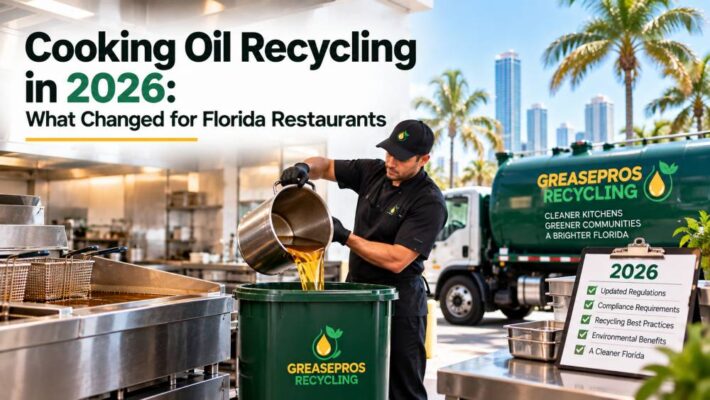
Cooking oil recycling in 2026 turns on one documented change: federal clean fuel credit rules now limit eligible feedstock to material produced in the United States, Mexico, or Canada. Kitchen procedure has not changed.
What has changed is the eligibility rule governing the fuel market a Florida restaurant’s yellow grease feeds into. GreasePros Recycling LLC collects statewide through scheduled used oil pickup.
Kitchens still paying to haul away a feedstock refiners want lose money twice. GreasePros Recycling collects and rebates across Florida — start a pickup schedule.
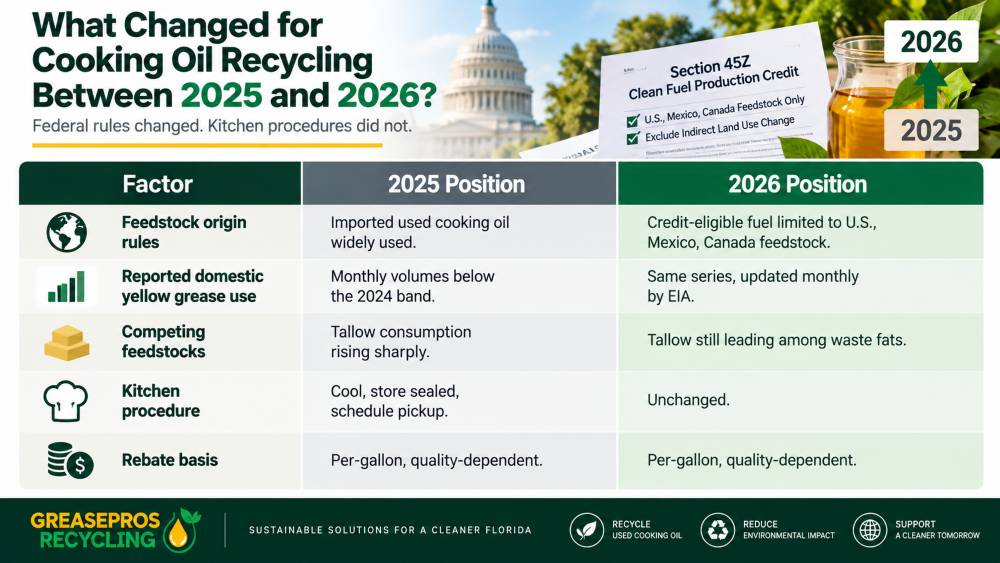
Federal feedstock eligibility rules changed; kitchen procedure did not. The Section 45Z clean fuel production credit, extended and revised by the One Big Beautiful Bill Act, limits eligible transportation fuel to fuel derived exclusively from feedstocks produced or grown in the United States, Mexico, or Canada, and requires emissions rates to exclude indirect land use change. IRS guidance released in September 2026 provided the 2026 emissions rate table along with transition rules addressing used cooking oil and other feedstocks.
Domestically collected yellow grease therefore sits inside the eligible pool, while imported material faces substantiation questions still being worked through.
GreasePros Recycling reads that as an improvement in the standing of U.S.-collected restaurant oil, which is an interpretation of the policy change rather than a measured pricing effect. Per-gallon rates still move month to month with feedstock markets.
| Factor | 2025 position | 2026 position |
| Feedstock origin rules | Imported used cooking oil widely used | Credit-eligible fuel limited to U.S., Mexico, Canada feedstock |
| Reported domestic yellow grease use | Monthly volumes below the 2024 band | Same series, updated monthly by EIA |
| Competing feedstocks | Tallow consumption rising sharply | Tallow still leading among waste fats |
| Kitchen procedure | Cool, store sealed, schedule pickup | Unchanged |
| Rebate basis | Per-gallon, quality-dependent | Per-gallon, quality-dependent |
If you’re ready to get started, call us now!
Domestic yellow grease consumption at U.S. biofuel plants declined through 2025 and has not returned to its prior band.
EIA’s monthly biofuels feedstock data, collected on Form EIA-819, shows consumption running between roughly 513 and 714 million pounds per month across 2024, then falling into a band of roughly 312 to 490 million pounds per month through September 2025.
Over the same stretch, tallow consumption climbed and overtook yellow grease among waste fats.
Lower consumption is not the same as lower demand, and the series alone does not establish which direction restaurant-level rates moved. What it does establish is that the domestic yellow grease stream feeding U.S. biofuel production has not been expanding.
Restaurants tracking their own rebate should read the monthly EIA update alongside whatever rate their collector quotes rather than treating either as a forecast.
Quality is the variable a kitchen controls directly. Three things set the grade on a load:
Very little, which is the point. The kitchen cools fryer oil, moves it into a dedicated sealed container, and holds it until a scheduled collection. The collector supplies the container, runs the route, and handles transport.
On GreasePros Recycling accounts, setup typically completes within a week, and the company walks each account through the sequence as part of its collection process.
The recurring problems GreasePros Recycling sees across its Florida routes cluster in the gaps between those steps:
Water and boil-out waste pull down what a load earns. GreasePros Recycling supplies dedicated containers that keep both out — request container setup.
Two Florida frameworks appear to govern restaurant fryer oil, and each defines it differently. Section 403.75(7), Florida Statutes defines used oil as oil refined from crude or synthetic oil, which excludes vegetable-based fryer oil.
Section 403.0741, Florida Statutes governs grease waste removal and disposal, and its definition of a grease interceptor expressly excludes receptacles designed for collecting used cooking oil.
That statute does impose real duties on grease trap waste: haulers must dispose of it at a permitted facility and document each removal with a signed service manifest retained for one year.
What reaches the fryer oil comes from elsewhere. The U.S. Environmental Protection Agency’s pretreatment guidance for food service establishments reports that grease causes 47% of reported sewer blockages and that federal rules at 40 CFR 403.5(b)(3) prohibit discharging solid or viscous pollutants in amounts that obstruct flow.
Above that federal floor, Florida counties, municipalities, and sewer utilities set their own FOG discharge limits and stormwater rules, and those differ meaningfully between jurisdictions.
A restaurant in Miami-Dade and one in Brevard County may face different numbers and different paperwork, so the operative requirement is whatever the local sewer authority and county environmental office specify. That local check is the one step this article cannot perform for a reader.
If you’re ready to get started, call us now!
Evaluation comes down to four things a collector either provides or does not: appropriate credentials for the stream being collected, equipment, route reliability, and documentation. Rebate rate matters, but a strong rate from a collector who misses pickups costs more than it returns.
Credentials deserve a careful question rather than a checklist, because the two streams carry different requirements. Grease trap pumping is the stream with clear statutory hauler and manifest duties under Section 403.0741.
For yellow grease, the applicable permits are county-level and vary, so the useful question is which permits and vehicle registrations the collector holds in the specific county being served.
GreasePros Recycling publishes its credentials and licensing for that check.
| Criterion | What to confirm | Why it matters |
| Credentials | Which county permits and USDOT registration the collector holds, per stream | Requirements differ between yellow grease and grease trap waste |
| Equipment | Sealed containers sized to output, with lockable options | Protects grade and reduces oil theft exposure |
| Route reliability | Stated service window and emergency response time | Prevents overflow between scheduled stops |
| Documentation | Written record of date, volume, and destination per collection | Supports inspection questions without reconstruction |
| Rebate terms | Rate basis, quality deductions, and payment cadence | Determines what clean oil actually returns |
| Multi-site handling | Coverage across locations under one account | Matters for groups, as in hotel and resort programs |
Collected yellow grease leaves the waste stream and enters the fuel supply. Restaurant grease sits alongside soybean oil and rendered animal fats on the U.S. Department of Energy’s list of biodiesel feedstocks, and fuel made from it qualifies under the Renewable Fuel Standard’s biomass-based diesel and advanced biofuel categories. The finished product breaks down naturally and is produced domestically.
Renewable diesel, produced through hydrogenation rather than esterification, draws on the same feedstock pool.
The avoided harm matters as much as the produced fuel. Oil that reaches a sewer line congeals, narrows the pipe, and contributes to blockages that EPA largely attributes to grease. Oil that reaches a storm drain moves to surface water untreated.
A scheduled collection removes both paths, and the return shows up on the invoice and in the account’s operating economics.
Is used cooking oil still worth money in 2026?
Yes. Refiners continue buying yellow grease as feedstock for biodiesel and renewable diesel. Federal credit rules now favor North American supply, though rates move with feedstock markets, so collectors quote per gallon rather than fixing a rate for a full year.
What changed between 2025 and 2026 for restaurants?
Federal clean fuel credit rules tightened around feedstock origin, and EIA data showed domestic yellow grease consumption running below its 2024 band through 2025. Kitchen procedure did not change; what collectors can pay still tracks feedstock markets month to month.
Does a restaurant get paid or charged for pickup?
Both arrangements exist in Florida. On GreasePros Recycling accounts, high-volume kitchens producing clean, water-free oil typically receive a per-gallon rebate, while low-volume sites more often trade the rebate for containers and service. Terms vary by collector and market.
What lowers the value of collected oil?
Water, food solids, boil-out chemicals, and mop water all cut a load’s value, since refiners pay for clean feedstock. Mixing grease trap waste into the same container causes the steepest drop, because brown grease processes differently and sells for less.
Does Florida require restaurants to recycle used cooking oil?
No statewide Florida recycling mandate applies specifically to restaurant fryer oil. Federal pretreatment rules and local sewer and stormwater ordinances, which vary by county and utility, are the binding constraints. Restaurants should confirm local requirements directly with their sewer authority.
Which permits should a used cooking oil collector hold?
Requirements differ by stream and county. Grease trap pumping carries statutory hauler and manifest duties under Section 403.0741, Florida Statutes. For yellow grease, restaurants should ask which county permits and vehicle registrations the collector holds locally before signing a contract.
What paperwork should a kitchen keep?
Collection records showing date, volume, and destination cover most inspection questions. Grease trap servicing carries its own requirement: Section 403.0741, Florida Statutes requires the originator and hauler to retain a signed service manifest for one year on site after disposal.
How often should oil be collected?
Collection frequency depends on fryer count and cover volume. Across GreasePros Recycling’s Florida routes, single-fryer cafés generally receive monthly collection, while high-volume kitchens receive weekly service. Containers should be emptied before they pass roughly three-quarters full, an operating benchmark rather than a rule.
Can a restaurant sell oil directly to a biodiesel producer?
Direct sale is possible at high volumes, though most processors buy from collectors who aggregate loads and handle transport. For small and mid-size kitchens, a collector arrangement usually costs less effort than arranging sales, transport, and paperwork independently each month.
Does higher oil value increase theft risk?
Yes. Rising feedstock value has made unsecured containers a target across South Florida. Locked lids, tamper-resistant fittings, and lighting over the collection area reduce exposure, and collection records make unauthorized removal easier to identify and report to police.
Cooking oil recycling in 2026 rewards the same discipline it rewarded in 2025, backed by a documented policy change. Federal credit rules narrowed eligible feedstock to North American origin, and EIA’s monthly series shows domestic yellow grease consumption running below its 2024 band.
GreasePros Recycling reads that combination as improving the standing of U.S.-collected restaurant oil, though month-to-month rates remain a market question rather than a settled one.
Kitchen procedure is unchanged: cool the oil, keep it sealed and uncontaminated, and collect on a schedule matched to output.
Florida’s used oil and grease waste statutes both define around fryer oil, which leaves federal pretreatment rules and locally set sewer and stormwater limits as the operative requirements — and those need checking with the local authority.
Oil sitting in a back-alley drum earns nothing and attracts pests. GreasePros Recycling turns it into scheduled revenue — book Florida oil pickup.
Founded with a vision to revolutionize the used cooking oil recycling industry, GreasePros Recycling has established itself as a trusted and leading provider of sustainable waste management solutions. With over 20 years of experience, our dedicated team brings extensive expertise and a commitment to environmental stewardship.
Quick Links
Contact Information
Get in Touch with GreasePros