Trusted and leading provider of sustainable waste management solutions from 20 years. (786) 655-7070
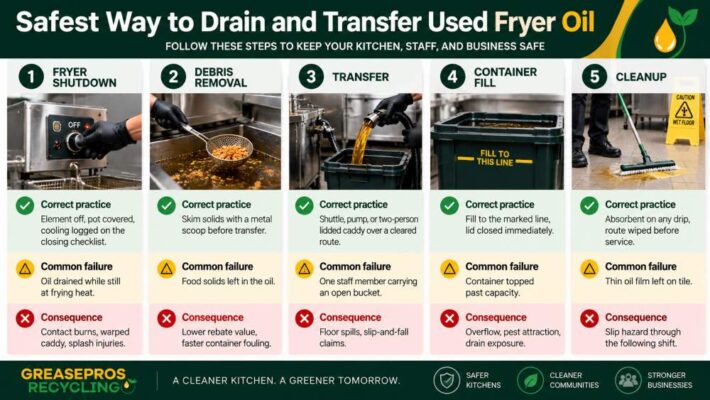
Florida kitchens dispose of fryer oil in three moves: cool the oil to room temperature, hold it in a sealed container away from drains, and release it to a collector on a set schedule. Few of those steps come from a statewide rule.
Florida’s binding requirements for fryer oil concern where it may not go, not how it must be stored. GreasePros Recycling LLC covers the full routine through scheduled used oil pickup.
Hot drums and overflowing caddies stall a dinner service. GreasePros Recycling collects used fryer oil on a fixed Florida schedule — book a pickup.
Fryer oil should reach room temperature before any staff member lifts, pours, or pumps it. Warm oil splashes on transfer, softens plastic caddies, and causes deep contact burns.
The U.S. Occupational Safety and Health Administration identifies deep fat fryers as the number one cause of burns among young restaurant workers, with injuries occurring during straining, moving, and contact with splashing oil. No Florida rule sets a transfer temperature, so the cool-down window is a safety practice.
Across GreasePros Recycling’s Florida accounts, the common pattern is to drain fryers after the last cover and leave the oil overnight in the pot or a covered caddy.
Morning crews transfer it before service, when the kitchen is quiet and the floors are dry. Kitchens running continuous service cool oil during the mid-afternoon lull instead, and reserve emergency oil retrieval for days when a fryer fails mid-shift and the oil cannot wait.
GreasePros Recycling recommends building the cool-down into the closing checklist rather than leaving it to judgment:
If you’re ready to get started, call us now!
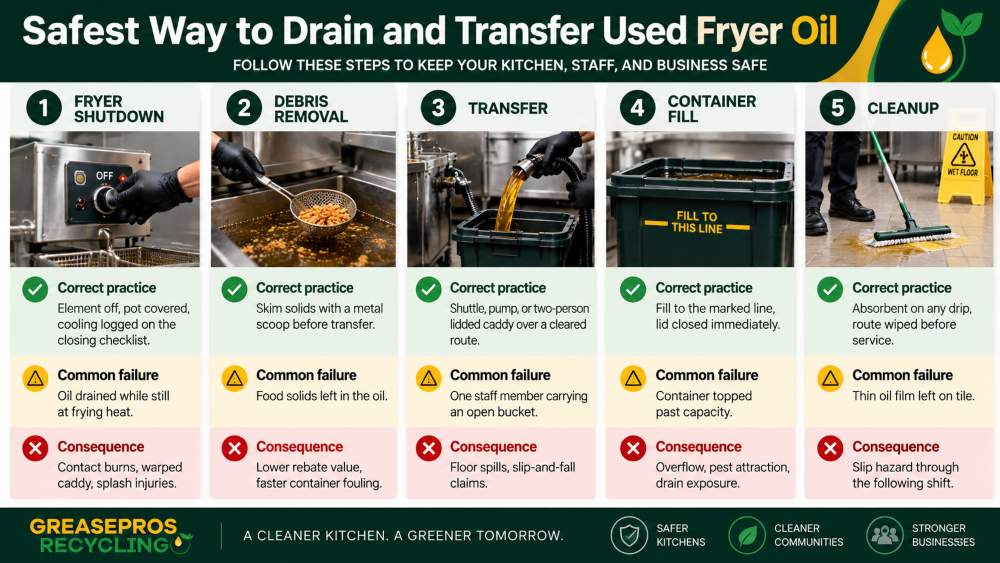
Safe transfer depends on the equipment doing the lifting rather than the person. Filtration carts, shuttle units, and pump systems move cooled oil from the pot to the storage container without a hand-carried bucket crossing the kitchen floor.
For kitchens without a shuttle, GreasePros Recycling recommends a lidded caddy with a spout, moved by two staff members over a cleared route, and reviews transfer routes during setup as part of its collection process.
| Stage | Correct practice | Common failure | Consequence |
| Fryer shutdown | Element off, pot covered, cooling logged on the closing checklist | Oil drained while still at frying heat | Contact burns, warped caddy, splash injuries |
| Debris removal | Skim solids with a metal scoop before transfer | Food solids left in the oil | Lower rebate value, faster container fouling |
| Transfer | Shuttle, pump, or two-person lidded caddy over a cleared route | One staff member carrying an open bucket | Floor spills, slip-and-fall claims |
| Container fill | Fill to the marked line, lid closed immediately | Container topped past capacity | Overflow, pest attraction, drain exposure |
| Cleanup | Absorbent on any drip, route wiped before service | Thin oil film left on tile | Slip hazard through the following shift |
Protective gear covers the gap equipment cannot. OSHA advises restaurant cooks to wear long-sleeved cotton clothing and a clean, properly worn apron against hot oil splashes.
GreasePros Recycling adds heat-resistant gloves reaching past the wrist and closed-toe slip-resistant footwear for anyone handling a transfer, since residual warmth persists at the bottom of a deep pot well after the surface cools.
No statewide Florida rule specifies fryer oil container design, labeling, or containment. Restaurant operators sometimes assume the state’s used oil storage rules apply, but those rules track the statutory definition of used oil and stop at petroleum and synthetic products.
The practical standard therefore comes from the collector, the kitchen’s insurer, local fire and health inspectors, and any county FOG ordinance in force.
GreasePros Recycling supplies containers and sets them up to a single account standard: sealed and lidded, labeled with contents, placed on spill containment, kept away from food prep surfaces and heat sources, and sited within truck reach.
Those choices prevent leaks, pests, and inspection findings even where no rule compels them.
| Setup | Best fit | Spill risk | Theft exposure |
| Indoor lidded caddy | Single-fryer cafés, low output | Moderate — lifted and carried | Low |
| Outdoor sealed drum | Mid-volume full-service kitchens | Low on containment | High without a lock |
| Outdoor bulk tank | High-volume and multi-fryer kitchens | Lowest — pumped directly | Low with tamper-resistant fittings |
| Locked collection unit | Kitchens in high-theft corridors | Low | Lowest, paired with secure oil collection |
Kitchens in areas where used oil theft is active should specify locked containers for used cooking oil at setup rather than retrofitting after a loss.
Containers filling faster than the route schedule create overflow and pest risk. GreasePros Recycling adjusts service intervals mid-contract — request a schedule review.
Collection frequency follows fryer count and cover volume, not the calendar. Across GreasePros Recycling’s Florida routes, single-fryer cafés generally receive monthly service, full-service kitchens receive service every two weeks, and high-volume quick-service operations receive weekly service.
The company schedules collection before a container reaches roughly three-quarters full, leaving headroom for an unexpectedly busy weekend.
That threshold is an operating benchmark drawn from route experience, not a figure set by any rule.
Frequency also carries a cost consequence, since clean oil collected on schedule holds its value while fouled or overflowing oil does not.
The tradeoff between service intervals appears in the comparison of weekly versus monthly pickup, and the rebate side shows up in the breakdown of used cooking oil pickup ROI.
Three situations justify moving off the standing schedule:
If you’re ready to get started, call us now!
Drain disposal ranks first, and federal and local authorities, not state, govern it. The U.S. Environmental Protection Agency’s pretreatment guidance for food service establishments reports that grease causes 47% of reported sewer blockages and that 40 CFR 403.5(b)(3) prohibits discharging solid or viscous pollutants in amounts that obstruct flow.
Florida sewer utilities and counties set their own FOG discharge limits above that federal floor, which is where the enforceable number for any given restaurant actually lives.
The remaining prohibitions rest on practical and local grounds:
Broader compliance context for Florida food service operators sits in the breakdown of Florida used oil disposal regulations.
Restaurant operators need this distinction because fryer oil sits in a genuine regulatory gap.
Section 403.75(7), Florida Statutes, defines used oil as oil refined from crude or synthetic oil, which excludes vegetable-based fryer oil and with it, the state’s used oil storage, labeling, and transporter certification rules.
Section 403.0741, Florida Statutes, defines grease waste as material retained in a grease interceptor or trap, and its definition of that device excludes receptacles designed specifically for collecting used cooking oil. Fryer oil is neither.
| Practice | Status | Basis |
| Keep fryer oil out of sewer drains | Binding | 40 CFR 403.5(b)(3); local FOG ordinances |
| Keep fryer oil out of storm drains | Binding | Municipal stormwater ordinances |
| Use a county-permitted liquid waste transporter where required | Binding, jurisdiction-specific | Miami-Dade DERM permitting; varies by county |
| Haul grease trap waste under a service manifest | Binding, separate stream | s. 403.0741, F.S. |
| Meet Chapter 62-710 used oil storage and transporter rules | Not applicable | s. 403.75(7), F.S. excludes vegetable oil |
| Cool oil to room temperature before transfer | Safety practice | OSHA fryer burn guidance; GreasePros protocol |
| Two-person movement of a lidded caddy | Safety practice | GreasePros handling protocol |
| Sealed, labeled container on spill containment | GreasePros recommendation | Account standard |
| Collect before roughly three-quarters capacity | GreasePros recommendation | Florida route experience |
| Locked container where theft is active | GreasePros recommendation | Account standard |
The setup runs on a short sequence that most Florida restaurants finish within a week.
The kitchen checks the collector’s county permits and vehicle registrations, agrees on container type and placement, sets the service interval, and receives collection documentation from the first pickup forward.
GreasePros Recycling publishes its credentials and licensing for that step and runs routes from Miami through the Space Coast, including dedicated grease pickup service in Miami.
Four questions separate a credentialed collector from an unknown one:
Fire protection belongs in the same conversation, since oil storage and exhaust systems share one risk map. NFPA 96, the standard for ventilation control and fire protection of commercial cooking operations, governs grease-laden vapor handling above the fryer line, while container discipline governs the oil below it.
Can used fryer oil be poured down a restaurant drain in Florida?
No. Local sewer ordinances and federal pretreatment rules at 40 CFR 403.5(b)(3), which bar discharges that obstruct sewer flow, govern that prohibition. Florida’s used oil chapter does not, because fryer oil is vegetable-based and falls outside the state’s used oil definition.
Does Florida require a certified hauler for used cooking oil?
No statewide certification covers used cooking oil specifically, since it falls outside Florida’s used oil definition. Counties set their own rules — Miami-Dade requires DERM liquid waste transporter permitting. Restaurants should confirm county requirements and verify a hauler’s credentials before signing.
How cool does fryer oil need to be before transfer?
Fryer oil should reach room temperature before transfer, since warm oil splashes, softens plastic caddies, and burns skin on contact. GreasePros Recycling’s Florida accounts typically drain fryers after final service, cool the oil overnight, and move it during the morning shift.
What container works best for used fryer oil storage?
Sealed, leak-proof containers built for oil storage work best. No statewide Florida rule dictates fryer oil container specifications, so the standard comes from the collector. GreasePros Recycling supplies lidded drums or tanks, sets them on spill containment, and labels each one.
How often should a restaurant schedule fryer oil pickup?
Frequency follows fryer count and cover volume. Across GreasePros Recycling’s Florida routes, single-fryer cafés generally run monthly collection and high-volume kitchens run weekly. The company schedules pickups before containers pass roughly three-quarters full, an operating threshold rather than a rule.
Does used fryer oil have resale value?
Yes. Used cooking oil, known as yellow grease, feeds biodiesel and renewable diesel production, so collectors including GreasePros Recycling often pay a per-gallon rate or offset service costs. Clean, water-free oil earns the strongest rate; contaminated loads earn measurably less.
Can water or cleaning chemicals go into the used oil container?
No. Water, degreasers, and boil-out solution contaminate the load and cut its rebate value. Boil-out wastewater routing depends on the chemicals used and local sewer or pretreatment requirements, so kitchens should confirm the correct destination before every boil-out.
Is used fryer oil the same waste stream as grease trap waste?
No. Fryer oil is yellow grease, collected from a dedicated container and refined into fuel. Grease waste is what section 403.0741, Florida Statutes, covers: material retained in a grease trap. That statute expressly excludes used cooking oil receptacles from the term.
What happens when a fryer oil container overflows?
An overflowing container creates a slip hazard, attracts pests, and can push oil toward a storm drain, which triggers cleanup costs and potential penalties. Emergency retrieval removes the excess, though a corrected pickup schedule prevents the situation from repeating in future weeks.
How can a kitchen protect stored fryer oil from theft?
GreasePros Recycling recommends locking lids, tamper-resistant tanks, and lighting over the collection area, since oil theft targets unsecured containers. Sealed collection equipment also records each legitimate pickup, making unauthorized removal easier for management to spot and report promptly to local police.
Fryer oil occupies a gap in Florida’s waste framework. It is not “used oil” under s. 403.75(7), Florida Statutes, and not “grease waste” under s. 403.0741, Florida Statutes, so neither chapter’s storage, labeling, or transporter rules reach it.
What binds a Florida restaurant is narrower: keep the oil out of sewer and storm drains under federal pretreatment rules and local ordinances, and use a transporter carrying whatever permits the county requires.
Everything else — cooling overnight, moving oil with equipment rather than hands, sealing and siting the container, collecting before three-quarters capacity — is safety protocol and service design worth following on its own merits.
The oil leaves as yellow grease and becomes biodiesel or renewable diesel feedstock, per the U.S. Department of Energy’s biodiesel fuel basics.
Fryer oil handled loosely becomes a burn risk, a pest problem, and a fine. GreasePros Recycling manages the full cycle — schedule Florida oil pickup.
Founded with a vision to revolutionize the used cooking oil recycling industry, GreasePros Recycling has established itself as a trusted and leading provider of sustainable waste management solutions. With over 20 years of experience, our dedicated team brings extensive expertise and a commitment to environmental stewardship.
Quick Links
Contact Information
Get in Touch with GreasePros